
Am I Genderfluid Quiz
How the Scales are Structured
Who Usually Takes This Test?
See How You Compare
Below is a preview of how scores are typically distributed across each scale.
Example Questions From the Test
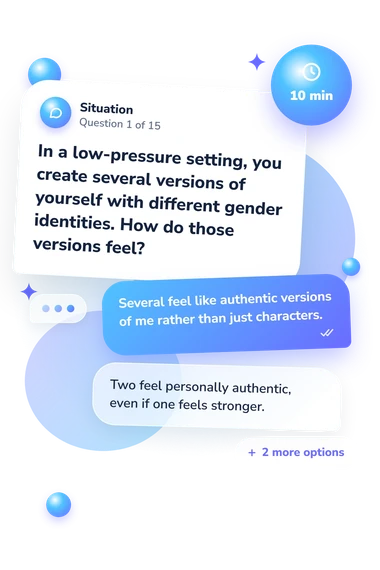
- Several feel like authentic versions of me rather than just characters.
- Two feel personally authentic, even if one feels stronger.
- Trying alternatives is enjoyable, but only one feels like me.
- I prefer one consistent identity across the versions.
- Mostly inaccurate or unnecessary.
- Worth trying as an idea, though not especially personal yet.
- Promising and somewhat relieving, with questions still remaining.
- Deeply fitting or clarifying as a way to understand myself.
- It has felt consistently the same to me.
- I can recall one or two uncertain or unusual moments.
- It has shifted at several noticeable points.
- It has moved between distinct experiences in a recurring way.
Am I Genderfluid Quiz - Description and methodology of the test
People exploring whether genderfluidity describes part of their experience can use the Am I Genderfluid Quiz as a guided self-reflection rather than a gatekeeping test. It is suited to anyone thinking about labels, changing internal experiences, or different forms of gendered recognition. That makes it useful as a genderfluid quiz, organizing observations into a profile that is easier to revisit and discuss.
What This Assessment Explores
The questions focus on inner gender experience rather than appearance, interests, clothing, or pronoun habits. They explore whether different gendered positions feel authentic, whether one fixed category feels incomplete, and whether experience changes over time.
The label-focused questions also ask whether the label feels clarifying, useful, or freeing. In this gender fluid quiz, those themes are organized into three dimensions shown in the result:
- Genderfluid Label Resonance (0-15) shows whether the label feels understandable and useful; Limited resonance (0-5), Open exploration (6-10), or Strong resonance (11-15) names the band.
- Range of Gender Alignment (0-15) reflects how gendered recognitions feel authentic; Focused alignment (0-5), Expanding range (6-10), or Broad alignment (11-15) names the band.
- Shifts in Gender Experience (0-15) reflects movement over time apart from presentation; Mostly steady (0-5), Some movement (6-10), or Meaningful movement (11-15) describes it.
Methodology and Scientific Basis
Each prompt describes a situation and offers four response options distinguishing degrees of fit, resonance, or movement. It is a graded self-report exercise, not a yes-or-no verdict. Results are reported on three 0-15 scales with displayed bands; the contribution of an individual response is not specified.
The Genderqueer Identity Scale (GQI; McGuire et al., 2019) offers a conceptual comparison. This questionnaire is conceptually consistent with that instrument but is not an adaptation of it, and GQI validation findings do not apply to these online scales. Catalpa et al. (2019) report related predictive-validity findings for the GQI, while Galupo et al. (2017) discuss gender identity flexibility as change that is not defined by appearance or social presentation.
The results of this Am I Gender Fluid Quiz are best interpreted by comparing the bands with personal examples and noticing what feels stable, emerging, or context-dependent. The bands are descriptive rather than population norms or clinical cutoffs; because answers depend on self-report, current context, and self-awareness, this online self-reflection tool cannot confirm or reject an identity.
- McGuire, Jenifer K., Titia F. Beek, Jory M. Catalpa, and Thomas D. Steensma. "The Genderqueer Identity (GQI) Scale: Measurement and validation of four distinct subscales with trans and LGBQ clinical and community samples in two countries." International Journal of Transgenderism 20, no. 2-3 (2019): 289-304. 10.1080/15532739.2018.1460735
- Catalpa, Jory M., Jenifer K. McGuire, Jessica N. Fish, G. Nic Rider, Nova Bradford, and Dianne Berg. "Predictive validity of the genderqueer identity scale (GQI): differences between genderqueer, transgender and cisgender sexual minority individuals." International Journal of Transgenderism 20, no. 2-3 (2019): 305-314. 10.1080/15532739.2018.1528196
- Galupo, M. Paz, Lex Pulice-Farrow, and Johanna L. Ramirez. "Like a constantly flowing river": Gender identity flexibility among nonbinary transgender individuals. In Identity Flexibility During Adulthood: Perspectives in Adult Development, edited by Jan D. Sinnott, 163-177. Springer International Publishing, 2017. 10.1007/978-3-319-55658-1_10
Updated: