
Am I Emo Quiz
How the Scales are Structured
Who Usually Takes This Test?
See How You Compare
Below is a preview of how scores are typically distributed across each scale.
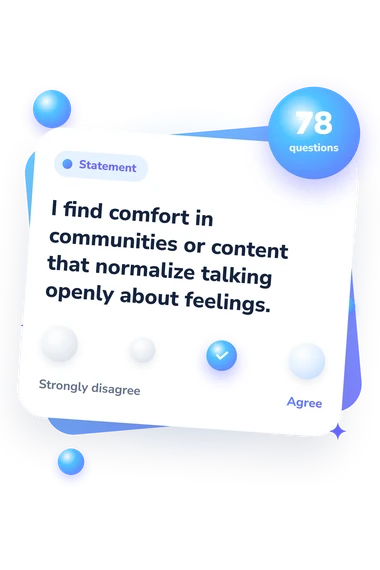
Example Questions From the Test
- Strongly disagree
- Disagree
- Not sure
- Agree
- Strongly disagree
- Disagree
- Not sure
- Agree
- Strongly disagree
- Disagree
- Not sure
- Agree
Am I Emo Quiz - Description and methodology of the test
People curious about whether their appearance, music choices, and emotional openness fit emo or broader alternative culture can use the Am I Emo Quiz as a structured self-reflection exercise. Rather than assigning a single identity label, this emo quiz connects visible style with personal meaning and emotional expression. It suits anyone exploring identity, presentation, or subcultural affiliation and offers a profile rather than a fixed verdict.
What This Assessment Explores
The questionnaire examines how your appearance, music, emotional openness, and identity decisions align with alternative and emo-associated signals. Items address clothing, accessories, hair and makeup, personal spaces, profile imagery, lyrical themes, vulnerability, and whether choices feel authentic rather than trend-led. This emo test lets you examine how visible style, emotional meaning, and emo-related preferences fit together in your profile.
The result dimensions are:
- Alt Style Spectrum (0-30) measures overall presentation, from Mostly mainstream/mixed (0-10) through Occasional alt signals (11-20) to Strong alt presentation (21-30).
- Authentic Expression (0-20) reflects motivation, from Trend-Exploring (0-7) through Mixed Motivations (8-14) to Self-Directed (15-20).
- Emo Affinity (0-30) captures connection with emo influences, from Exploratory (0-10) through Moderate (11-20) to Strong (21-30).
Together, these dimensions show whether style, meaning, and emo-related preferences move in the same direction or form a more mixed profile.
Methodology and Evidence Base
The representative statements use four ordered options: Strongly disagree, Disagree, Not sure, and Agree. The items ask about recurring preferences rather than requiring an emo label. Responses are summarized across three dimensions, and the questionnaire supplies each dimension’s score range and result bands.
Conceptually, the questionnaire is consistent with Schmitt (2011) on emo dress and behavior, Seganti and Smahel (2011) on online meaning-making, and Fathallah (2020) on emo as a subculture shaped by music, identity, style, and fandom. It is a separate online questionnaire, not an adaptation of those authors’ work.
Mixed results are possible: a person may value emotional openness and music while using few visible style cues, or enjoy the aesthetic without strong identification. Because answers are self-reported, scores can shift with mood, social context, experimentation, and self-presentation. Read the profile as a snapshot of preferences rather than a definitive identity statement. The questionnaire functions as an are you emo quiz for the practical question of whether you are emo, offering a nuanced profile rather than a yes-or-no result.
- Schmitt, Kaci. Exploring Dress and Behavior of the Emo Subculture. Master's thesis, Kennesaw State University, 2011.
- Seganti, Francesca Romana, and David Smahel. Finding the Meaning of Emo in Youths' Online Social Networking: A Qualitative Study of Contemporary Italian Emo. First Monday, 16(7), 2011. 10.5210/fm.v16i7.3197
- Fathallah, Judith May. Emo: How Fans Defined a Subculture. Iowa City: University of Iowa Press, 2020.