
Am I Being Haunted Quiz
How the Scales are Structured
Who Usually Takes This Test?
See How You Compare
Below is a preview of how scores are typically distributed across each scale.
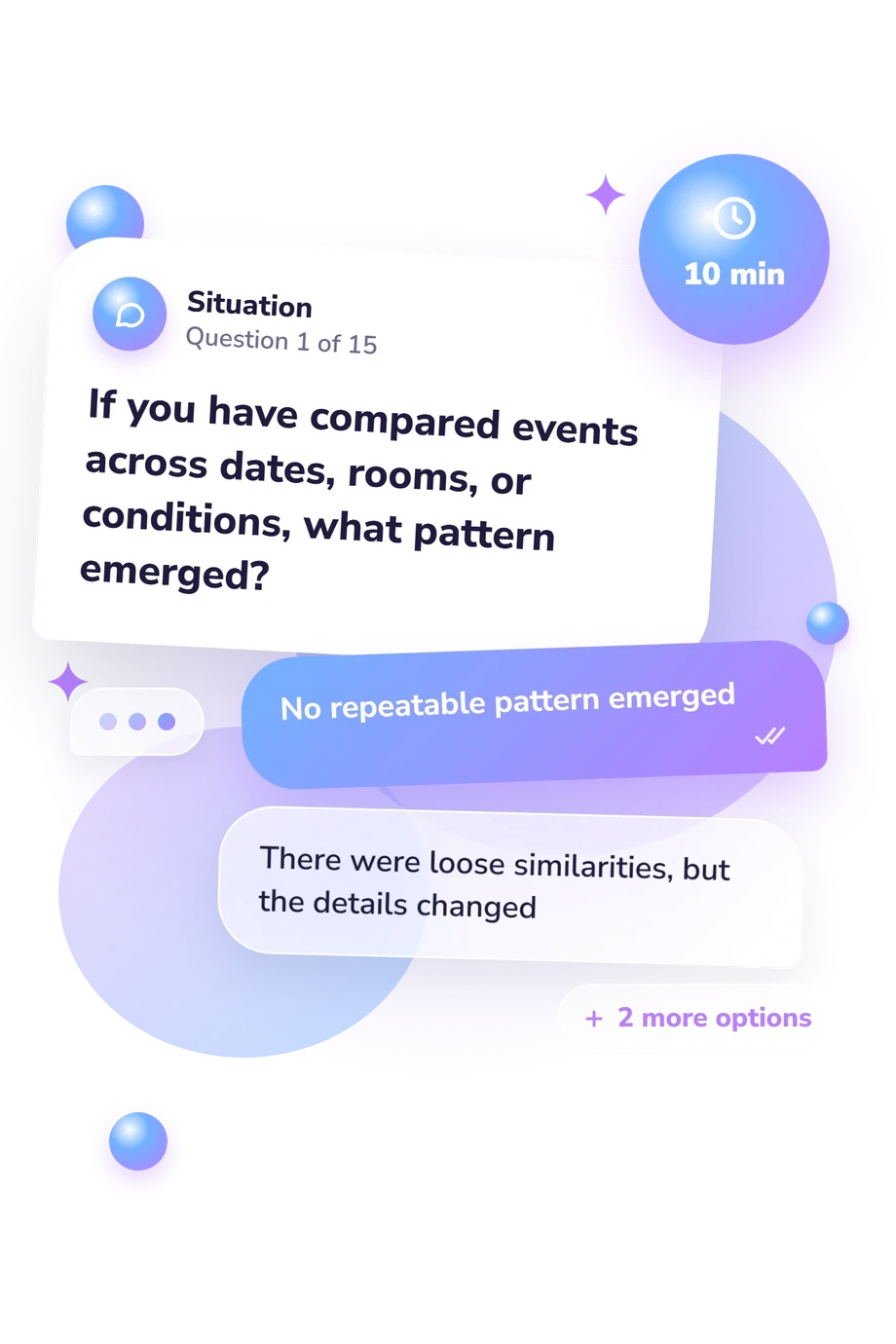
Example Questions From the Test
- No repeatable pattern emerged
- There were loose similarities, but the details changed
- The events often involved the same place, time, or trigger
- A specific pattern recurred across several recorded observations
- I have not noticed one
- I noticed one isolated event
- I noticed several events, but they seemed unrelated
- I repeatedly noticed the same type of event
- No one else has reported noticing anything unusual
- Someone noticed something only after I drew attention to it
- One person independently mentioned a similar event
- Several people independently described the same recurring detail
Am I Being Haunted Quiz - Description and methodology of the test
For people unsettled by noises, movements, or other hard-to-explain events, the Am I Being Haunted Quiz offers a structured way to examine what is happening without assuming a supernatural cause. It is an unexplained experiences quiz, helping readers notice observable patterns alongside sleep, stress, safety, and daily functioning. The result can clarify practical next steps and the kind of support that may fit.
What This Assessment Explores
Three connected areas are examined: disruption and support need, consistency of an unexplained pattern, and overlap with sleep, stress, health, substances, or medication changes. For someone asking whether unusual events could mean they are haunted, this am i haunted quiz focuses on observable situations and practical responses rather than proving a supernatural cause.
These are the result scales:
- Daily Impact and Support Need (0-15) describes disruption: Manageable impact (0-5), Meaningful impact (6-10), or Substantial impact (11-15).
- Experience Pattern (0-15) describes recurrence and independent observation: Limited pattern (0-5), Mixed pattern (6-10), or Strong recurring pattern (11-15).
- Sleep and Stress Link (0-15) describes contextual overlap: Little apparent link (0-5), Possible link (6-10), or Strong contextual link (11-15).
Together, the scales show what the experiences are doing to daily life and what circumstances may shape them; none verifies a haunting.
Methodology and Scientific Basis
Each item offers four ordered answers, moving from little or no occurrence, impact, or contextual connection toward more frequent, disruptive, persistent, or independently observed experiences. Questions cover recurring events, practical checks, safety, sleep, health or medication changes, emotional strain, and responses to rest or grounding. Weighting and aggregation are not specified, so interpret only the displayed scales and bands.
Evidence is consistent with the 2019 Survey of Strange Events study by Houran and colleagues, which used Rasch modelling to examine features in spontaneous ghostly accounts. This questionnaire is separate from that instrument. Sleep content is consistent with a 2023 review by Rauf and colleagues; work by Wing and colleagues from 1994 shows how sleep paralysis may be interpreted as ghost oppression in a cultural setting.
Displayed bands are descriptive, not population norms or clinical cutoffs. As a haunting experience test, results remain sensitive to context, memory, self-awareness, and response bias. Dated records and independent observations may add context; signs of gas, fire, forced entry, injury, an immediate threat, or risk of harm require leaving danger and contacting emergency services regardless of the score.
- Houran, J., Lange, R., Laythe, B., Dagnall, N., Drinkwater, K., & O'Keeffe, C. (2019). Quantifying the Phenomenology of Ghostly Episodes: Part II - A Rasch Model of Spontaneous Accounts. Journal of Parapsychology, 83(2), 168-192. 10.30891/jopar.2019.02.05
- Rauf, B., Perach, R., Madrid-Valero, J. J., Denis, D., Sharpless, B. A., Farron, H., French, C. C., & Gregory, A. M. (2023). Associations between sleep variables and ostensibly paranormal experiences and paranormal beliefs: A scoping review. British Journal of Psychology, 114(4), 797-818. 10.1111/bjop.12655
- Wing, Y.-K., Lee, S. T., & Chen, C.-N. (1994). Sleep paralysis in Chinese: Ghost oppression phenomenon in Hong Kong. Sleep, 17(7), 609-613. 10.1093/sleep/17.7.609
Updated: