
Am I Being Groomed Quiz
How the Scales are Structured
Who Usually Takes This Test?
See How You Compare
Below is a preview of how scores are typically distributed across each scale.
Example Questions From the Test
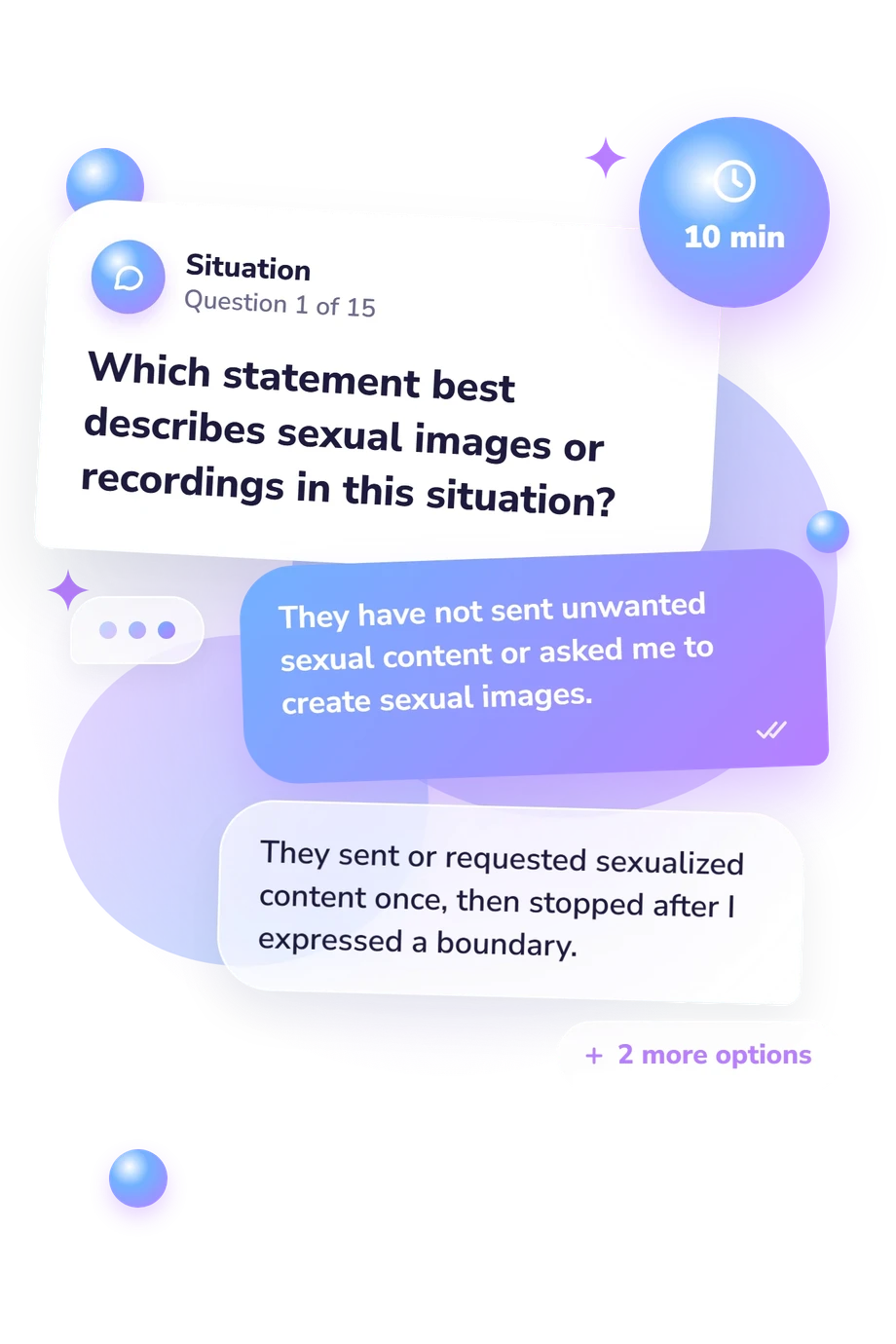
- They have not sent unwanted sexual content or asked me to create sexual images.
- They sent or requested sexualized content once, then stopped after I expressed a boundary.
- They repeatedly sent sexual content or asked for images after I hesitated, refused, or seemed uncomfortable.
- They forced, tricked, threatened, or blackmailed me into creating, viewing, sharing, or allowing sexual images or recordings.
- They have not tried to weaken or control my supportive relationships.
- They criticized a trusted person or acted jealous once, but did not push me to reduce contact.
- They repeatedly encouraged secrecy, distrust, or distance from people who might question the relationship.
- They threatened, blackmailed, punished, or trapped me to stop me from contacting supportive people.
- They have not initiated unwanted, sexualized, or boundary-testing touch.
- They tried touch that felt like a boundary test, but stopped when I moved away or objected.
- They repeated or escalated touching despite my refusal, freezing, discomfort, or lack of participation.
- They forced sexual contact, restrained me, injured me, or continued through threats or clear non-consent.
Am I Being Groomed Quiz - Description and methodology of the test
People trying to make sense of pressure, secrecy, or changing boundaries may turn to the Am I Being Groomed Quiz to organize what happened without reducing it to one incident. It is intended for someone reflecting on a current or past relationship or situation. For a past situation, its result can help organize grooming concerns and communicate them to a trusted person.
What This Assessment Explores
The questions examine boundaries, privacy, support, dependence, and safety. They distinguish isolated discomfort from repeated, escalating, or coercive conduct. The result identifies areas with endorsed experiences, while context determines their meaning. Grooming warning signs often appear as patterns rather than single events.
The three displayed scales are:
- Emotional Control, Dependence, and Neglect (0-15) shows emotional leverage, dependence, and care-related concerns; poverty, disability, crisis, or unavailable support can affect their meaning. Bands: None selected here (0), Concern to examine (1-2), Act on the concern (3-15).
- Physical Safety and Threats (0-15) shows intimidation, confinement, force, incapacitation, or threats; bands are None selected here (0-0), Concern to examine (1-2), and Act on the concern (3-15).
- Sexual Boundary Pressure (0-15) shows pressure involving sexual content, touch, secrecy, or exploitation; bands are None selected here (0), Concern to examine (1-2), and Act on the concern (3-15).
Methodology and Scientific Basis
Viewed as a sexual grooming assessment, this is a structured self-report questionnaire. Each item offers four responses, moving from no listed experience through an isolated concern and repeated pressure to coercive or dangerous conduct. This format highlights persistence, escalation, retaliation, and loss of choice, but the questionnaire does not state a universal point value for each answer. Read the result alongside the situations endorsed.
The closest published reference is Sexual Grooming Scale-Victim Version. The questionnaire is conceptually consistent with that instrument's focus on grooming behaviors, not an adaptation of it. It also fits the model of grooming and related definitional work described in the literature. That literature concerns grooming involving children and does not establish norms or validation for this specific online questionnaire.
The displayed bands are unvalidated reflective summaries, not severity, legal, or clinical cutoffs; a low total cannot prove safety, any concerning endorsed experience matters independently of the total, and a single red flag should be acted on rather than discounted because of the overall score. Memory, current context, fear, and limited self-awareness can shape self-report, so immediate threats, forced contact, confinement, incapacitation, or danger require prompt real-world support.
- Winters, Georgia M., and Elizabeth L. Jeglic. "The Sexual Grooming Scale - Victim Version: The Development and Pilot Testing of a Measure to Assess the Nature and Extent of Child Sexual Grooming." Victims & Offenders 17, no. 6 (2022): 919-940. 10.1080/15564886.2021.1974994
- Winters, Georgia M., Elizabeth L. Jeglic, and Leah E. Kaylor. "Validation of the Sexual Grooming Model of Child Sexual Abusers." Journal of Child Sexual Abuse 29, no. 7 (2020): 855-875. 10.1080/10538712.2020.1801935
- Winters, Georgia M., Leah E. Kaylor, and Elizabeth L. Jeglic. "Toward a Universal Definition of Child Sexual Grooming." Deviant Behavior 43, no. 8 (2022): 926-938. 10.1080/01639625.2021.1941427
Updated: