
Am I Being Ghosted Quiz
How the Scales are Structured
Who Usually Takes This Test?
See How You Compare
Below is a preview of how scores are typically distributed across each scale.
Example Questions From the Test
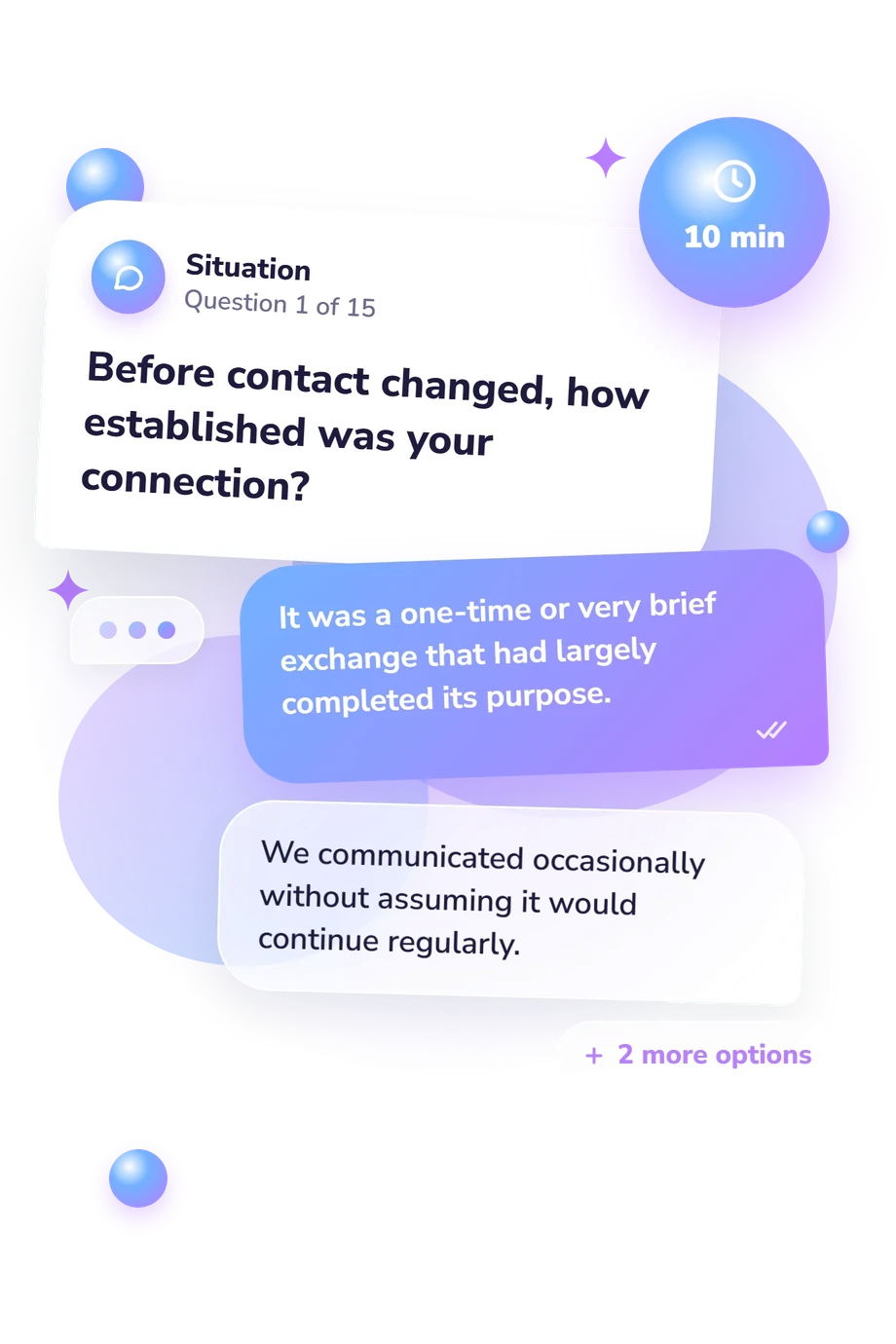
- It was a one-time or very brief exchange that had largely completed its purpose.
- We communicated occasionally without assuming it would continue regularly.
- We had repeated contact, although we had not defined what to expect from it.
- We had explicitly discussed continuing the relationship, friendship, or regular contact.
- They replied to what I said or asked.
- They acknowledged it briefly, such as with a reaction, but did not really answer.
- They have not answered an open question or clear invitation.
- They have left multiple reasonable, spaced-out attempts unanswered as expected moments for contact passed.
- There was no recurring pattern of contact.
- We checked in from time to time, with long gaps being normal.
- We communicated regularly enough that this gap stands out.
- We had a dependable, mutual routine that stopped without warning.
Am I Being Ghosted Quiz - Description and methodology of the test
Anyone trying to understand an abrupt change in contact can use the Am I Being Ghosted Quiz to organize observable events and patterns. It suits people facing unanswered messages, disrupted routines, or unclear endings. The result organizes changes in communication, the effect of uncertainty on attention and choices, and unresolved expectations about continued contact, helping you assess whether this communication pattern resembles ghosting rather than identify the other person's intent.
What This Assessment Explores
The questionnaire examines changed contact, its effect on the respondent, and unresolved expectations about continued communication. Its items cover reply delays, unanswered invitations, altered routines, boundaries, pending plans, and the degree to which silence interrupts attention or decisions. That makes it relevant when weighing whether someone is ghosting you or simply busy, because the result describes observable patterns rather than motives.
The three result dimensions are:
- Communication Withdrawal (0-15) reflects changes in contact, with Limited withdrawal signs (0-5), Mixed withdrawal pattern (6-10), and Strong withdrawal pattern (11-15).
- Impact of Uncertainty (0-15) reflects how much unanswered contact occupies attention and affects choices, with Lower impact (0-5), Noticeable impact (6-10), and Substantial impact (11-15).
- Unresolved Expectation (0-15) considers whether continued communication seemed reasonably expected, with Little unresolved expectation (0-5), Some unresolved expectation (6-10), and Clear unresolved expectation (11-15).
Methodology and Scientific Basis
Each item offers four response descriptions that move from little or no disruption toward stronger withdrawal, uncertainty, or reliance on a reply. They address concrete events and personal reactions, combining situational judgment with self-report. Answering this ghosting questionnaire about one specific connection keeps the three dimensions focused on the same situation.
Responses are presented across the three dimensions separately. Displayed bands describe the pattern represented by selected answers, but the questionnaire does not state an item-level weighting rule; interpret the result as presented rather than reverse-engineering points from the range.
Its closest conceptual reference is GHOST (Jahrami et al., 2023), a published measure of sudden, unexplained communication exclusion. The questionnaire is conceptually consistent with GHOST, LeFebvre and Fan's work on ambiguity around unclear relational loss, and Kay and Courtice's definition of ghosting as a relationship-dissolution method. It is not presented as a validated adaptation.
As an online self-report questionnaire with descriptive result bands, scores may be affected by memory of earlier exchanges, current distress, limited information about the other person's circumstances, and the wish for a definite explanation, so read them as a snapshot of this situation and your present response.
- Jahrami, H., Saif, Z., Chen, W., Helmy, M., Ghazzawi, H., Trabelsi, K., Pires, G. N., Bragazzi, N. L., Pandi-Perumal, S. R., & Seeman, M. V. (2023). Development and validation of a questionnaire (GHOST) to assess sudden, unexplained communication exclusion or “ghosting”. Heliyon, 9(6), e17066. 10.1016/j.heliyon.2023.e17066
- LeFebvre, L. E., & Fan, X. (2020). Ghosted?: Navigating strategies for reducing uncertainty and implications surrounding ambiguous loss. Personal Relationships, 27(2), 433-459. 10.1111/pere.12322
- Kay, C., & Courtice, E. L. (2022). An empirical, accessible definition of “ghosting” as a relationship dissolution method. Personal Relationships, 29(2), 386-411. 10.1111/pere.12423
Updated: