
Am I a Loser Quiz
How the Scales are Structured
Who Usually Takes This Test?
See How You Compare
Below is a preview of how scores are typically distributed across each scale.
Example Questions From the Test
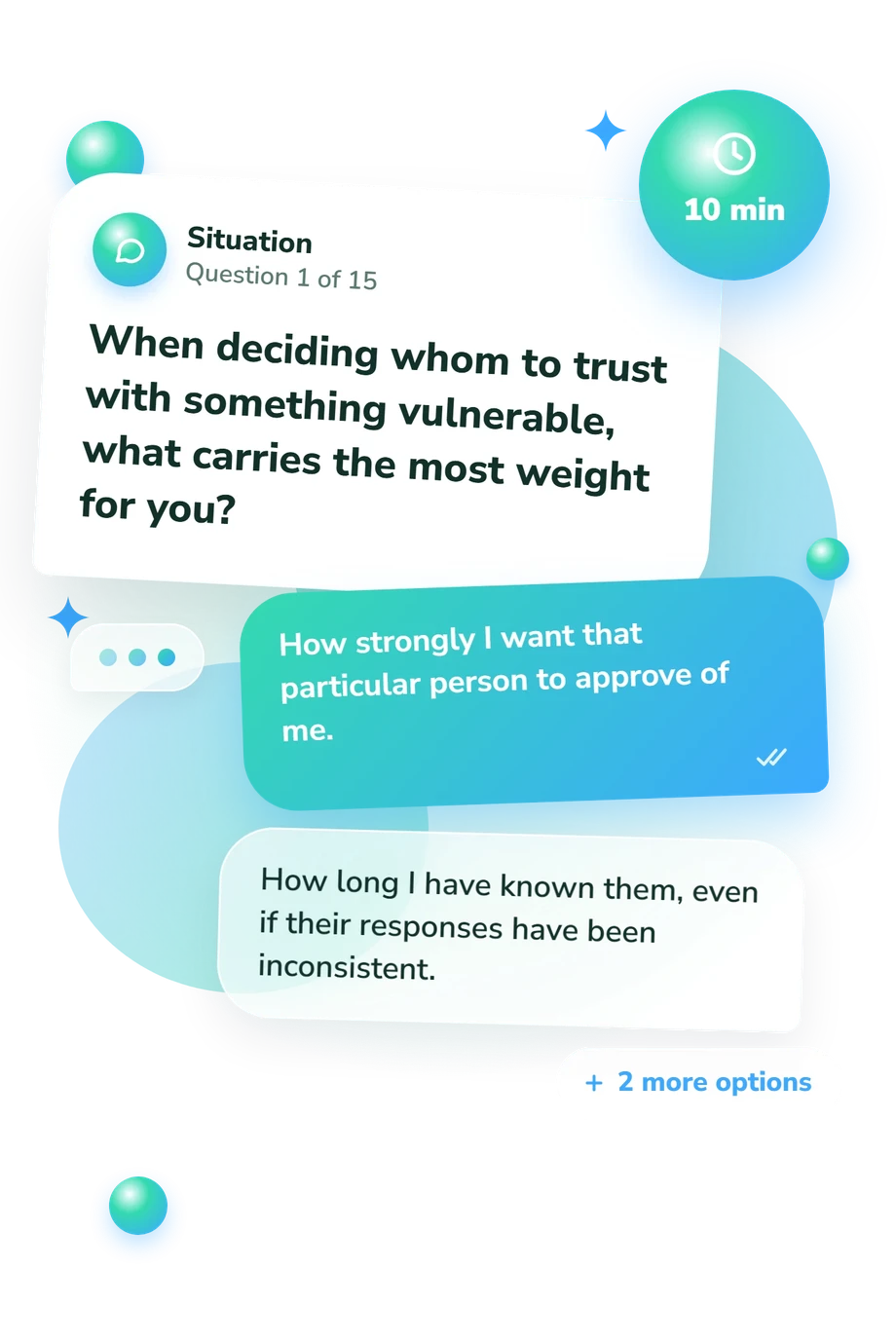
- How strongly I want that particular person to approve of me.
- How long I have known them, even if their responses have been inconsistent.
- Whether they seem caring in the moment and usually mean well.
- Their demonstrated pattern of respect, discretion, honesty, and care.
- Accept, because some connection feels better than being left out.
- Join while telling myself I can manage the discomfort privately.
- Restate one limit and attend if they sound receptive, even without a clear plan.
- Weigh the repeated behavior, hold the limit, and seek connection that does not require abandoning it.
- I treat the setback as a sign that further effort is pointless.
- I put the goal aside indefinitely because reviewing it feels discouraging.
- I make another attempt, usually with only minor changes.
- I examine what happened and either revise the method or consciously change the goal.
Am I a Loser Quiz - Description and methodology of the test
For readers wondering whether the Am I a Loser Quiz fits their concerns, the purpose is to examine how setbacks, uncertainty, closeness, and self-judgment shape everyday choices. It is designed for self-reflection when a harsh label has started to replace a more specific view of what is happening. As a loser self-assessment, it points toward patterns that may be changed rather than defining identity.
What This Assessment Explores
This assessment links everyday agency with relationship judgment and self-regard. Its scenarios ask how you handle trust, disrespect, setbacks, praise, comparison, help-seeking, and manageable tasks. Results describe patterns in these situations, not a permanent identity or moral ranking.
The profile contains three dimensions:
- Agency and Follow-Through (0-15) shows whether you choose workable next steps, adjust after setbacks, and complete or deliberately reschedule commitments. Bands: Constrained momentum (0-5), Emerging agency (6-10), Active agency (11-15).
- Healthy Relationship Choices (0-15) reflects whether respect, boundaries, repair, honesty, and reciprocity guide closeness when loneliness or hope complicates judgment. Bands: Discernment Overridden (0-5), Mixed Signals (6-10), Reciprocal Choice (11-15).
- Self-Respect Under Pressure (0-15) indicates whether mistakes, criticism, or comparison become judgments about your whole worth. Bands: Needs more room (0-5), Uneven self-regard (6-10), Steady self-respect (11-15).
This loser quiz suits readers seeking language for patterns they may want to understand and change.
Methodology and Scientific Basis
Each item presents a concrete situation with four response choices. The options generally move from avoidance, self-dismissal, or approval-seeking toward clearer boundaries, flexible problem-solving, and proportionate self-evaluation. This makes the format useful for comparing an immediate reaction with a more deliberate response.
Answers are combined into separate dimension scores, but the point value assigned to each option is not stated. The bands should therefore be read as descriptive prompts, not reverse-engineered clinical cutoffs.
Relationship content is conceptually consistent with Murphy and Hoover (1999) and Frei and Shaver (2002), while agency and self-worth themes connect with Schwarzer and Jerusalem’s (1995) self-efficacy measure and Rosenberg’s (1965) self-esteem framework. These are reference points, not evidence that this questionnaire adapts or reproduces those instruments.
Because no norm group, reliability estimates, or clinical validation are stated, the result is best used for structured self-observation. As a self-worth quiz, it can highlight patterns, but mood, fatigue, recent conflict, and self-perception may shift responses; persistent distress or relationship danger calls for support beyond a score.
- Murphy, Christopher M., and Sharon A. Hoover. (1999). Measuring Emotional Abuse in Dating Relationships as a Multifactorial Construct. Violence and Victims, 14(1), 39-53. 10.1891/0886-6708.14.1.39
- Frei, Jennifer R., and Phillip R. Shaver. (2002). Respect in Close Relationships: Prototype Definition, Self-Report Assessment, and Initial Correlates. Personal Relationships, 9(2), 121-139. 10.1111/1475-6811.00008
- Schwarzer, Ralf, and Matthias Jerusalem. (1995). Generalized Self-Efficacy Scale. In John Weinman, Stephen Wright, and Marie Johnston (Eds.), Measures in Health Psychology: A User’s Portfolio. Causal and Control Beliefs, pp. 35-37. Windsor, UK: NFER-NELSON.
- Rosenberg, Morris. (1965). Society and the Adolescent Self-Image. Princeton, NJ: Princeton University Press. 10.1515/9781400876136
Updated: