
Am I a Drama Queen Quiz
How the Scales are Structured
Who Usually Takes This Test?
See How You Compare
Below is a preview of how scores are typically distributed across each scale.
Example Questions From the Test
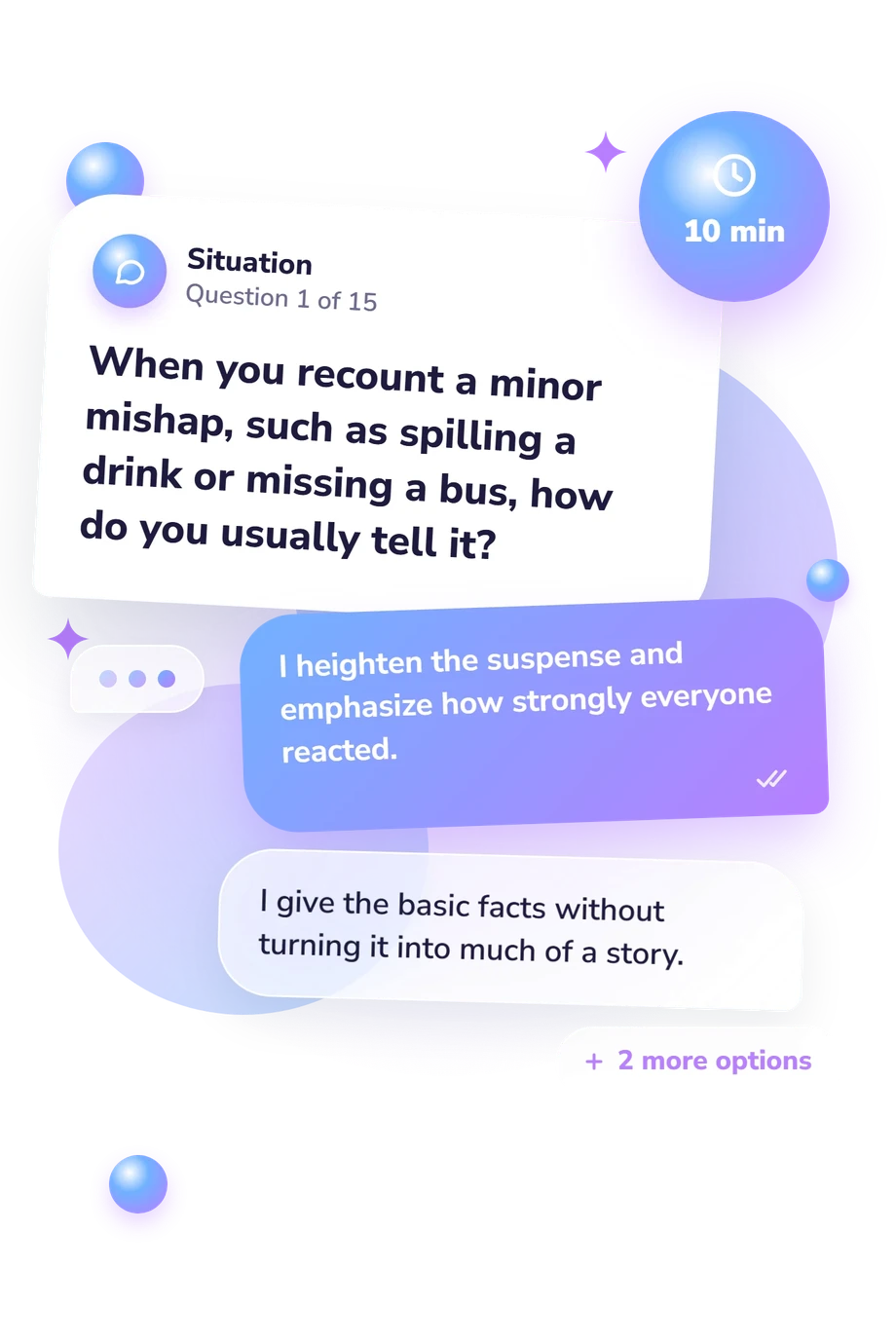
- I heighten the suspense and emphasize how strongly everyone reacted.
- I give the basic facts without turning it into much of a story.
- I make it a full performance, complete with reenactments and dramatic commentary.
- I add some humor and colorful detail to make it entertaining.
- I check reactions several times because the response affects how exciting the news feels.
- I am more likely to share directly with a few people or keep it offline.
- I shape the reveal for maximum buzz and feel notably deflated if the response is quiet.
- I post it straightforwardly and may check responses once or twice.
- Bring up earlier examples to show that the disagreement is part of a larger pattern.
- Ask what they mean and keep the discussion limited to the current point.
- Raise the emotional stakes and look to the group to recognize who is right.
- Defend my position firmly without introducing unrelated issues.
Am I a Drama Queen Quiz - Description and methodology of the test
People who wonder whether their reactions become larger, more public, or more emotionally charged can use this am i dramatic quiz to examine recurring interpersonal patterns. People asking whether they are dramatic can use am i a drama queen quiz to examine how attention, conflict, and emotional intensity appear in everyday situations.
What This Assessment Explores
This drama queen quiz looks beyond a label at visibility, emotional charge, and disagreement. Situations involving news, delayed replies, criticism, storytelling, and arguments let readers compare the profile with behavior. It can support self-reflection about expressive habits without turning them into judgments about confidence or worth.
These dimensions show how everyday events may become more intense or socially expansive:
- Audience and Validation Pull (0-15) indicates how strongly attention, visible reactions, or reassurance energize expression: Self-Contained Sharing (0-5), Response-Aware (6-10), or Audience-Fueled (11-15).
- Conflict Escalation (0-15) reflects whether disagreements stay focused or gather intensity, past grievances, or an audience: Contained Disagreement (0-5), Rising Stakes (6-10), or Escalating Momentum (11-15).
- Emotional Amplification (0-15) captures a tendency to experience or express everyday events at high emotional volume: Steady Volume (0-5), Expressive Range (6-10), or High Emotional Volume (11-15).
Methodology and Scientific Basis
Each item presents a social or emotional scenario with four response options. Choices range from contained or proportionate reactions to stronger display, reassurance-seeking, broader conflict, or heightened interpretation. Respondents choose the option that best fits each scenario, and answers are summarized across the three displayed scores.
This dramatic behavior quiz produces a profile of expressive, audience-related, and conflict patterns rather than a fixed label. The displayed ranges identify bands, but the item-level contribution of each response is not specified. Its themes are conceptually consistent with Need for Drama (Frankowski et al., 2016), which addresses drama-related interpersonal behavior, and with Affect Intensity (Larsen and Diener, 1987), which treats emotional intensity as an individual difference. This online version is neither a standardized administration nor a direct adaptation of either measure.
Interpret the outcome as a pattern across attention, conflict, and emotional volume, considering whether the descriptions fit repeatedly rather than reacting to one memorable incident. No normative sample, reliability estimate, or clinical cutoff is specified for this online version; self-report can shift with current mood, relationship context, self-awareness, and willingness to answer candidly.
- Frankowski, Scott, Amber K. Lupo, Brandt A. Smith, Mosi Dane'El, Corin Ramos, and Osvaldo F. Morera. "Developing and Testing a Scale to Measure Need for Drama." Personality and Individual Differences, 89, 192-201, 2016. 10.1016/j.paid.2015.10.009
- Larsen, Randy J., and Ed Diener. "Affect Intensity as an Individual Difference Characteristic: A Review." Journal of Research in Personality, 21(1), 1-39, 1987. 10.1016/0092-6566(87)90023-7
Updated: