
Age Regression Test
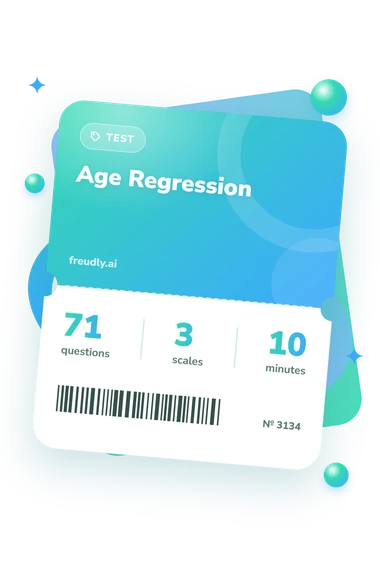
How the Scales are Structured
Who Usually Takes This Test?
See How You Compare
Below is a preview of how scores are typically distributed across each scale.
Example Questions From the Test
- Strongly disagree
- Disagree
- Not sure
- Agree
- Strongly disagree
- Disagree
- Not sure
- Agree
- Strongly disagree
- Disagree
- Not sure
- Agree
Age Regression Test - Description and methodology of the test
People who notice younger-feeling reactions under stress may use this age regression test to organize their observations. Its profile helps readers observe recurring comfort-seeking and younger-feeling responses, along with how readily stressors or environments cue them. This age regression quiz organizes these patterns into a profile that can make them easier to name and discuss.
What This Assessment Explores
The questions examine what happens when distress, overload, loneliness, criticism, fatigue, conflict, or practical pressure makes a younger-feeling response more likely. They cover reassurance and care, simpler interests, softer speech, sensory soothing, comfort objects, and feeling less able to manage adult responsibilities. The profile also considers age regression triggers by indicating how readily stressors or environments cue a younger-feeling shift.
The result separates three related dimensions:
- Comfort-Seeking Coping (0-30) measures reliance on soothing, nurturing, or sensory strategies; Low 0-10, Moderate 11-20, and High 21-30 are the displayed bands.
- Regression Tendency (0-40) measures the frequency and intensity of younger-feeling mindset or behavior; Low 0-13, Moderate 14-26, and High 27-40 are the displayed bands.
- Trigger Sensitivity (0-20) measures how readily stressors or environments cue a younger-state shift; Low 0-6, Moderate 7-13, and High 14-20 are the displayed bands.
Methodology and Scientific Basis
Each statement uses four response options: Strongly disagree, Disagree, Not sure, or Agree. The items ask about reactions, preferences, emotional context, and behavior. The questionnaire presents three displayed scales, each with a range and three result bands, so the profile shows the respondent’s level on each dimension.
The questionnaire is an age regression self-assessment, while Nash’s work on hypnotically induced age regression and transitional-object relationships offers an adjacent conceptual reference rather than direct evidence for it. Winnicott’s writing on transitional phenomena offers context for comfort objects, while the questionnaire includes related comfort-seeking content. Diehl and colleagues add broad context about coping and defense across adulthood, not evidence for the scales. Together, these works offer interpretive context; the questionnaire is not presented as an adaptation or replication of any of them.
Because this is a self-report snapshot, current stress, hunger, fatigue, relationship context, memory, and candor can affect scores. Use the profile to notice patterns and formulate questions for further reflection, rather than treating it as a diagnosis or a complete account of your emotional functioning.
- Nash, M. R., Johnson, L. S., & Tipton, R. D. (1979). Hypnotic age regression and the occurrence of transitional object relationships. Journal of Abnormal Psychology, 88(5), 547-555. 10.1037/0021-843X.88.5.547
- Diehl, M., Chui, H., Hay, E. L., Lumley, M. A., Grühn, D., & Labouvie-Vief, G. (2014). Change in coping and defense mechanisms across adulthood: Longitudinal findings in a European American sample. Developmental Psychology, 50(2), 634-648. 10.1037/a0033619
- Winnicott, D. W. (1953). Transitional objects and transitional phenomena; a study of the first not-me possession. The International Journal of Psychoanalysis, 34(2), 89-97.
Updated: