
Accounting Quiz
How the Scales are Structured
Who Usually Takes This Test?
See How You Compare
Below is a preview of how scores are typically distributed across each scale.
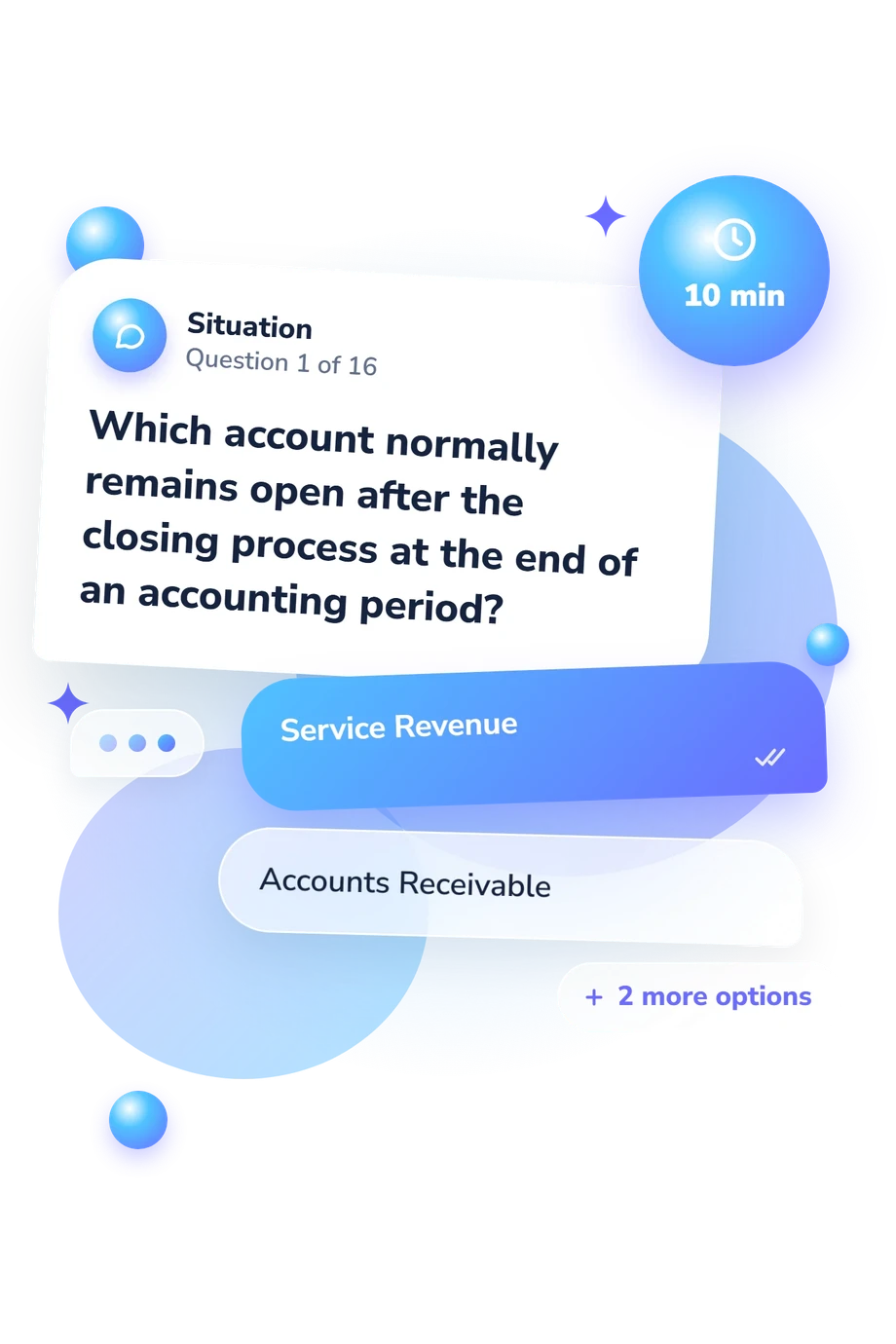
Example Questions From the Test
- Service Revenue
- Accounts Receivable
- Dividends
- Rent Expense
- Assets increase and liabilities decrease by the same amount.
- Assets decrease and expenses increase by the same amount.
- Liabilities decrease and equity increases by the same amount.
- Assets decrease and liabilities decrease by the same amount.
- $40,000
- $90,000
- $60,000
- $240,000
Accounting Quiz - Description and methodology of the test
Designed for students, trainees, and anyone refreshing introductory financial accounting, this accounting quiz turns familiar principles into a focused self-check. It helps a learner connect journal entries with balances, reports, and transaction effects. As a basic quiz on accounting, it can show which foundations feel secure and which topics deserve more deliberate practice before further study.
What This Assessment Explores
Questions examine how accounting ideas work in reporting situations rather than asking only for definitions. They cover the accounting equation, normal balances, accruals and deferrals, depreciation, allowances, inventory cost flow, ratios, cash-flow classification, and errors that can remain hidden in a balanced trial balance. An accounting knowledge quiz is most useful for people learning or revising foundational financial accounting.
The following themes describe what the result reflects:
- The accounting equation shows how changes in assets, liabilities, and equity connect.
- Recording and adjustment tasks show how you apply accruals, deferrals, depreciation, allowances, and closing procedures.
- Reporting and analysis items show whether you can calculate or interpret profit, ratios, inventory effects, and cash flows.
- Accounting Knowledge (0-16) places performance in Foundations to Build (0-6), Developing Knowledge (7-12), or Strong Knowledge (13-16), summarizing foundational understanding without serving as professional certification.
Methodology and Evidence Base
Each item presents a short accounting situation or principle with four answer choices. The respondent selects the option that best explains an entry, relationship, calculation, classification, or control issue. This format tests applied recognition and basic reasoning; the questionnaire does not state a separate weighting scheme.
The content of this online quiz covering basic accounting concepts is conceptually consistent with the 2026 diagnostic-assessment study by Herawati and colleagues, which also addresses foundational accounting understanding, but this questionnaire is not a direct adaptation. The OpenStax textbook by Franklin, Graybeal, and Cooper provides a compatible framework for recording, financial statements, measurement, and analysis, while FASB Concepts Statement No. 8 supports relationships among assets, liabilities, equity, income, and expenses.
Those sources clarify the content logic, but they do not establish published reliability, norms, or validation for this online questionnaire. The multiple-choice format makes each accounting situation a focused check, and the result can guide review of entries, calculations, classifications, and reporting relationships. Results are an educational snapshot shaped by prior instruction, attention, and interpretation of the scenarios. Guessing, unfamiliar terminology, or one missed calculation can affect the total, so use the bands to choose review priorities rather than claim complete mastery.
- Herawati, Nyoman Trisna, Made Ary Meitriana, and Putu Eka Nopiyani. (2026). Development of a diagnostic assessment to measure university student’s understanding of basic accounting concepts. Journal of International Education in Business, 19(2), 290-308. 10.1108/JIEB-03-2025-0030
- Franklin, Mitchell, Patty Graybeal, and Dixon Cooper. (2019). Principles of Accounting, Volume 1: Financial Accounting. Houston, TX: OpenStax, Rice University.
- Financial Accounting Standards Board. (2024). Conceptual Framework for Financial Reporting (FASB Concepts Statement No. 8, as amended through September 2024). Norwalk, CT: Financial Accounting Foundation.
Updated: