
Abdominopelvic Regions Quiz
How the Scales are Structured
Who Usually Takes This Test?
See How You Compare
Below is a preview of how scores are typically distributed across each scale.
Example Questions From the Test
- Into four sections formed by one vertical and one horizontal line
- Into six regions arranged around the umbilicus
- Into nine regions arranged in three rows and three columns
- Into eight regions corresponding to individual abdominal organs
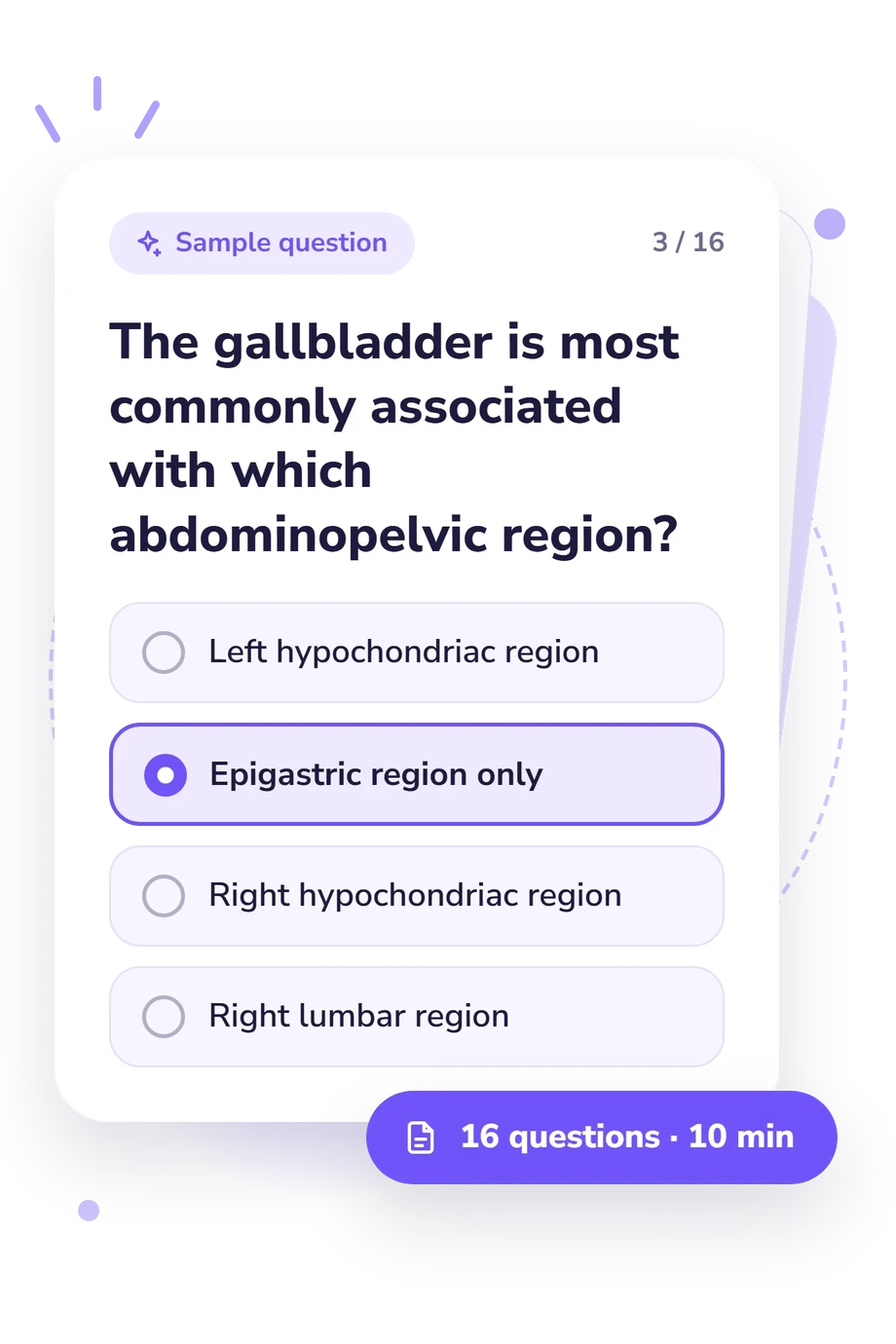
- Left hypochondriac region
- Epigastric region only
- Right hypochondriac region
- Right lumbar region
- Right hypochondriac region
- Right lumbar region
- Right iliac region
- Epigastric region
Abdominopelvic Regions Quiz - Description and methodology of the test
Students, trainees, and curious learners can use this assessment to check whether they can locate abdominal structures within the standard nine-region framework. The abdominopelvic regions quiz focuses on practical anatomical orientation rather than symptoms or disease. With this abdominal regions quiz, you can rehearse regional names, row-and-column relationships, and the reference lines used to describe them.
What This Assessment Explores
At its core, this nine-region anatomy quiz checks whether a learner can map the grid, identify neighboring areas, and connect organs with usual surface regions. Patient-perspective wording makes right-left orientation part of the task. The result describes how securely the framework is understood.
The main learning dimensions are:
- Region names show whether you can distinguish the nine regions built from six recurring anatomical terms.
- Grid organization shows whether you understand its three rows, three columns, and center.
- Surface boundaries indicate whether you recognize the reference lines and planes.
- Organ relationships show whether you connect major structures with usual regions.
The displayed scale is Abdominopelvic Regions Knowledge (0-16), with Foundation to Build at 0-6, Developing Knowledge at 7-12, and Strong Knowledge at 13-16. It summarizes knowledge of the nine-region framework and its common anatomical applications.
Methodology and Evidence Base
Each item presents an anatomical prompt or spatial description with four answer choices. You may name a region, place it within the grid, identify an alternative term, or connect an organ with its usual location. This format tests recognition and application rather than extended recall.
The questionnaire turns responses into one educational result; no item-weighting rule is stated, so particular answer choices should not be assigned assumed points. Read the outcome as a snapshot of current understanding and areas needing review.
Its framework is conceptually consistent with Cirocchi et al. (2014), whose study addresses standardized abdominal surface landmarks. Gray’s Anatomy, edited by Standring and Tubbs, and Moore et al. (2018) describe regions, planes, and organ relationships. These sources support the terminology, but they do not make this questionnaire a validated adaptation of either source.
As an abdominopelvic anatomy quiz, it can reveal gaps in spatial vocabulary and guide targeted revision. Because performance can reflect memory, attention, prior exposure, and confusion over patient-side orientation, the result is an educational snapshot rather than a medical assessment.
- Cirocchi, Roberto, Carlo Boselli, Claudio Renzi, Alessia Corsi, Lucio Cagini, Andrea Boccolini, Giuseppe Noya, and Abe Fingerhut. "The surface landmarks of the abdominal wall: a plea for standardization." Archives of Medical Science, vol. 10, no. 3, 2014, pp. 566-569. 10.5114/aoms.2014.43749.
- Standring, Susan, and Shane R. Tubbs, editors. Gray's Anatomy: The Anatomical Basis of Clinical Practice. 43rd ed. Elsevier, 2025. ISBN 9780443124785.
- Dalley, Arthur F., II, and Anne M. R. Agur. Moore's Clinically Oriented Anatomy. 9th ed. Wolters Kluwer, 2023. ISBN 9781975209544.
Updated: