
6.4 Comprehension Quiz
How the Scales are Structured
Who Usually Takes This Test?
See How You Compare
Below is a preview of how scores are typically distributed across each scale.
Example Questions From the Test
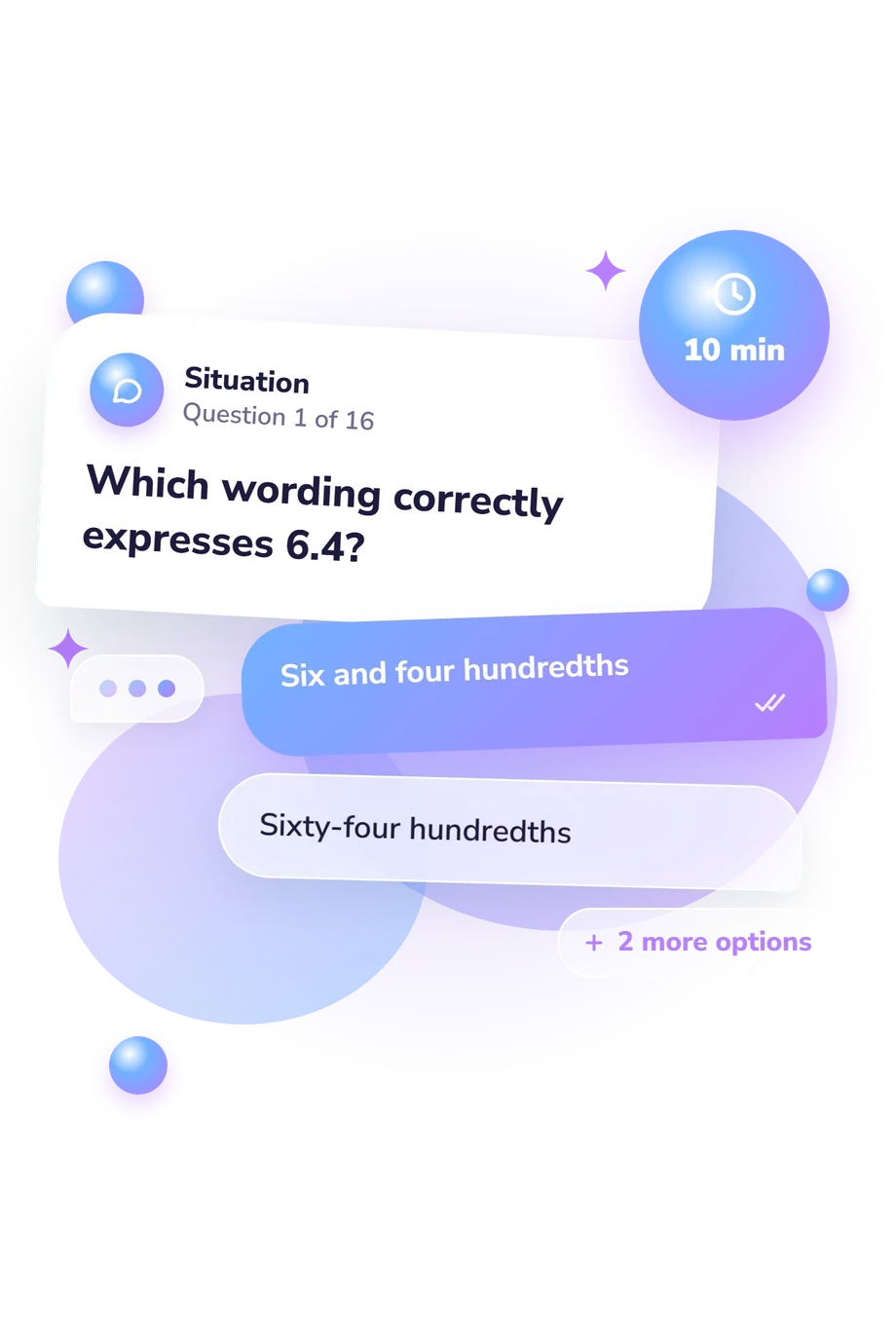
- Six and four hundredths
- Sixty-four hundredths
- Six hundred forty
- Six and four tenths
- 15 kilometers
- 15 kilometers
- 55 kilometers
- 9 kilometers
- 64 grams
- 40 grams
- 64 grams
- 640 grams
6.4 Comprehension Quiz - Description and methodology of the test
For learners who want to check how securely they understand the decimal 6.4, this 6.4 comprehension quiz offers a focused measure of numerical understanding. It is useful for a student, parent, or educator who wants to see whether place value knowledge transfers into calculations and practical situations. It helps learners identify which decimal skills need review.
What This Assessment Explores
The questions treat 6.4 as a number that can be represented, compared, transformed, and applied. They cover place value, equivalent forms, rounding, operations, number-line reasoning, and contexts involving money, distance, mass, capacity, and area.
As a focused quiz on the decimal 6.4, it suits a learner, parent, or educator seeking a focused check of decimal notation. The result appears on the 6.4 Comprehension Knowledge scale: 0-16, with Foundational (0-6), Developing (7-12), and Strong (13-16) bands.
These item groups show what the result reflects:
- Representation and place value show whether the learner can interpret 6.4 and express it in equivalent forms.
- Number sense shows whether the learner can compare, round, locate, and identify decimal values.
- Calculation shows whether the learner can solve operations involving 6.4.
- Application shows whether the learner can use the decimal in measurement, money, geometry, and everyday contexts.
Methodology and Scientific Basis
The questionnaire uses 16 selected-response items with four answer choices. Tasks ask the learner to identify representations, compare decimals, convert forms, calculate, or apply 6.4 in measurement and everyday contexts. This variety samples connected skills without relying on one question type.
Scoring is direct: each correct answer contributes one point to the total, which reflects performance across representation, comparison, conversion, calculation, and measurement. The result summarizes performance across the tested content rather than estimating general mathematical ability.
Resnick et al. (1989) offers conceptual context for decimal-fraction errors, including confusion about place value and equivalent forms. Lachance and Confrey (2001) discuss how decimal notation relates to ratio and proportional reasoning, while the 2010 Common Core mathematics standards provide curricular context for decimal representations, operations, and applications. The questionnaire is conceptually consistent with these works rather than an adaptation of them.
After completing the quiz, the result can guide review of work with 6.4 by indicating which task types merit attention. Guessing, arithmetic slips, prior instruction, and current familiarity may affect performance, so interpret it as a snapshot of demonstrated knowledge.
- Resnick, L. B., Nesher, P., Léonard, F., Magone, M., Omanson, S., & Peled, I. (1989). Conceptual Bases of Arithmetic Errors: The Case of Decimal Fractions. Journal for Research in Mathematics Education, 20(1), 8-27. 10.2307/749095
- Lachance, A., & Confrey, J. (2001). Helping students build a path of understanding from ratio and proportion to decimal notation. The Journal of Mathematical Behavior, 20(4), 503-526. 10.1016/S0732-3123(02)00087-1
- National Governors Association Center for Best Practices, & Council of Chief State School Officers. (2010). Common Core State Standards for Mathematics. Washington, DC.
Updated: