
2000s Quiz
How the Scales are Structured
Who Usually Takes This Test?
See How You Compare
Below is a preview of how scores are typically distributed across each scale.
Example Questions From the Test
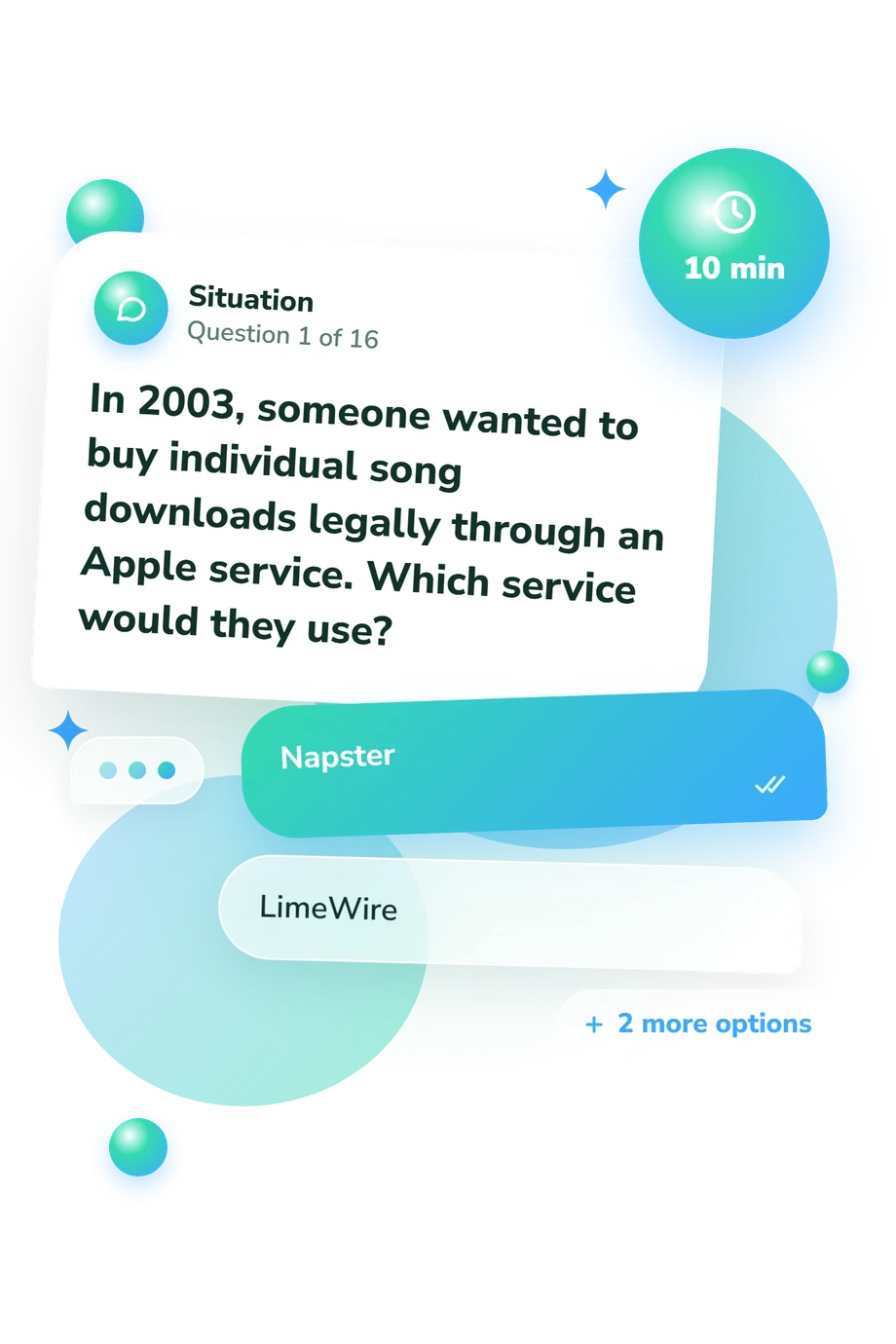
- Napster
- LimeWire
- iTunes Store
- Kazaa
- Harry Potter and the Sorcerer’s Stone
- Harry Potter and the Chamber of Secrets
- Harry Potter and the Prisoner of Azkaban
- Harry Potter and the Goblet of Fire
- 2000
- 2005
- 2003
- 2001
2000s Quiz - Description and methodology of the test
Anyone who lived through the decade-or simply wants to test cultural recall-can use this 2000s quiz to revisit the music, screens, devices, games, and online habits that shaped everyday life. As a 2000 quiz, it suits casual self-testing, group play, and nostalgic reflection. The result shows how broadly your knowledge reaches across major cultural touchstones rather than measuring personal taste.
What This Assessment Explores
This assessment is a broad knowledge check for people interested in the defining entertainment and technology of the decade. Its questions ask you to identify services, platforms, devices, games, films, television, music, internet jokes, and everyday conventions from recognizable clues. An early 2000s-themed quiz label fits the emphasis on cultural memory, although the coverage extends across the full decade rather than one narrow year.
The single reported scale is 2000s Culture Knowledge (0-16), which treats each correct response as evidence of recognition across these domains. Its result bands describe increasing breadth and confidence:
- Time-Capsule Starter (0-6) indicates recognition of some landmarks while leaving many details to rediscover.
- Decade-Savvy (7-12) reflects a solid grasp of major entertainment, technology, and internet-culture touchstones with some gaps.
- Millennium Master (13-16) shows strong, wide-ranging knowledge of the decade’s defining cultural references.
Methodology and Evidence Base
Each item presents a short scenario or factual prompt with four answer choices. This recognition-based format moves across music, screens, devices, games, and online culture, so performance is not tied to one fandom. Read as a 2000s trivia quiz, the result is best understood as a profile of remembered touchstones, not general intelligence.
Scoring is direct: each correct answer adds one point to the total, which is then placed in the displayed band. The selection of references is conceptually consistent with Hall (2021), whose decade-focused cultural account covers music, film, television, games, technology, and internet life. Online profiles, video sharing, and texting are conceptually consistent with Lenhart, Purcell, Smith, and Zickuhr (2010). This questionnaire is not an adaptation of either source; it uses overlapping subject matter in an online knowledge assessment.
Performance can vary with familiarity with English-language and U.S.-centered references, memory, media habits, age, and geographic background. A 2000 pop quiz result is therefore a personal snapshot. This version provides no norm group or reliability estimate, so its bands do not support comparison with a standardized population.
- Hall, Richard A. Pop Goes the Decade: The 2000s. Greenwood, 2021. 10.5040/9798400699023.
- Lenhart, Amanda, Kristen Purcell, Aaron Smith, and Kathryn Zickuhr. Social Media & Mobile Internet Use Among Teens and Young Adults. Pew Internet & American Life Project, February 3, 2010.
Updated: