
Women in the Bible Quiz
How the Scales are Structured
Who Usually Takes This Test?
See How You Compare
Below is a preview of how scores are typically distributed across each scale.
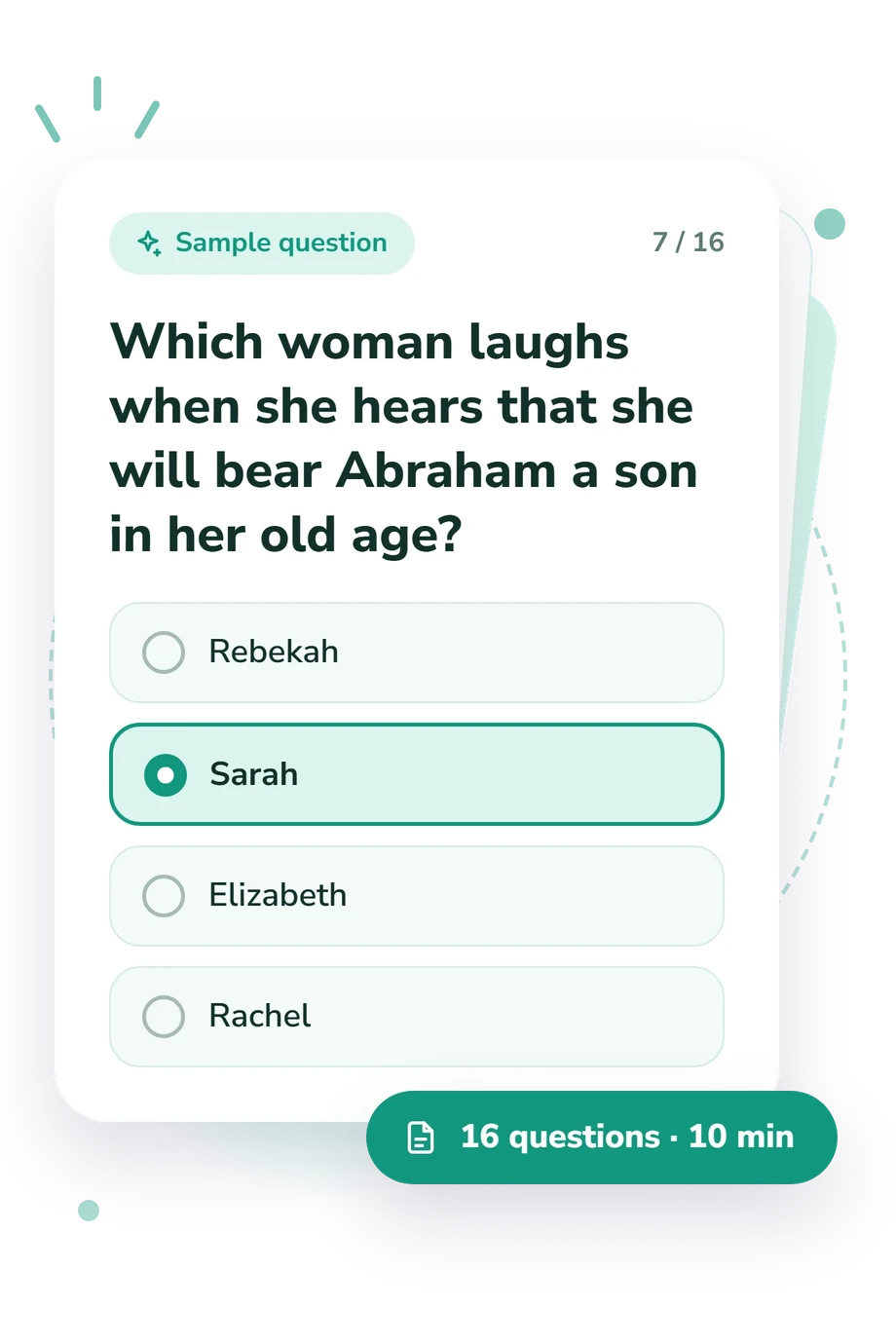
Example Questions From the Test
- Damaris
- Lydia
- Sapphira
- Rhoda
- Anna
- Salome
- Elizabeth
- Martha
- Esther
- Bathsheba
- Vashti
- Jezebel
Women in the Bible Quiz - Description and methodology of the test
Readers who want to check their familiarity with biblical narratives can use the women in the bible quiz as a focused knowledge exercise. It is suitable for learners, study groups, and anyone revisiting Scripture who wants to identify women through their actions, relationships, and roles rather than by names alone. Approached as a women bible quiz, it turns recall into a compact review of connected stories.
What This Assessment Explores
The questionnaire measures recognition of women in biblical narratives and the events or relationships that distinguish them. Each clue links a person with a setting, action, relationship, or responsibility, so the result reflects scriptural recall rather than personality or attitude.
This quiz on women in the Bible spans Hebrew Bible and New Testament figures, including queens, judges, prophets, mothers, hosts, disciples, and women facing danger or instruction. It suits personal study and informal revision by showing how consistently featured women are identified.
The main content groups are:
- Hebrew Bible women are recognized through family, migration, courage, leadership, and encounters with God.
- New Testament women are identified through Jesus, testimony, teaching, and hospitality.
- Narrative clues test attention to names, kinship, places, and actions.
The displayed scale is Women in the Bible Knowledge: 0-16, with Foundations to build (0-6), Developing knowledge (7-12), and Strong knowledge (13-16).
Methodology and Evidence Base
Each item presents a short biblical situation with four answer choices. Selecting the woman who fits the clue tests recognition among similar names, relationships, and episodes; the displayed total counts correct answers. It does not measure religious commitment or general intelligence.
The biblical women quiz uses a knowledge format rather than a personality or clinical scale. Its content is conceptually consistent with Women in Scripture (Meyers, Craven, and Kraemer, 2001), a scholarly reference point for women across biblical collections. The 2021 NRSV Updated Edition supports passage wording, while Osiek, MacDonald, and Tulloch (2006) helps contextualize early Christian household and teaching scenes. Savran (2005) reviews the reference work rather than supplying a scoring method.
This online questionnaire is not a standardized psychometric instrument or a direct adaptation of those publications. Its bands describe the displayed correct-answer total, not population norms. Results can vary with translation familiarity, prior study, self-administered recall, and attention to context, so the outcome is best used as a focused learning indicator rather than evidence of complete biblical knowledge.
- Meyers, Carol L., Toni Craven, and Ross Shepard Kraemer, eds. Women in Scripture: A Dictionary of Named and Unnamed Women in the Hebrew Bible, the Apocryphal/Deuterocanonical Books, and the New Testament. Grand Rapids, MI: William B. Eerdmans Publishing Company, 2001.
- Savran, George. “Women in Scripture: A Dictionary of Named and Unnamed Women in the Hebrew Bible, the Apocryphal/Deuterocanonical Books, and the New Testament” (review). Nashim: A Journal of Jewish Women’s Studies & Gender Issues 9 (2005): 204-207. 10.1353/nsh.2005.0013
- New Revised Standard Version Updated Edition: Holy Bible. National Council of the Churches of Christ in the United States of America, 2021.
- Osiek, Carolyn, Margaret Y. MacDonald, and Janet H. Tulloch. A Woman’s Place: House Churches in Earliest Christianity. Minneapolis, MN: Fortress Press, 2006.
Updated: