
Will I Be a Millionaire Quiz
How the Scales are Structured
Who Usually Takes This Test?
See How You Compare
Below is a preview of how scores are typically distributed across each scale.
Example Questions From the Test
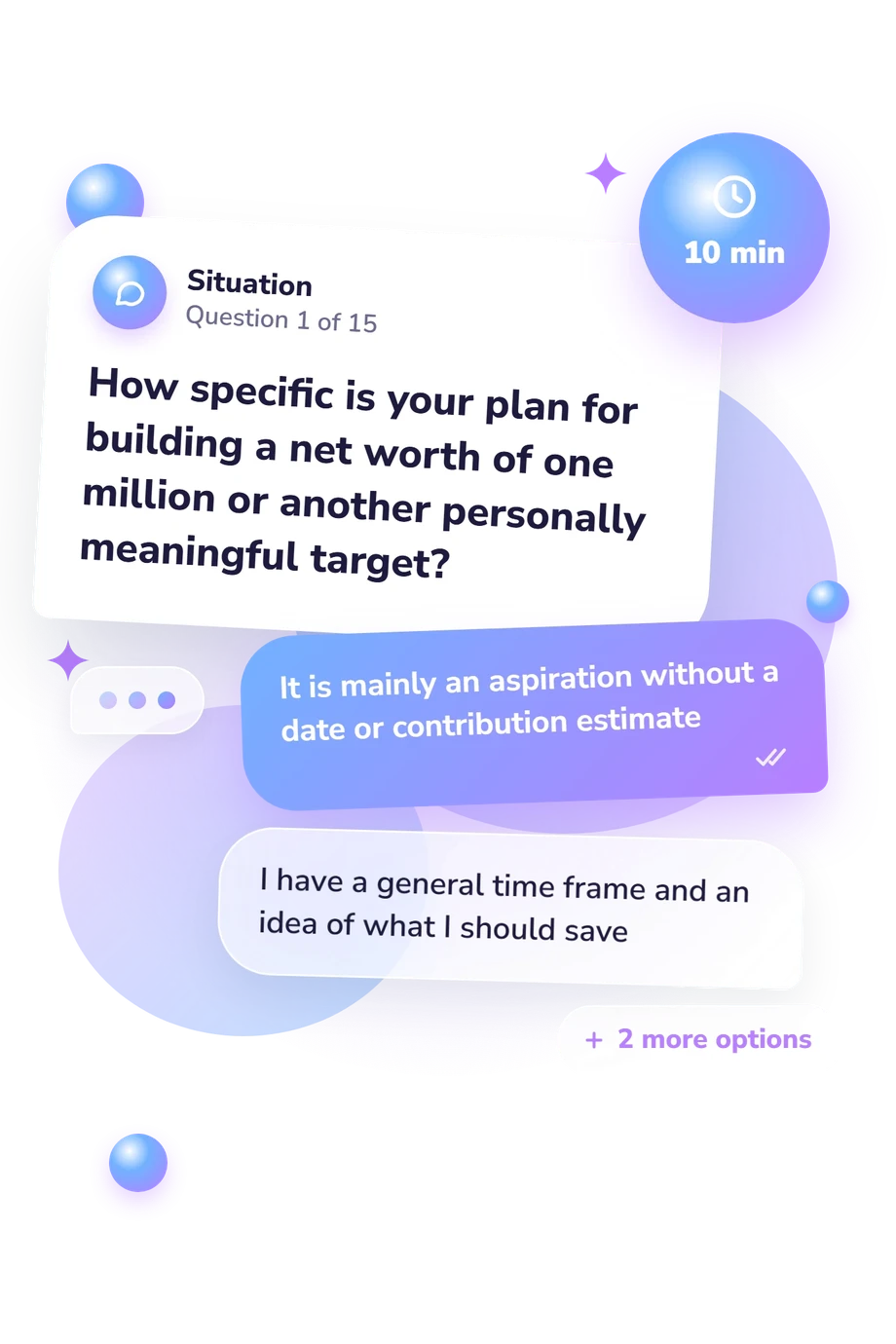
- It is mainly an aspiration without a date or contribution estimate
- I have a general time frame and an idea of what I should save
- I have a target, time frame, and rough contribution assumptions that I revisit occasionally
- I track a defined target using milestones and update the assumptions when circumstances change
- I automate or schedule contributions and adjust other spending to keep them going
- I make occasional contributions when the month works out well
- I contribute most months but sometimes change the amount without reviewing the goal
- Immediate priorities usually replace the goal before much progress occurs
- Wait until an employer or another person provides a clear reason to learn it
- Explore free introductory material without committing to a timeline
- Choose a manageable course or project and work on it when time permits
- Create a scheduled learning plan tied to a specific role, service, or income opportunity
Will I Be a Millionaire Quiz - Description and methodology of the test
People who want to examine their financial direction rather than receive a promise can use this assessment to review practical habits. The Will I Be a Millionaire Quiz turns a broad wealth question into behaviors that can be examined and adjusted. A useful will i become a millionaire quiz asks not for certainty, but for a closer look at long-term choices. The result offers a starting profile for deliberate planning.
What This Assessment Explores
The questions examine practical behaviors behind wealth building: defining goals, expanding earning options, protecting saving capacity, and handling investment choices under uncertainty. The result is a profile of current habits, not a promise about status. Its three displayed scales are:
- Earning Power and Goal Execution (0-15) shows how deliberately you build income opportunities and turn ambitions into sustained action: Unstructured Path (0-5), Building Momentum (6-10), or Strong Execution (11-15).
- Investing Consistency (0-15) shows whether you use diversified, long-term investing with patience and risk awareness: Limited structure (0-5), Developing structure (6-10), or Strong structure (11-15).
- Saving Capacity (0-15) shows how reliably cash flow leaves surplus for long-term wealth building: Constrained (0-5), Emerging (6-10), or Strong (11-15).
Together, they show where deliberate routines are established and where the practical value of a could you be a millionaire quiz lies in creating clearer systems.
Methodology and Evidence Base
Each item presents a financial situation with four response options, moving from reactive or unsupported action toward more deliberate behavior. The topics span goals, earning development, debt, saving routines, investment costs, diversification, market volatility, reserves, negotiation, and increased income.
Selected responses become the displayed scale scores, but the questionnaire has no published population norms or universal forecast formula. The bands describe current patterns rather than returns, career success, or millionaire status. A millionaire quiz is most useful when it prompts one observable next step, such as automating a contribution.
The closest conceptual reference is the Financial Management Behavior Scale (Dew & Xiao, 2011), which treats saving, investing, and related money management as behaviors. Lown (2011) supports attention to financial self-efficacy, while Lusardi and Mitchell (2014) connect financial knowledge with planning and economic decisions. This questionnaire is conceptually consistent with those works, not an adaptation or validation of them.
Self-reported answers can reflect current circumstances, memory, confidence, and social desirability; comparing the profile with actual records and longer-term behavior gives a more grounded interpretation.
- Dew, Jeffrey, and Jing Jian Xiao. (2011). The Financial Management Behavior Scale: Development and Validation. Journal of Financial Counseling and Planning, 22(1), 43-59.
- Lown, Jean M. (2011). Development and Validation of a Financial Self-Efficacy Scale. Journal of Financial Counseling and Planning, 22(2), 54-63.
- Lusardi, Annamaria, and Olivia S. Mitchell. (2014). The Economic Importance of Financial Literacy: Theory and Evidence. Journal of Economic Literature, 52(1), 5-44. 10.1257/jel.52.1.5
Updated: