
What Time Was I Born Quiz
How the Scales are Structured
Who Usually Takes This Test?
See How You Compare
Below is a preview of how scores are typically distributed across each scale.
Example Questions From the Test
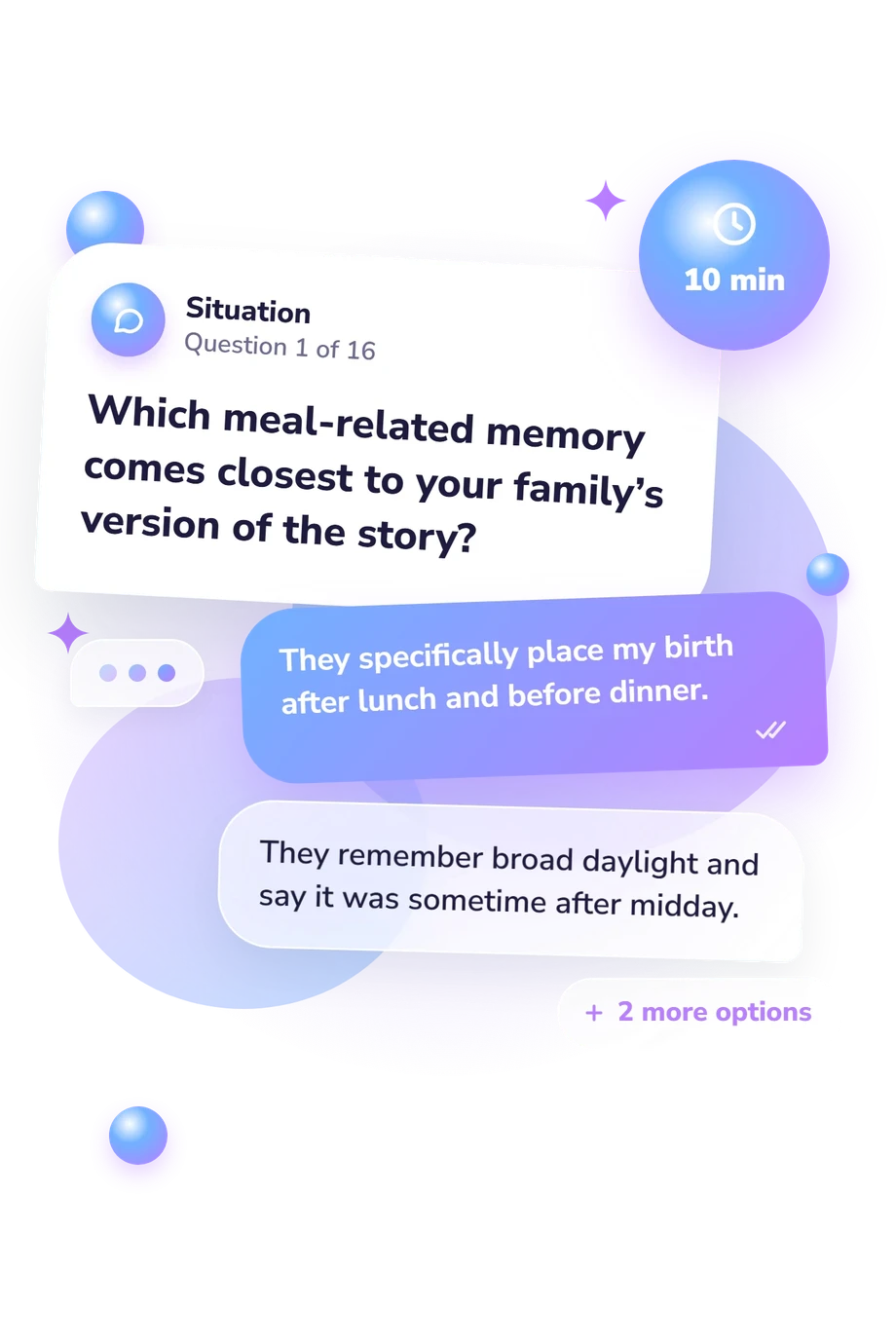
- They specifically place my birth after lunch and before dinner.
- They remember broad daylight and say it was sometime after midday.
- They recall labor or hospital activity during lunch, but not the birth itself.
- No meal-related memory points to an afternoon birth.
- They were told I had been born only minutes earlier.
- They are confident the call came on the same evening as the birth.
- The call came that evening, but no one knows whether I was born earlier that day.
- The news memory cannot be reliably connected to my birth day or time.
- It clearly shows a time from 6:00 through 11:59 a.m.
- It says “a.m.” or “morning,” but the exact hour is missing.
- The handwriting or notation could be read as either a.m. or p.m.
- I have not seen a written clue pointing to morning.
What Time Was I Born Quiz - Description and methodology of the test
People with incomplete family records can use the What Time Was I Born Quiz to organize indirect clues about an uncertain birth hour. Its purpose suits anyone comparing memories, documents, and ordinary events linked to an arrival. The result does not claim to recover a hidden fact; this when were you born quiz identifies the time window that deserves closer checking and suggests a focused next step.
What This Assessment Explores
Not an exact reconstruction, it compares meals, daylight, routines, records, and recollections, separating birth from labor, admission, announcements, and later events. As a birth time quiz, it shows which period evidence favors and how strongly clues converge.
Displayed scales show clue support:
- Afternoon (12:00-5:59 p.m.), 0-12, rates support: Little support (0-4), Possible fit (5-8), or Strong clue match (9-12).
- Evening (6:00-11:59 p.m.), 0-12, rates support: Little support (0-4), Possible fit (5-8), or Strong clue match (9-12).
- Morning (6:00-11:59 a.m.), 0-12, rates support: Little support (0-4), Possible fit (5-8), or Strong clue match (9-12).
- Overnight (12:00-5:59 a.m.), 0-12, rates support: Little support (0-4), Possible fit (5-8), or Strong clue match (9-12).
Methodology and Scientific Basis
Each item presents four situation-based self-report options. The choices move from a clear, supported clue through weaker or ambiguous evidence to no useful support for the named window. This structure distinguishes specific, converging evidence from a memory that merely concerns the same day.
Norvilas and Miller (2015) support treating remembered birth details as shaped by family narratives and conversational context. This questionnaire is conceptually consistent with that work, not an adaptation of it. Liu et al. (2013) and Petersen et al. (2019) show why recalled birth events should be checked against documentation, while the National Center for Health Statistics guide identifies the birth certificate as a key record.
Answers are combined into four displayed scales, but the questionnaire does not state point-by-point weighting. It has no norm sample, diagnostic cutoff, or verified probability for any window. A high score indicates concentrated clue affinity, not proof of an exact time; scores within one point are blended. A time of birth quiz is therefore best used to organize follow-up evidence, because memory can merge labor, admission, announcements, and birth.
- Norvilas, Algis, and Jeffrey Miller. “Remembering dates of birth: Memory as a discursive process.” Psichologija, vol. 51, 2015, pp. 7-28. 10.15388/Psichol.2015.51.8253
- Liu, Jianghong, Catherine Tuvblad, Linda Li, Adrian Raine, and Laura A. Baker. “Medical Record Validation of Maternal Recall of Pregnancy and Birth Events From a Twin Cohort.” Twin Research and Human Genetics, vol. 16, no. 4, 2013, pp. 845-860. 10.1017/thg.2013.31
- Petersen, Julie M., Allen A. Mitchell, Carla Van Bennekom, and Martha M. Werler. “Validity of Maternal Recall of Gestational Age and Weight at Birth: Comparison of Structured Interview and Medical Records.” Pharmacoepidemiology and Drug Safety, vol. 28, no. 2, 2019, pp. 269-273. 10.1002/pds.4699
- National Center for Health Statistics and National Vital Statistics System. Guide to Completing the Facility Worksheets for the Certificate of Live Birth and Report of Fetal Death (2003 Revision). Updated September 2022.
Updated: