
What Eyebrow Shape Is Best for Me Quiz
How the Scales are Structured
Who Usually Takes This Test?
See How You Compare
Below is a preview of how scores are typically distributed across each scale.
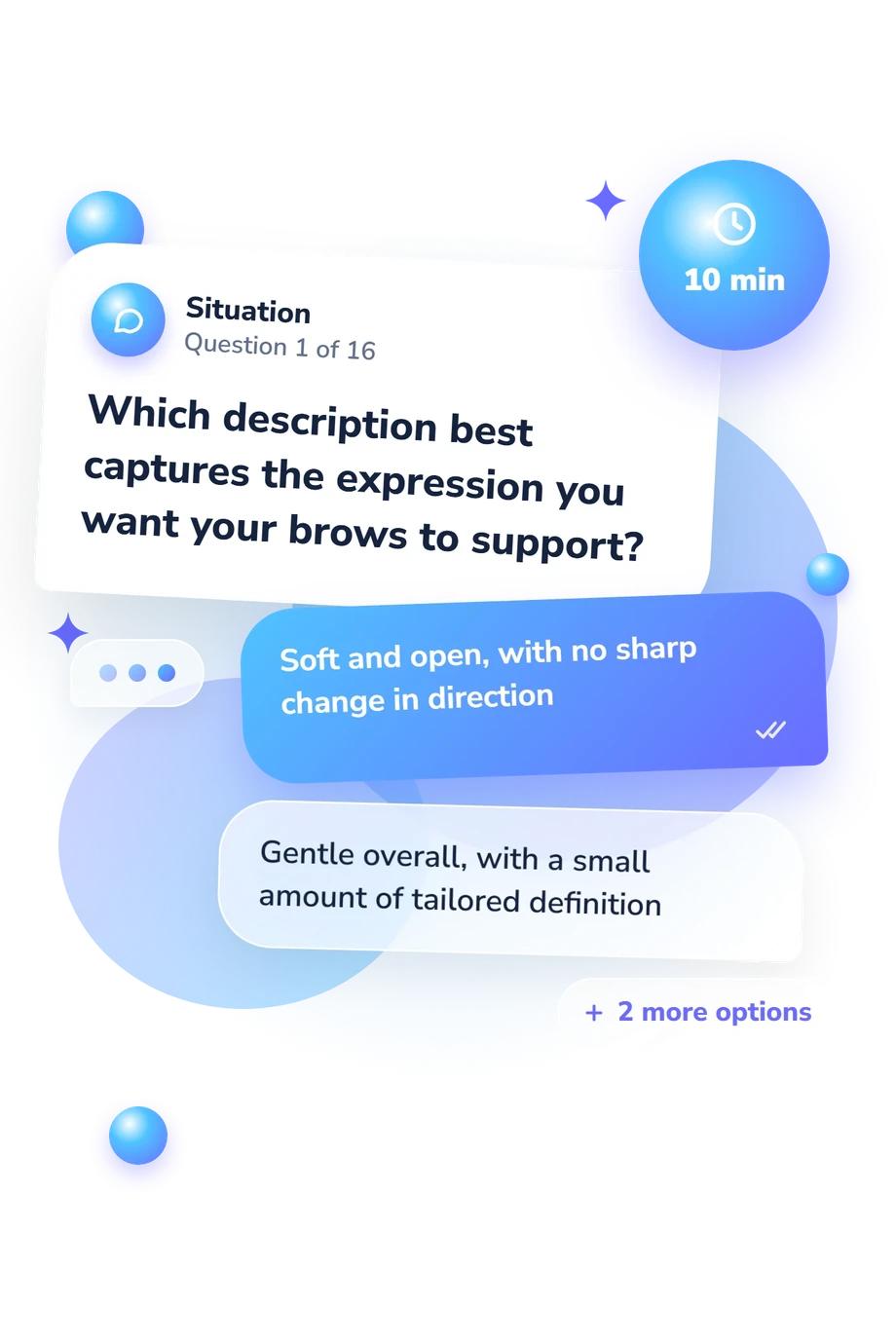
Example Questions From the Test
- Soft and open, with no sharp change in direction
- Gentle overall, with a small amount of tailored definition
- Polished and structured, with a visible angle
- Boldly lifted or distinctly horizontal rather than curved
- Very important; I want the lift to be a defining feature
- Somewhat important; a noticeable angle helps frame my look
- Only mildly important; a tiny rise is enough
- Not important; I prefer a calm, horizontal emphasis
- I actively want that lifted, expressive effect
- I like it when the lift is noticeable but controlled
- I might use a little lift, though I usually prefer softer framing
- It does not match my taste; I prefer a lower silhouette
What Eyebrow Shape Is Best for Me Quiz - Description and methodology of the test
People who want their brows to complement their features, makeup habits, and preferred level of definition can use this questionnaire as a guided style exercise. The What Eyebrow Shape Is Best for Me Quiz turns choices about lift, curvature, angles, natural growth, and upkeep into a comparative profile. As a brow shape quiz, it helps you compare the four styles before changing your routine.
What This Assessment Explores
The items explore lift, curvature, angle, horizontal structure, growth, and upkeep.
The questionnaire compares your eyebrow shape preferences across four styles:
- High Arch Brows (0-12) reflects preference for lift and a defined peak; bands are Subtler Shape Preferred (0-4), Selective Match (5-8), and Strong Affinity (9-12).
- Rounded Brows (0-12) reflects smooth curvature and soft framing; bands are More Definition Preferred (0-4), Possible Match (5-8), and Strong Affinity (9-12).
- Soft Angled Brows (0-12) reflects balanced definition without a sharp arch; bands are Different Direction (0-4), Possible Match (5-8), and Strong Affinity (9-12).
- Straight Brows (0-12) reflects a low, horizontal silhouette; bands are More Shape Desired (0-4), Possible Match (5-8), and Strong Affinity (9-12).
The highest score marks the strongest affinity; totals within one point indicate a blended result.
Methodology and Evidence Base
Each prompt offers four answer choices about preferred lift, curvature, natural growth, outline, or maintenance. The options compare rounded, soft angled, high-arched, and straight directions, capturing style preference rather than brow anatomy.
Results display four totals. Comparing them identifies the strongest affinity; scores within one point indicate a blended result.
Its evidence base is conceptual. A 2023 study by Richer, Berkowitz, and Trindade de Almeida examined eyebrow-shape preferences across demographic groups. A 2021 study by Packirisamy and Sadacharan examined preferred brow-apex positions across facial shapes and ethnic groups; a 2007 study by Baker and colleagues examined perceptions of facial form and aesthetics. These studies support the relevance of lift, apex, curvature, and proportion; this questionnaire is conceptually consistent with that work, not an adaptation of those published instruments.
Interpretation is most useful when an eyebrow shape quiz is considered alongside your natural growth, styling skill, face-framing goals, and present preferences. Current taste, context, and response style can influence self-reported preferences, so treat the result as a snapshot.
- Vincent Richer, Jonathan Berkowitz, Ada Trindade de Almeida. Eyebrow shape preference across age, gender, and self-reported ethnic group. Dermatologic Surgery. 2023;49(2):171-176. 10.1097/DSS.0000000000003679
- Vasanthakumar Packirisamy, Chakravarthy Marx Sadacharan. Preference of eyebrow apex positions on different facial shapes in Malaysian population: An inter-ethnic study. Journal of Cosmetic Dermatology. 2021;20(12):3991-4000. 10.1111/jocd.14062
- Stephen B. Baker, Joseph H. Dayan, Amy Crane, Sugene Kim. The influence of brow shape on the perception of facial form and brow aesthetics. Plastic and Reconstructive Surgery. 2007;119(7):2240-2247. 10.1097/01.prs.0000260771.76102.6c
Updated: