
Soulmate Test
How the Scales are Structured
Who Usually Takes This Test?
See How You Compare
Below is a preview of how scores are typically distributed across each scale.
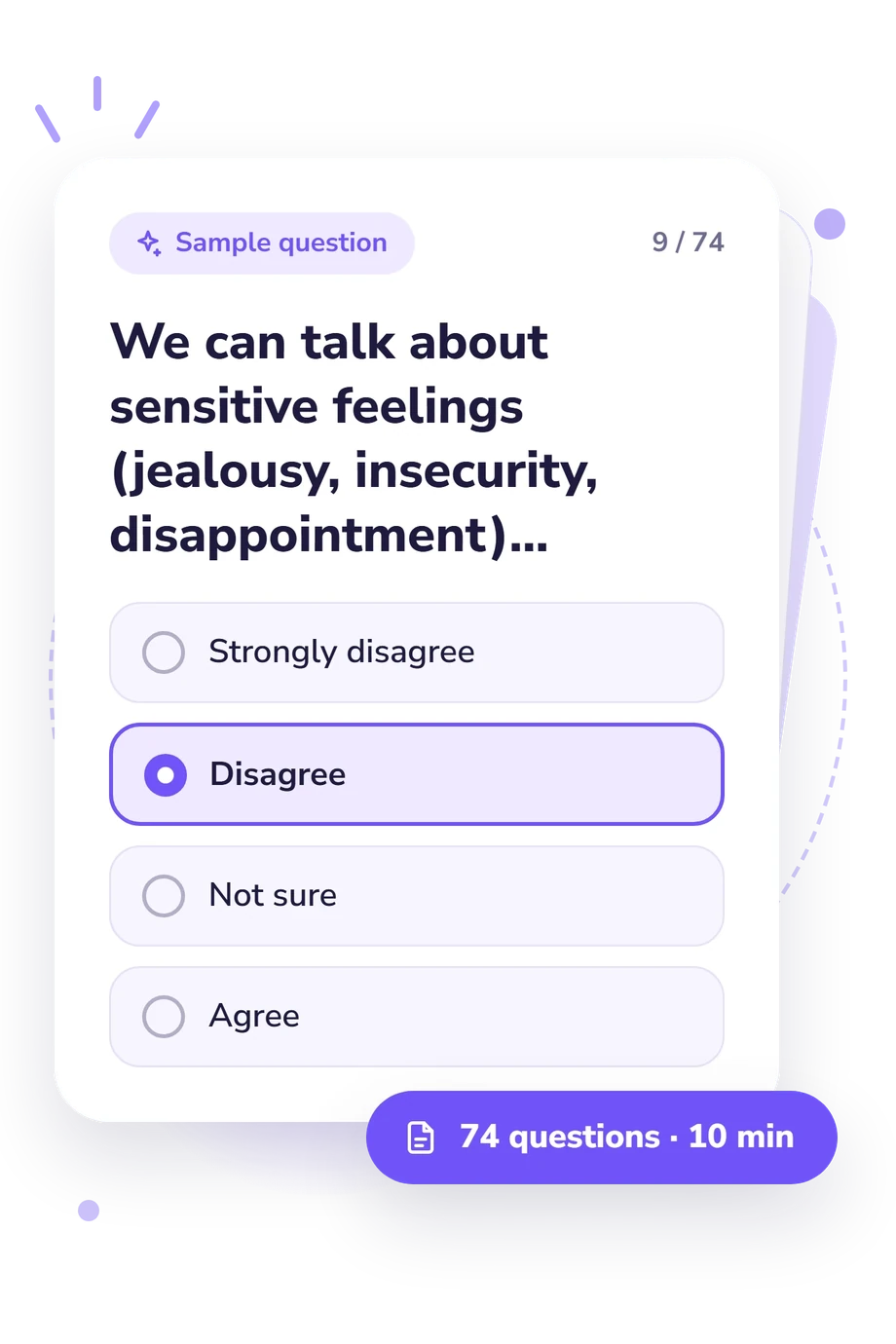
Example Questions From the Test
- Strongly disagree
- Disagree
- Not sure
- Agree
- Strongly disagree
- Disagree
- Not sure
- Agree
- Strongly disagree
- Disagree
- Not sure
- Agree
Soulmate Test - Description and methodology of the test
People considering a serious romantic relationship can use the soulmate test to examine whether daily connection and long-term expectations fit together. It is intended for anyone who wants a structured conversation starter before making assumptions about permanence. The result organizes self-reported impressions into areas of strength, tension, and possible discussion. As a soulmate quiz, it turns broad hopes about compatibility into specific relationship themes.
What This Assessment Explores
Questions cover partnership situations such as expressing needs, feeling understood, handling difficult emotions, repairing misunderstandings, enjoying ordinary time, and coordinating expectations about work, family, finances, health, independence, and commitment. Although it may be approached as a who is my soulmate quiz, this questionnaire assesses the connection you describe rather than predicting a predetermined match.
The result is organized into three dimensions:
- Communication & Conflict Fit (0-40) measures listening, clarity, respect, compromise, and repair. Challenging (0-19), Generally workable (20-31), and Strong (32-40) show increasing resolution skill.
- Overall Compatibility (0-100) reflects fit across values, communication, emotional safety, conflict, goals, and chemistry. Needs Alignment (0-39), Mixed Fit (40-69), and Strong Match (70-100) show increasing alignment.
- Values & Future Alignment (0-40) evaluates shared priorities and long-term direction. Low alignment (0-19), Moderate alignment (20-29), and High alignment (30-40) show increasing compatibility of plans.
Methodology and Scientific Basis
Four agreement choices-Strongly disagree, Disagree, Not sure, and Agree-frame items about recurring interaction patterns and shared expectations. As a soul mate test, it works best when answers describe typical relationship patterns rather than only a recent high or low point.
Responses are grouped into the displayed dimensions, but equal point weights and norm-based conversion are not stated. Read the bands descriptively, then compare areas to identify strengths and useful conversations. This free soulmate compatibility test cannot determine a destined partner from a score.
Conceptually, the domains are consistent with PREPARE/ENRICH Inventories (Fournier et al., 1983), a multidimensional relationship framework. Communication items correspond to the constructive communication subscale examined by Heavey et al. (1996), and the values domain is compatible with couple-values measurement by Danioni et al. (2023). Fowers and Olson (1989) support multidimensional relationship assessment, but these studies do not validate this online questionnaire.
No independently reported norms or validation results are provided for this questionnaire. Current stress, recent conflict, expectations, and self-awareness can influence self-report, so treat the result as a reflection prompt when relationship concerns are serious.
- Fournier, D. G., Olson, D. H., & Druckman, J. M. (1983). Assessing marital and premarital relationships: The PREPARE/ENRICH Inventories. In E. E. Filsinger (Ed.), Marriage and Family Assessment: A Sourcebook for Family Therapy (pp. 229-250). Beverly Hills, CA: Sage Publications.
- Fowers, B. J., & Olson, D. H. (1989). ENRICH Marital Inventory: A discriminant validity and cross-validation assessment. Journal of Marital and Family Therapy, 15(1), 65-79. 10.1111/j.1752-0606.1989.tb00777.x
- Heavey, C. L., Larson, B. M., Zumtobel, D. C., & Christensen, A. (1996). The Communication Patterns Questionnaire: The reliability and validity of a constructive communication subscale. Journal of Marriage and the Family, 58(3), 796-800. 10.2307/353737
- Danioni, F., Russo, C., Zagrean, I., Regalia, C., & Barni, D. (2023). What matters to us: The portrait values questionnaire to measure couple values. Personal Relationships, 30(2), 681-699. 10.1111/pere.12483
Updated: