
Personal Egogram Test

See which ego state drives your thinking and behavior in about 6 minutes. Get a clear profile to guide coaching, career fit, and personal growth with fast, practical insight.
Start Online Test
Questions306 minutes
Hi! My name is Freudly, i am an AI therapist, I will give you an interpretation of the test after you complete it.
08:30
October 2, 2025
October 2, 2025
Material has been updated
20,820 views
1,462 completions
1,057 likes
Verified by Daniel Hall
Psychologist with 25 years of experience
Share
Scale Explorer

How the Scales are Structured

example score
8/12
Adapted Child (AC) (AC)
Measures the tendency to adapt to expectations by following rules, being polite, and complying with social norms.
Low adaptation
Balanced adaptation
High adaptation
14Low adaptation58Balanced adaptation912High adaptation
A score of 8 indicates a balanced level of adaptability, suggesting you can follow rules and accommodate others while still retaining some flexibility.
example score
5/12
Natural Child (NC) (NC)
Measures the degree of spontaneity, emotional expressiveness, playfulness, and creative impulse associated with the Natural Child ego state.
Low
Moderate
High
14Low58Moderate912High
A score of 5 indicates a moderate Natural Child presence, suggesting some access to spontaneity and creative expression while remaining fairly contained.
example score
8/12
Adult (A) (A)
Measures the strength of the Adult ego state—objective, logical information processing and fact-based decision-making.
Low
Moderate
High
14Low58Moderate912High
A score of 8 indicates a moderately strong Adult state, suggesting generally rational, fact-oriented thinking and planning while still allowing other ego states to influence behavior.
example score
7/12
Nurturing Parent (NP) (NP)
Measures the tendency to express supportive, empathetic, and encouraging care toward others.
Low
Moderate
High
14Low58Moderate912High
A score of 7 indicates a moderate Nurturing Parent tendency, suggesting you often offer warmth and encouragement while balancing care with other ego states.
example score
7/12
Critical Parent (CP) (CP)
Critical Parent measures how strongly a person tends to enforce rules, judge behavior, and use moralizing or corrective control in interactions.
Low
Moderate
High
14Low58Moderate912High
A score of 7 falls in the Moderate range, suggesting a balanced but noticeable tendency to set standards and correct others when order or rules feel important.
Start Online Test
just completed the test
DATA-BASED USER COHORTS

Who Usually Takes This Test?

Coaches and trainers
41%OF USERS
They use it as a quick diagnostic to tailor sessions and help clients see whether Parent, Adult, or Child patterns are driving their choices.
HR and career advisors
34%OF USERS
They apply it for career guidance and role fit, identifying which ego state resources best match a person’s work style and responsibilities.
Self-development seekers
25%OF USERS
They take it to understand their default reactions in relationships and work, and to balance control, rationality, and spontaneity.
BASED ON AGGREGATED, ANONYMIZED DATA FROM TENS OF THOUSANDS OF FREUDLY USERS.
RESULTS YOU CAN ACTUALLY USE

What You’ll See After You Finish the Test

Scale Results
— Explained Clearly
Your scores across each test scale, translated into plain, usable insights. Not just numbers, but what they actually mean for your daily life, emotional state, and overall well-being.
AI-Powered
Interpretation
A structured, clinically grounded explanation. Our AI analyzes patterns and relationships between scales to provide a coherent interpretation — without alarmist language.
Statistical
Comparison
See how you compare to others. Your scores are placed in a statistical context, showing percentiles and trends based on anonymized platform data to help you understand what`s typical.
Practical
Recommendations
Actionable guidance tailored to your profile. Receive clear, realistic suggestions you can apply immediately — focused on coping, self-regulation, and realistic next steps.
AI-Detected
Insights
Key patterns you might not notice on your own. Surfacing subtle connections in your responses that help you better understand what may be driving your current results.
Discuss with
an AI Psychologist
Clarify, reflect, and explore right away. Talk through your outcomes, ask questions, and explore meanings in a calm, non-diagnostic dialogue environment.
Start Online Test
Used in 52+ countries
Benchmarking

See How You Compare

Once you finish the test, your results will be compared with real-world data from people in your country.
Below is a preview of the benchmarks we use to place your score in context.
Adaptive Child (AC) (AC()
Average
5.6
Normal range
4.27
min.
1
max.
12
majority
This curve shows how scores are typically distributed.
Once you complete the test, your result will appear here so you can see where you land.
Natural Child (NC) (NC()
Average
8
Normal range
6.59.5
min.
1
max.
12
majority
This curve shows how scores are typically distributed.
Once you complete the test, your result will appear here so you can see where you land.
Adult (A) (A()
Average
8.7
Normal range
7.210.2
min.
1
max.
12
majority
This curve shows how scores are typically distributed.
Once you complete the test, your result will appear here so you can see where you land.
Nurturing Parent (NP) (NP()
Average
5.5
Normal range
3.47.6
min.
1
max.
12
majority
This curve shows how scores are typically distributed.
Once you complete the test, your result will appear here so you can see where you land.
Critical Parent (CP) (CP()
Average
8.5
Normal range
7.19.9
min.
1
max.
12
majority
This curve shows how scores are typically distributed.
Once you complete the test, your result will appear here so you can see where you land.
Featured On
CLEAR ANSWERS TO COMMON QUESTIONS

Frequently Asked Questions

What does this questionnaire measure?
It estimates the relative strength of Parent, Adult, and Child ego states as reflected in current thinking and behavior. Results describe which resources are most emphasized at the time of testing.
How long does it take and how many items are included?
Estimated completion time is about 6 minutes. The questionnaire contains 30 items.
How should responses be selected?
Choose the option that most closely matches typical behavior in everyday situations. Use the first response that seems accurate and avoid extended analysis.
How are results reported?
Results are presented as a profile showing the relative prominence of the three ego states. A higher score suggests that state is more likely to guide decisions and interpersonal style.
How should the results be used and what are the limits?
Results can support coaching, training, career guidance, and self-development by identifying likely strengths and preferred modes of action. They are not a diagnosis and should not be used as the sole basis for clinical or employment decisions.
WHAT THE TEST MEASURES
About This Assessment
Personal egogram Test

Personal Egogram Test - Symptoms and Signs
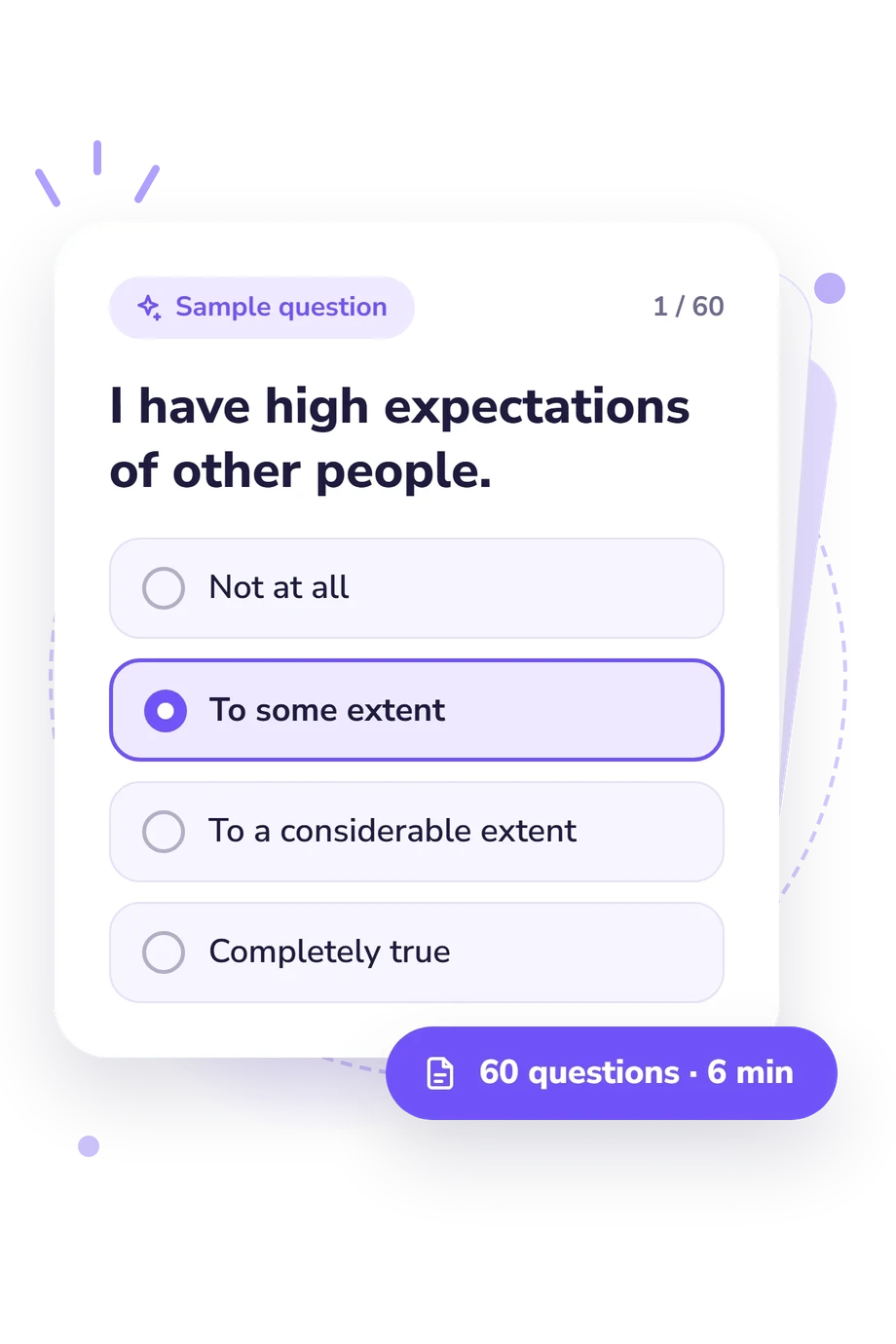
This brief self-report measure is designed to estimate the relative prominence of transactional analysis ego states in current functioning. The Personal Egogram is commonly used to support clinical formulation and self-reflection by describing patterns consistent with Parent, Adult, and Child modes as outlined by Eric Berne.

The instrument includes 30 items and typically requires about 6 minutes to complete. Results are generally summarized as a profile that may help guide discussion of behavioral tendencies, coping resources, and situational role preferences; the Personal Egogram is best interpreted as an adjunct to clinical judgment rather than a stand-alone diagnostic tool.

Author: Eric Berne
Literature: James, M., & Jongeward, D. Born to win: Transactional analysis with gestalt experiments. Addison-Wesley. 1971.; Berne, E. A layman’s guide to psychiatry and psychoanalysis. Simon & Schuster. 1964.
Test Question Form
You Might Also Like
Personal Belief in a Just World Scale
This self-report measure evaluates an individual’s endorsement of the belie…
Start Test
Street Peer Group
Peer affiliations can shape adolescents’ behavior and value formation. Stre…
Start Test
Secondary Gain From Illness Scale
This self-report measure examines potential psychological and interpersonal…
Start Test
Popular tests
Narcissistic Personality Inventory (NPI)
This self-report measure is used to assess narcissism as a personality trai…
Start Test
Yale-Brown Obsessive Compulsive Scale (Y-BOCS)
This measure is used to rapidly quantify the current severity of obsessive…
Start Test
CRAFFT Screening Test (CRAFFT 2.1)
This brief screening measure is designed to identify potential alcohol and…
Start Test
Patient Health Questionnaire-9 (PHQ-9)
This measure is commonly used to quickly screen for the presence and severi…
Start Test
Maslach Burnout Inventory (MBI)
This self-report measure is used to assess occupational burnout symptoms in…
Start Test
Adolescent Anxiety Questionnaire
This measure is designed to support a brief appraisal of anxiety symptoms a…
Start Test
Emotional Creativity Inventory (ECI)
This self-report measure assesses individual differences in the originality…
Start Test
Horne–Ostberg Morningness–Eveningness Questionnaire (MEQ)
Circadian preferences influence typical patterns of alertness and sleep tim…
Start Test
Ambivalent Sexism Inventory (ASI)
This measure is designed to assess attitudes toward women, including both o…
Start Test
Internalized Misogyny Scale (IMS)
This measure is designed to assess internalized negative beliefs and stereo…
Start Test
Perceived Stress Scale (PSS-10)
This self-report measure assesses the degree to which individuals appraise…
Start Test
Impulsive Behavior Scale (SUPPS-P)
Impulsivity is a multidimensional construct that is often assessed with bri…
Start Test
Clinical Institute Withdrawal Assessment for Alcohol, Revised (CIWA-Ar)
This rating scale is used to rapidly assess the severity of alcohol withdra…
Start Test
Positive and Negative Affect Schedule (PANAS)
This measure provides a brief self-report assessment of current or typical…
Start Test
Light Triad Scale (LTS)
This self-report measure assesses prosocial personality tendencies and orie…
Start Test
Suicidal Ideation Scale
In clinical settings, the Suicidal Ideation Scale is used to structure an i…
Start Test
Body Dysmorphic Disorder Scale (BDD-D)
This brief self-report measure is designed to screen for and quantify distr…
Start Test
Beck Anxiety Inventory (BAI)
This measure is a brief self-report inventory used to screen for anxiety sy…
Start Test
Differential Test of Perfectionism
This instrument is used to screen for perfectionism-related attitudes and t…
Start Test
Locus of Control Scale
This measure assesses generalized expectancies regarding the degree to whic…
Start Test
New Apathy Scale
This brief self-report measure is used to screen for apathy-related symptom…
Start Test
Perth Alexithymia Questionnaire (PAQ)
This measure assesses individual differences in alexithymia, including diff…
Start Test
Social Intelligence Scale
This brief self-report measure is designed to support rapid screening of in…
Start Test
Fear Test
This measure is designed to evaluate individual differences in fear-related…
Start Test
Neuroticism Level Scale
The measure is intended for brief screening of an individual’s propensity t…
Start Test
Aggressiveness Indicators Screening Questionnaire
This screening tool is designed to quickly identify behavioral indicators a…
Start Test
Comments
Leave a Comment