
Kentucky Inventory of Mindfulness Skills (KIMS) Test
How the Scales are Structured
Who Usually Takes This Test?
See How You Compare
Below is a preview of how scores are typically distributed across each scale.
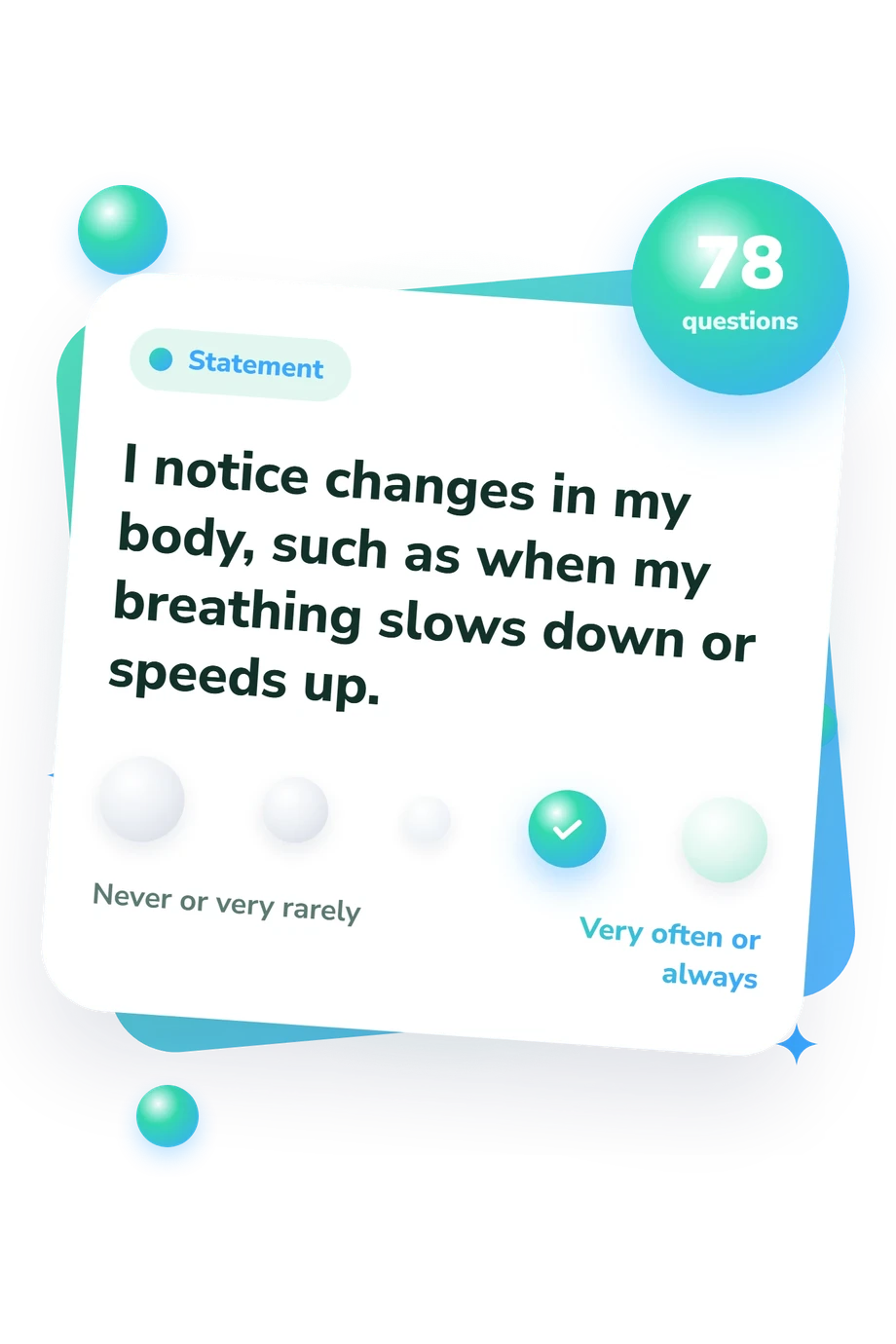
Example Questions From the Test
- Never or very rarely
- Rarely
- Sometimes
- Often
- Very often or always
- Never or very rarely
- Rarely
- Sometimes
- Often
- Very often or always
- Never or very rarely
- Rarely
- Sometimes
- Often
- Very often or always
Kentucky Inventory of Mindfulness Skills (KIMS) Test - Description and methodology of the test
People who want a structured look at how they notice, describe, and respond to present-moment experience may find the Kentucky Inventory of Mindfulness Skills (KIMS) Test useful. It is intended for personal reflection by people who want a clearer picture of everyday mindfulness habits. As a mindfulness assessment, it highlights relative strengths across several skills rather than producing a single global label.
What This Assessment Explores
Rather than asking whether someone is mindful in general, the items sample moments such as noticing bodily sensations, naming feelings, staying with one task, and recognizing self-judgment or distraction. As a mindfulness skills test, it describes present-moment abilities rather than one overall trait.
The four displayed dimensions are:
- Accepting Without Judgment measures allowing experiences without evaluative judgment or avoidance; its range is 9–45, with Low 9–23, Moderate 24–36, and High 37–45.
- Acting With Awareness measures focused, deliberate engagement instead of automatic action; its range is 10–50, with Low 10–22, Moderate 23–34, and High 35–50.
- Describing measures putting thoughts, feelings, and sensations into words; its range is 8–40, with Low 8–21, Moderate 22–33, and High 34–40.
- Observing measures noticing internal and external details in the present moment; its range is 12–60, with Lower observation 12–29, Moderate observation 30–43, and Higher observation 44–60.
Methodology and Scientific Basis
Each statement uses one of five frequency choices, from Never or very rarely to Very often or always. Items cover four groups: some describe direct skills, while others describe distraction, difficulty labeling experience, or judging emotions. Responses are combined within each facet; negatively worded statements are interpreted toward the underlying skill before the result is read. Displayed bands organize interpretation but do not establish universal clinical cutoffs.
The evidence base begins with Kentucky Inventory of Mindfulness Skills (KIMS), the four-facet self-report instrument described by Baer, Smith, and Allen in 2004. A later study by Baum and colleagues examined its psychometric properties in clinical populations. The KIMS questionnaire is conceptually consistent with that work, but should not be described as a direct adaptation or assumed to carry the same norms.
Scores are best read as a current self-report snapshot. Mood, stress, self-awareness, mindfulness experience, and a wish to present oneself favorably can influence answers. Meaningful interpretation should consider personal circumstances and other information rather than treating one result as a complete psychological profile.
- Baer, Ruth A., Gregory T. Smith, and Kristin B. Allen. "Assessment of mindfulness by self-report: The Kentucky Inventory of Mindfulness Skills." Assessment, 11(3), 191–206 (2004). 10.1177/1073191104268029
- Baum, Corinna, Willem Kuyken, Martin Bohus, Thomas Heidenreich, Johannes Michalak, and Regina Steil. "The Psychometric Properties of the Kentucky Inventory of Mindfulness Skills in Clinical Populations." Assessment, 17(2), 220–229 (2010). 10.1177/1073191109356525
Updated: