
Mindful Attention Awareness Scale (MAAS) Test
How the Scales are Structured
Who Usually Takes This Test?
See How You Compare
Below is a preview of how scores are typically distributed across each scale.
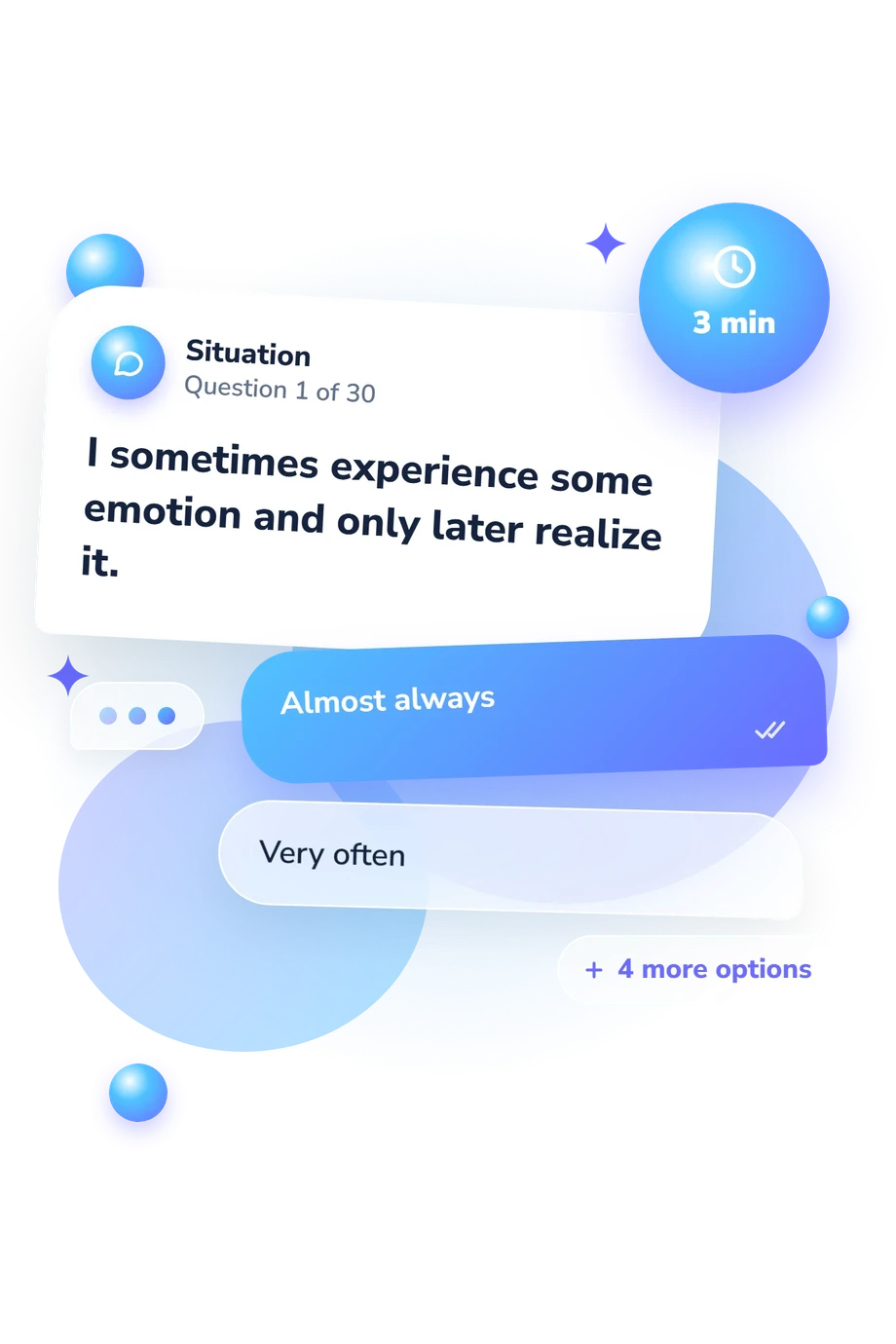
Example Questions From the Test
- Almost always
- Very often
- Somewhat often
- Somewhat infrequently
- Very infrequently
- Almost never
- Almost always
- Very often
- Fairly often
- Fairly rarely
- Very rarely
- Almost never
- Almost always
- Very often
- Somewhat often
- Somewhat rarely
- Very rarely
- Almost never
Mindful Attention Awareness Scale (MAAS) Test - Description and methodology of the test
For readers who want to understand how often attention drifts into automatic habits, the Mindful Attention Awareness Scale (MAAS) Test offers a focused self-report profile. It suits everyday reflection on noticing emotions, bodily sensations, actions, conversations, and present surroundings. As a test of mindful attention, it describes a current tendency toward awareness and attentional self-regulation rather than a fixed identity.
What This Assessment Explores
The questionnaire examines whether attention stays connected to present experience or shifts into automatic action, delayed emotion, unnoticed bodily discomfort, divided listening, or preoccupation with past and future thoughts. Its definition focuses on noticing experience without absorption in automatic reactions or rumination.
The questions cover these recurring situations:
- Emotional noticing shows whether feelings are recognized promptly or only later.
- Automatic activity indicates how often routine actions occur with little awareness.
- Bodily and sensory awareness reflects whether tension, discomfort, and surroundings are noticed in time.
- Attentional flexibility describes staying engaged when goals, memories, or future concerns compete.
These situations yield one result: Mindful Attention Awareness: 0-6. Low 0-3.2 suggests more automatic responding; Moderate 3.3-4.7 indicates an intermediate pattern; High 4.8-6 reflects attentional self-regulation and openness to current experience. It is a context-sensitive snapshot of mindfulness awareness.
Methodology and Scientific Basis
Each item describes a lapse or shift in awareness, and the respondent chooses from six frequency options ranging from "Almost always" to "Almost never." The statements address automatic behavior, divided attention, and noticing experience late rather than in the moment. Since these situations describe reduced awareness, less frequent experiences correspond to stronger results; the questionnaire reports a descriptive profile.
The Mindful Attention Awareness Scale (MAAS) is the named source instrument for the construct assessed here. Brown and Ryan’s research linked present-moment awareness with psychological well-being, while Osman and colleagues later examined the scale’s dimensionality, reliability, and concurrent validity. Published MAAS studies support the source instrument, while the psychometric properties and norms of this online scoring implementation are not separately established.
Its research basis comes from published psychometric work; the online presentation does not establish new norms or clinical cutoffs. Reviewing the result can help turn mindful awareness into a practical focus in daily life, although self-report is influenced by memory, self-awareness, stress, fatigue, and current circumstances. Read the displayed band as descriptive rather than diagnostic, and interpret it alongside the person’s broader context.
- Brown, Kirk Warren, and Richard M. Ryan. "The Benefits of Being Present: Mindfulness and Its Role in Psychological Well-Being." Journal of Personality and Social Psychology 84, no. 4 (2003): 822–848. 10.1037/0022-3514.84.4.822
- Osman, Augustine, Dorian A. Lamis, Courtney L. Bagge, Stacey Freedenthal, and Sean M. Barnes. "The Mindful Attention Awareness Scale: Further Examination of Dimensionality, Reliability, and Concurrent Validity Estimates." Journal of Personality Assessment 98, no. 2 (2016): 189–199. 10.1080/00223891.2015.1095761
Updated: