
Brief Hardiness Questionnaire Test
How the Scales are Structured
Who Usually Takes This Test?
See How You Compare
Below is a preview of how scores are typically distributed across each scale.
Example Questions From the Test
- Not true
- Rarely true
- Sometimes true
- Often true
- Not true
- Very rarely true
- Sometimes true
- Often true
- Not true
- Very rarely true
- Sometimes true
- Often true
Brief Hardiness Questionnaire Test - Description and methodology of the test
For people who want to understand how they respond to pressure, change, and responsibility, the Brief Hardiness Questionnaire Test offers a focused picture of coping-related tendencies. It helps compare which coping tendencies are more prominent in current responses. A hardiness questionnaire can clarify how engagement, perceived influence, and openness to challenge combine in one personal profile.
What This Assessment Explores
The items address engagement, control, reactions to change, and uncertainty. Statements about work, relationships, future direction, effort, luck, boredom, and new situations show everyday themes. Anyone seeking a structured view of coping under stress can use this profile.
The result groups those themes into four dimensions:
- Risk Acceptance (4-16) measures seeing change and obstacles as growth opportunities that support flexibility; Low 4-9, Moderate 10-13, High 14-16.
- Control (4-16) reflects belief that effort can influence circumstances and support active coping; Low control 4-9, Moderate 10-13, High 14-16.
- Commitment (4-16) measures staying engaged, showing concern for others, and seeking support; Low 4-9, Moderate 10-13, High 14-16.
- Hardiness (12-48) assesses coping, adaptation, and internal stability under stress; Lower resilience 12-29, Moderate resilience 30-39, Higher resilience 40-48.
Across the profile, readers compare prominent coping tendencies in this psychological hardiness test.
Methodology and Evidence Base
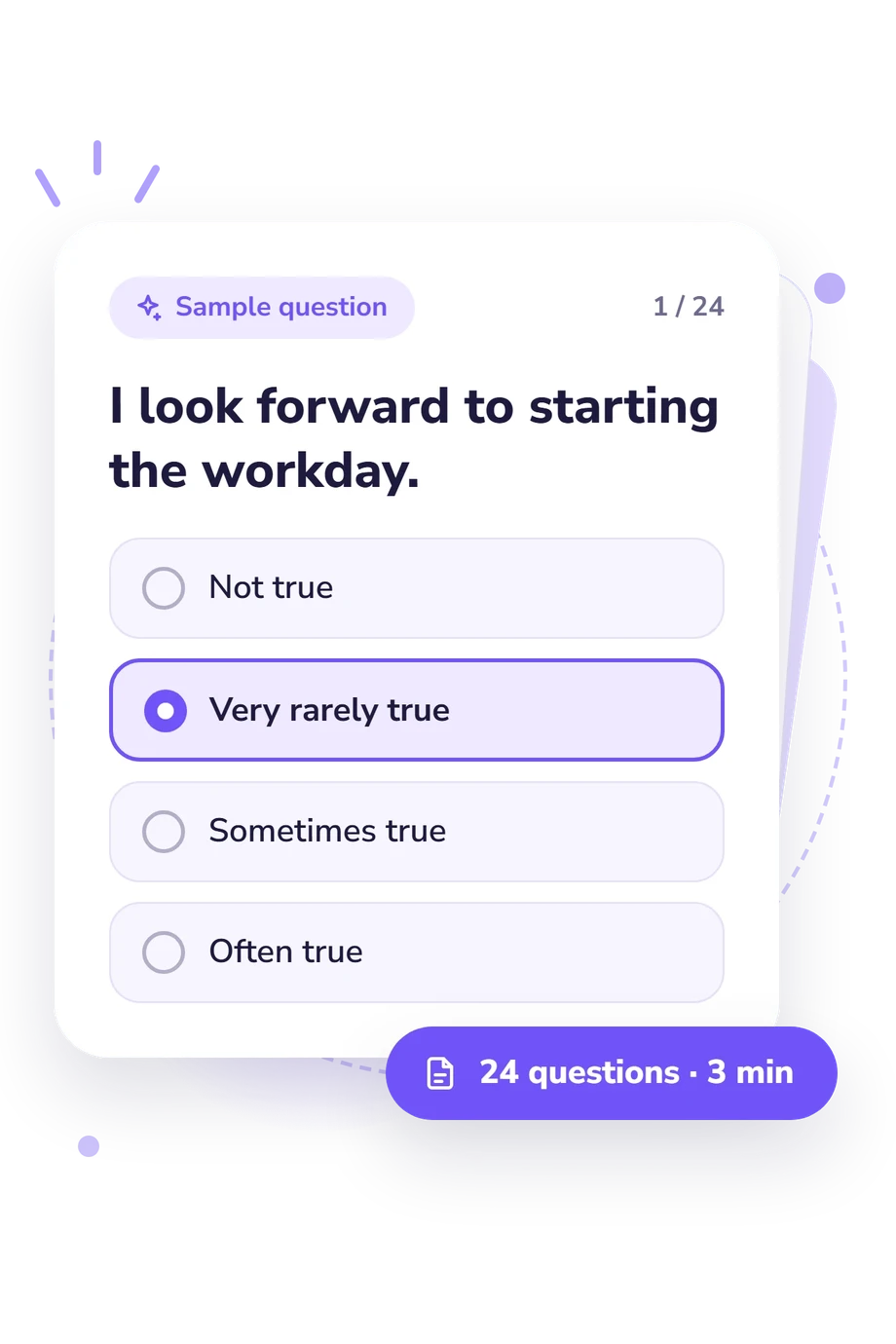
Each statement uses four ordered response choices: Not true, a low-frequency option worded Rarely true or Very rarely true, Sometimes true, and Often true. The format asks readers to judge familiar attitudes and reactions rather than report externally observed behavior.
The result reports scores for the four displayed scales and overall Hardiness, with the supplied bands providing the interpretation. The questionnaire does not specify how individual responses are combined.
The methodology is conceptually consistent with Kobasa’s hardiness model, which connects commitment, control, and challenge-related openness with responses to stress. Prospective work by Kobasa, Maddi, and Kahn, together with Bartone’s occupational study, examines relationships between hardiness and stress-related outcomes. This questionnaire is conceptually consistent with those sources, not an adaptation or standardized administration of them.
No norms or validation data are reported for this online version. Self-reported scores can also shift with current stress, self-awareness, and interpretation of the statements, so they are reflective indicators rather than a diagnosis.
As a hardiness assessment, it has no stated norms or independent validation for this online version.
- Seaward, B. L. (2018). Stress-prone and stress-resistant personality traits. In Managing Stress: Principles and Strategies for Health and Well-Being (9th ed., pp. 156–159). Burlington, MA: Jones & Bartlett Learning.
- Kobasa, S. C. (1979). Stressful life events, personality, and health: An inquiry into hardiness. Journal of Personality and Social Psychology, 37(1), 1–11. 10.1037/0022-3514.37.1.1
- Kobasa, S. C., Maddi, S. R., & Kahn, S. (1982). Hardiness and health: A prospective study. Journal of Personality and Social Psychology, 42(1), 168–177. 10.1037/0022-3514.42.1.168
- Bartone, P. T. (1989). Predictors of stress-related illness in city bus drivers. Journal of Occupational Medicine, 31(8), 657–663. 10.1097/00043764-198908000-00008
Updated: