
Individual Perception of the Group Assessment Test
How the Scales are Structured
Who Usually Takes This Test?
See How You Compare
Below is a preview of how scores are typically distributed across each scale.
Example Questions From the Test
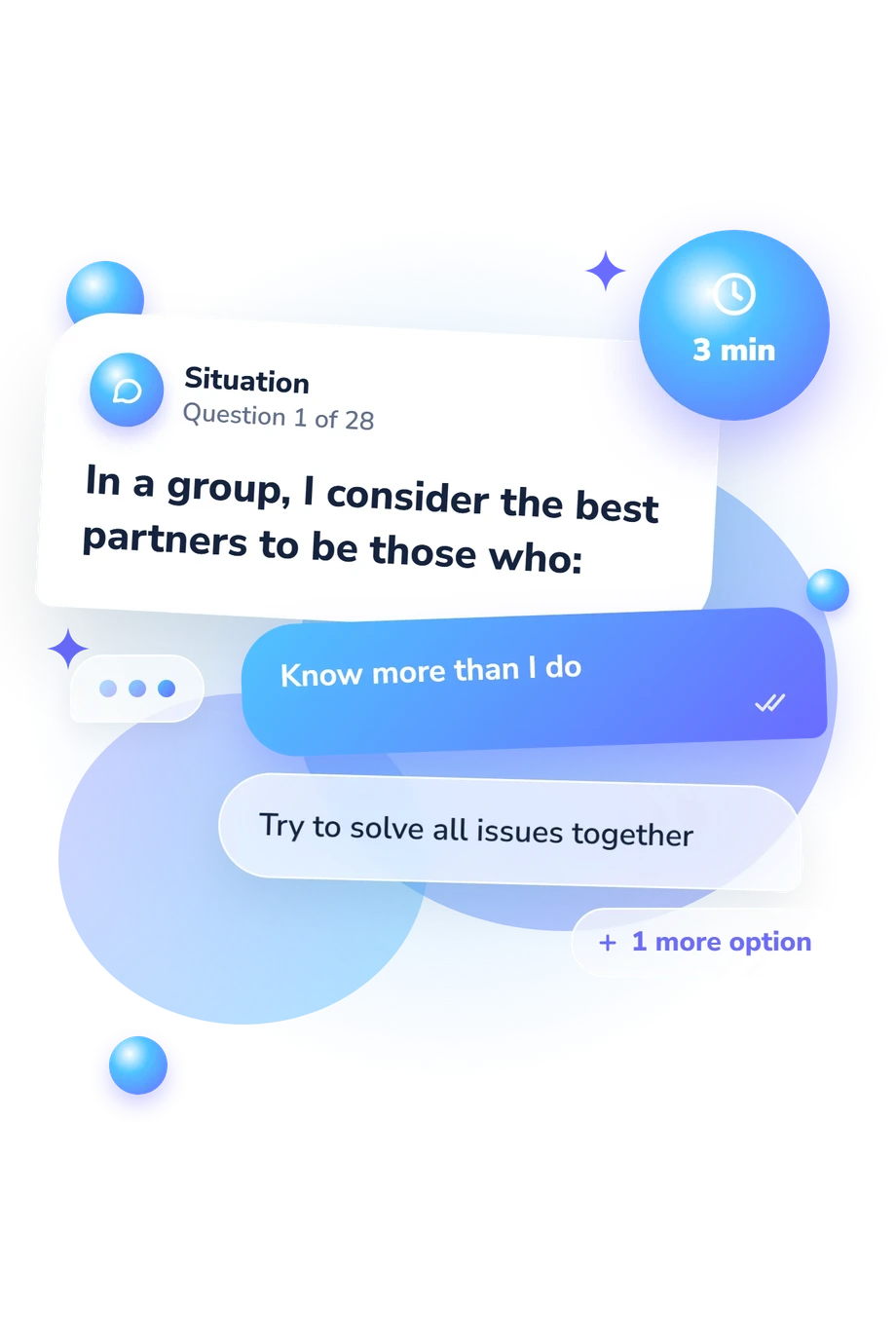
- Know more than I do
- Try to solve all issues together
- Do not distract the instructor’s attention
- Take an individual approach
- Create opportunities for others to provide help
- Create a group atmosphere in which no one is afraid to speak up
- A – there is no one to help
- B – I am interrupted while completing a task
- C – the others are less well prepared than I am
Individual Perception of the Group Assessment Test - Description and methodology of the test
For readers deciding whether this approach to shared work fits them, the Individual Perception of the Group Assessment Test offers a structured way to examine how group membership is understood. It is intended for people reflecting on cooperation, independence, and contribution in shared settings. As a group perception assessment, it can help readers decide whether examining their approach to shared work would be useful.
What This Assessment Explores
Rather than measuring sociability in general, the assessment examines what group membership means to the respondent. Its focus is perception of group membership: what the group represents in practical and social terms. Situations cover partners, teachers, friends, problem solving, shared success, help, recognition, and independent work. The dimensions examined by this group perception test are:
- Pragmatic: 0-14 measures viewing the group as a means to personal goals and capable cooperation; the result is Low pragmatic focus (0-4), Moderate pragmatic focus (5-9), or High pragmatic focus (10-14).
- Collectivistic: 0-14 measures valuing the group itself, its members’ success, and shared goals; the result is Low collectivist orientation (0-4), Moderate collectivist orientation (5-9), or High collectivist orientation (10-14).
- Individualistic: 0-14 measures viewing the group as an obstacle or minor influence; the result is Low (0-4), Moderate (5-9), or High (10-14).
The profile describes a group-life orientation, not a fixed personality type.
Methodology and Scientific Basis
Fourteen self-report items give this group orientation test three alternative responses. The alternatives repeatedly place the respondent in classroom, friendship, and problem-solving situations, so the profile concerns preferred relations with group members rather than general social confidence. The choices contrast reliance on capable partners, commitment to mutual support, and preference for independent action across group situations. Respondents select the position that best fits rather than rate agreement on a numerical scale.
Responses produce three orientation scores. The questionnaire does not specify how each response contributes points, so the displayed bands should be read as a descriptive profile rather than as a norm-referenced score.
The closest published basis is Zalyubovskaya (1984), whose method examines individual perception of a group. The questionnaire is conceptually consistent with that work and with Moseyko and Nelisova (1982) on socio-psychological orientation in a group.
The displayed bands describe the respondent's pattern and do not by themselves establish population norms or reliability. Self-report may reflect context, self-awareness, or impression management, while behavior across groups can add context.
- Zalyubovskaya, E. V. (1984). Methodology for Studying an Individual's Perception of a Group. In G. M. Andreeva and V. S. Ageev (Eds.), Methods of Studying Interpersonal Perception: Special Practicum in Social Psychology (pp. 64-71). Moscow: Moscow State University Press.
- Moseyko, E. V., and Nelisova, I. I. (1982). Methodology for Studying the Socio-Psychological Orientation of the Individual in a Group. In Activation of Educational Activity (pp. 140-144). Moscow: Moscow State University Press.
- Karkovska, Ruslana. (2014). Psychological factors of the image of the state in the students’ perception. Journal of Education Culture and Society, 5(1), 158-168. 10.15503/jecs20141.158.168
Updated: