
Emotional Type Questionnaire Test
How the Scales are Structured
Who Usually Takes This Test?
See How You Compare
Below is a preview of how scores are typically distributed across each scale.
Example Questions From the Test
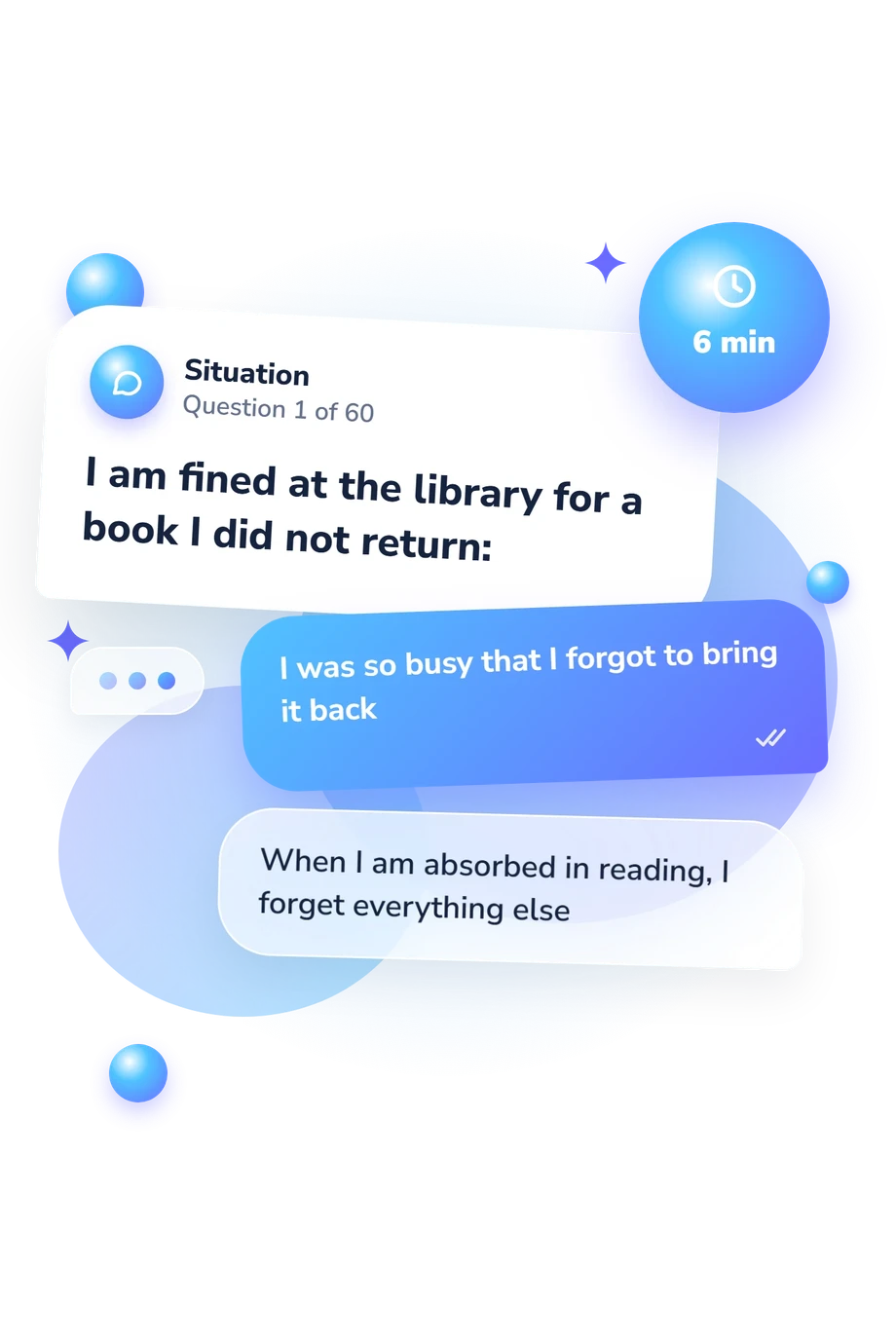
- I was so busy that I forgot to bring it back
- When I am absorbed in reading, I forget everything else
- She always speaks without considering others.
- She is in a bad mood today.
- It was ugly anyway.
- I would offer to buy her one like it.
Emotional Type Questionnaire Test - Description and methodology of the test
People who want a clearer picture of how they respond to everyday tensions, closeness, responsibility, and disappointment may use the Emotional Type Questionnaire Test to examine their reactions in context. Its format organizes those reactions into an emotional profile that helps readers consider recurring ways they experience emotions and relationships. It is intended for self-observation, not for assigning a clinical label.
What This Assessment Explores
The questionnaire presents everyday situations that elicit different emotional and interpersonal responses. The scenarios involve responsibility, hurt, empathy, jealousy, solitude, affection, envy, criticism, and disappointment. They reflect the balance among receptivity, passion, and sensitivity, helping readers consider their emotional relationship patterns.
The single displayed scale, Emotional Type Identification, ranges from 0-30. Its result bands are:
- The reserved type (0-12) identifies the reserved profile band without assigning a specific emotional trait.
- The integrated type (13-22) describes an integrated type characterized by emotional harmony, moderate passion, and well-developed empathy.
- The intensive type (23-30) identifies the intensive profile band without assigning it a single defining trait.
Together, these categories help clarify how a person experiences emotions and forms relationships; higher or lower scores may indicate predominance of specific emotional traits.
Methodology and Evidence Base
Each item presents an everyday situation and offers two possible reactions. The alternatives contrast blame with accountability, dismissal with empathy, or distance with engagement, making this an emotional style assessment rather than a symptom-frequency checklist. Selected options produce the displayed result categories; because the questionnaire does not state a universal point value for each alternative, the scale span should not be used to infer one. Recurring themes include accountability, empathy, and relationship expectations.
Conceptually, the pattern is consistent with the Emotional Style Questionnaire, which treats emotionality as multidimensional, and with the Affective Style Questionnaire developed by Hofmann and Kashdan. Gross and John's work on reappraisal and suppression offers a related framework for understanding emotion regulation in affect and relationships. These sources support the constructs, but this online questionnaire is not presented as a validated adaptation of them.
Use the result for self-observation. Stress, relationship context, social desirability, and self-awareness may influence answers. No normative data are provided, so the bands are descriptive catalogue categories rather than inferred population cutoffs. Repeated real-life patterns provide important context.
- Kesebir, Pelin, Agata Gasiorowska, Robin Goldman, Matthew J. Hirshberg, and Richard J. Davidson. “Emotional Style Questionnaire: A Multidimensional Measure of Healthy Emotionality.” Psychological Assessment 31, no. 10 (2019): 1234-1246. DOI 10.1037/pas0000745
- Hofmann, Stefan G., and Todd B. Kashdan. “The Affective Style Questionnaire: Development and Psychometric Properties.” Journal of Psychopathology and Behavioral Assessment 32, no. 2 (2010): 255-263. DOI 10.1007/s10862-009-9142-4
- Gross, James J., and Oliver P. John. “Individual Differences in Two Emotion Regulation Processes: Implications for Affect, Relationships, and Well-Being.” Journal of Personality and Social Psychology 85, no. 2 (2003): 348-362. DOI 10.1037/0022-3514.85.2.348
Updated: