
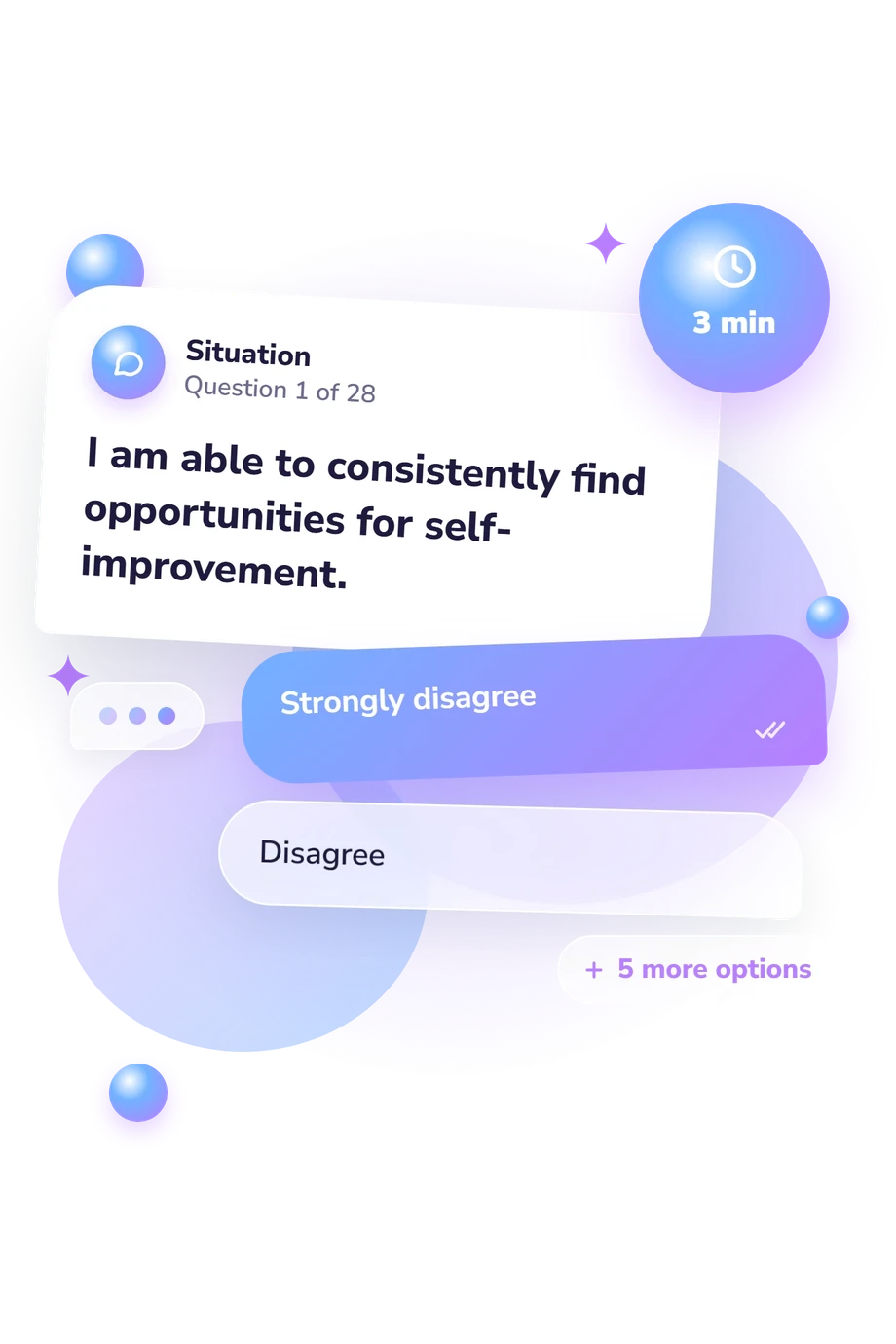
Perfectionism test

The perfectionism test is a 14-item self-report instrument developed by Hewitt and Flett that measures perfectionism across two independently scored dimensions: adaptive perfectionism (healthy, goal-directed striving with realistic standards and constructive responses to mistakes) and pathological perfectionism (rigid, distress-driven standards linked to chronic self-criticism, fear of failure, and anxiety). The two-subscale structure reveals not just whether you are a perfectionist, but whether your perfectionism is working for or against you.
Start Online Test
Questions143 minutes
Hi! My name is Freudly, i am an AI therapist, I will give you an interpretation of the test after you complete it.
08:30
October 2, 2025
October 2, 2025
Material has been updated
23,509 views
3,093 completions
2,696 likes
Verified by Daniel Hall
Psychologist with 25 years of experience
Share
Scale Explorer

How the Scales are Structured

example score
18/49
Pathological Perfectionism (PP)
Measures the extent of distressing, rigid, and unrealistic perfectionistic standards that can fuel chronic dissatisfaction and anxiety.
Low
Moderate
High
720Low2133Moderate3449High
A score of 18 falls in the Low range, suggesting relatively few signs of rigid, distress-driven perfectionism and more flexibility around mistakes and standards.
example score
25/49
Adaptive Perfectionism (AP)
Measures the extent of healthy, flexible striving for excellence with realistic standards and constructive responses to mistakes.
Low
Moderate
High
728Low2941Moderate4249High
A score of 25 falls in the Low range, suggesting a relatively modest tendency toward healthy perfectionistic striving and generally flexible standards.
Start Online Test
just completed the test
DATA-BASED USER COHORTS

Who Usually Takes This Test?

High achievers under pressure
41%OF USERS
People who set very high standards and feel stressed, guilty, or never satisfied even when they do well take it to see if their drive is healthy or harmful.
Therapy and coaching clients
34%OF USERS
Clients working on anxiety, procrastination, burnout, or self-criticism use it to clarify whether perfectionism is a core factor in their struggles.
Psychology trainees and supervisors
25%OF USERS
Students, interns, and supervisors use it as a quick screening tool for case formulation, supervision discussions, and skills practice.
BASED ON AGGREGATED, ANONYMIZED DATA FROM TENS OF THOUSANDS OF FREUDLY USERS.
Benchmarking

See How You Compare

Once you complete the test, your results are compared with real-world data from people in your country.
Below is a preview of how scores are typically distributed across each scale.
Pathological Perfectionism (PP)
Average
24.6
Normal range
19.130.1
min.
7
max.
49
Majority
This curve shows how scores are typically distributed.
Once you complete the test, your result will appear on the scale so you can see how you compare.
Normal Perfectionism (NP)
Average
25
Normal range
19.230.8
min.
7
max.
49
Majority
This curve shows how scores are typically distributed.
Once you complete the test, your result will appear on the scale so you can see how you compare.
Featured On
CLEAR ANSWERS TO COMMON QUESTIONS

Frequently Asked Questions

What does this perfectionism test measure?
This perfectionism test measures two distinct types of perfectionism: adaptive perfectionism (healthy striving with realistic standards and constructive responses to mistakes) and pathological perfectionism (rigid, distress-driven standards linked to fear of failure, anxiety, and chronic self-criticism). Each subscale is scored independently, revealing whether your perfectionism is working for or against you.
How long does it take and how many items are included?
The questionnaire includes 14 items and typically takes about 3 minutes to complete. Rate each item based on your typical behavior and thoughts over the past several months rather than a single day or unusual event.
Who should take a perfectionism test?
It is designed for high achievers who feel driven by their standards but also experience stress, procrastination, burnout, or chronic dissatisfaction. Therapists and coaches also use it during intake to assess whether perfectionist traits are a primary factor in a client's anxiety, self-criticism, or relationship difficulties.
How are the results of a perfectionism assessment interpreted?
Each subscale score is compared against low, moderate, and high ranges. A high pathological perfectionism score combined with low adaptive perfectionism points to a pattern most likely to cause distress. A high adaptive score suggests healthy striving. The combination of both scores gives the most clinically useful picture and should be discussed with a professional when scores fall in the high pathological range.
What is the difference between adaptive and pathological perfectionism?
Adaptive perfectionism involves high standards combined with flexibility — you aim for excellence, can accept mistakes, and feel motivated rather than threatened by challenges. Pathological perfectionism involves rigid, all-or-nothing standards driven by fear of failure and harsh self-judgment. The same level of effort looks very different from the inside depending on which type dominates.
Can this perfectionism questionnaire be used in therapy?
Yes. Therapists use the perfectionism scale during intake and at regular intervals to track whether pathological perfectionism is decreasing and adaptive striving is increasing across treatment. The two-subscale structure makes it easy to monitor change in each dimension separately, giving both clinician and client concrete evidence of progress.
Is perfectionism linked to anxiety and OCD?
Pathological perfectionism is consistently associated with elevated anxiety, depression, and OCD perfectionism patterns in clinical research. Rigid standards and intolerance of mistakes are core maintaining factors in several anxiety disorders and are a frequent target in cognitive behavioral therapy. This assessment helps identify whether perfectionism is playing that role before treatment begins.
WHAT THE TEST MEASURES
About This Assessment
Brief Differential Perfectionism Test

The perfectionism test is a 14-item self-report instrument developed by Hewitt and Flett that measures perfectionism across two independently scored dimensions: adaptive perfectionism (healthy, goal-directed striving with realistic standards and constructive responses to mistakes) and pathological perfectionism (rigid, distress-driven standards linked to chronic self-criticism, fear of failure, and anxiety). The two-subscale structure reveals not just whether you are a perfectionist, but whether your perfectionism is working for or against you.

Why Take a Perfectionism Test

Perfectionism is one of the most misunderstood personality traits — it ranges from a genuine driver of excellence to a core factor in anxiety, burnout, procrastination, and OCD perfectionism. Without a structured screen, it is difficult to know which type is dominant. A perfectionism assessment separates these patterns so that individuals and clinicians can target intervention precisely rather than treating all perfectionism as pathological or dismissing it as merely "high standards."

A perfectionism questionnaire like this one is used by therapists and coaches during intake to clarify whether perfectionism is a primary driver of a client's anxiety, procrastination, or self-criticism, and to establish a baseline for tracking change. For individuals, results provide validated language for what they are experiencing and a clear answer to whether their high standards are adaptive or maladaptive.

What the Assessment Measures

  • Adaptive Perfectionism — healthy striving for excellence characterized by realistic standards, positive motivation, and the ability to accept mistakes as learning opportunities without excessive self-criticism; scored 7–49.
  • Pathological Perfectionism — rigid, inflexible standards driven by fear of failure, chronic dissatisfaction, and harsh self-evaluation; associated with anxiety, burnout, and procrastination; scored 7–49.

Who This Assessment Is For

The perfectionism test is appropriate for high achievers who feel driven by their standards but also frequently stressed, dissatisfied, or stuck. It is widely used by therapists and counselors during intake to assess whether perfectionist traits are contributing to anxiety, OCD perfectionism, burnout, or relationship difficulties. Coaches use the perfectionism assessment to help clients distinguish between productive striving and self-defeating rigidity, and to identify which pattern to address first. Psychology trainees and researchers use it as a quick, validated screening tool in case formulation and group studies. No clinical background is required — each item describes a specific attitude toward standards and mistakes, and respondents rate how typical it is for them.

Clinical Validity and Use in Practice

The Brief Differential Test of Perfectionism was developed by Hewitt and Flett, whose multidimensional model of perfectionism is among the most extensively validated in the field. The two-subscale structure has demonstrated good internal consistency and discriminant validity, with pathological perfectionism scores correlating significantly with anxiety, depression, and self-criticism, while adaptive perfectionism correlates with goal persistence and life satisfaction. Results are screening-level indicators and should be interpreted alongside presenting concerns, functional impairment, and other assessment data — they are not a standalone diagnosis. In clinical practice, the perfectionism scale is most effective as a starting point for a structured

Author: Gordon L. Flett, Paul L. Hewitt
Literature: Frost, R. O., Marten, P., Lahart, C., & Rosenblate, R. The dimensions of perfectionism. Cognitive Therapy and Research. 1990.; Hewitt, P. L., & Flett, G. L. Perfectionism in the self and social contexts: Conceptualization, assessment, and association with psychopathology. Journal of Personality and Social Psychology. 1991.; Stoeber, J., & Otto, K. Positive conceptions of perfectionism: Approaches, evidence, challenges. Personality and Social Psychology Review. 2006.; Dunkley, D. M., Blankstein, K. R., Masheb, R. M., & Grilo, C. M. Personal standards and evaluative concerns dimensions of “clinical” perfectionism: A reply to Shafran et al. Behaviour Research and Therapy. 2006.
Test Question Form
You Might Also Like
Differential Test of Perfectionism
This instrument is used to screen for perfectionism-related attitudes and t…
Start Test
Perfectionism Scale
This measure assesses perfectionistic attitudes and goal-oriented standards…
Start Test
Physical Perfectionism Scale
This brief self-report measure assesses perfectionistic beliefs and concern…
Start Test
Popular tests
Narcissistic Personality Inventory (NPI)
This self-report measure is used to assess narcissism as a personality trai…
Start Test
Yale-Brown Obsessive Compulsive Scale (Y-BOCS)
This measure is used to rapidly quantify the current severity of obsessive…
Start Test
CRAFFT Screening Test (CRAFFT 2.1)
This brief screening measure is designed to identify potential alcohol and…
Start Test
Patient Health Questionnaire-9 (PHQ-9)
This measure is commonly used to quickly screen for the presence and severi…
Start Test
Maslach Burnout Inventory (MBI)
This self-report measure is used to assess occupational burnout symptoms in…
Start Test
Adolescent Anxiety Questionnaire
This measure is designed to support a brief appraisal of anxiety symptoms a…
Start Test
Emotional Creativity Inventory (ECI)
This self-report measure assesses individual differences in the originality…
Start Test
Horne–Ostberg Morningness–Eveningness Questionnaire (MEQ)
Circadian preferences influence typical patterns of alertness and sleep tim…
Start Test
Ambivalent Sexism Inventory (ASI)
This measure is designed to assess attitudes toward women, including both o…
Start Test
Internalized Misogyny Scale (IMS)
This measure is designed to assess internalized negative beliefs and stereo…
Start Test
Perceived Stress Scale (PSS-10)
This self-report measure assesses the degree to which individuals appraise…
Start Test
Impulsive Behavior Scale (SUPPS-P)
Impulsivity is a multidimensional construct that is often assessed with bri…
Start Test
Clinical Institute Withdrawal Assessment for Alcohol, Revised (CIWA-Ar)
This rating scale is used to rapidly assess the severity of alcohol withdra…
Start Test
Positive and Negative Affect Schedule (PANAS)
This measure provides a brief self-report assessment of current or typical…
Start Test
Light Triad Scale (LTS)
This self-report measure assesses prosocial personality tendencies and orie…
Start Test
Suicidal Ideation Scale
In clinical settings, the Suicidal Ideation Scale is used to structure an i…
Start Test
Body Dysmorphic Disorder Scale (BDD-D)
This brief self-report measure is designed to screen for and quantify distr…
Start Test
Beck Anxiety Inventory (BAI)
This measure is a brief self-report inventory used to screen for anxiety sy…
Start Test
Differential Test of Perfectionism
This instrument is used to screen for perfectionism-related attitudes and t…
Start Test
Locus of Control Scale
This measure assesses generalized expectancies regarding the degree to whic…
Start Test
New Apathy Scale
This brief self-report measure is used to screen for apathy-related symptom…
Start Test
Perth Alexithymia Questionnaire (PAQ)
This measure assesses individual differences in alexithymia, including diff…
Start Test
Social Intelligence Scale
This brief self-report measure is designed to support rapid screening of in…
Start Test
Fear Test
This measure is designed to evaluate individual differences in fear-related…
Start Test
Neuroticism Level Scale
The measure is intended for brief screening of an individual’s propensity t…
Start Test
Aggressiveness Indicators Screening Questionnaire
This screening tool is designed to quickly identify behavioral indicators a…
Start Test
Comments
Leave a Comment