
Cambridge Depersonalization Scale (CDS) Test
How the Scales are Structured
Who Usually Takes This Test?
See How You Compare
Below is a preview of how scores are typically distributed across each scale.
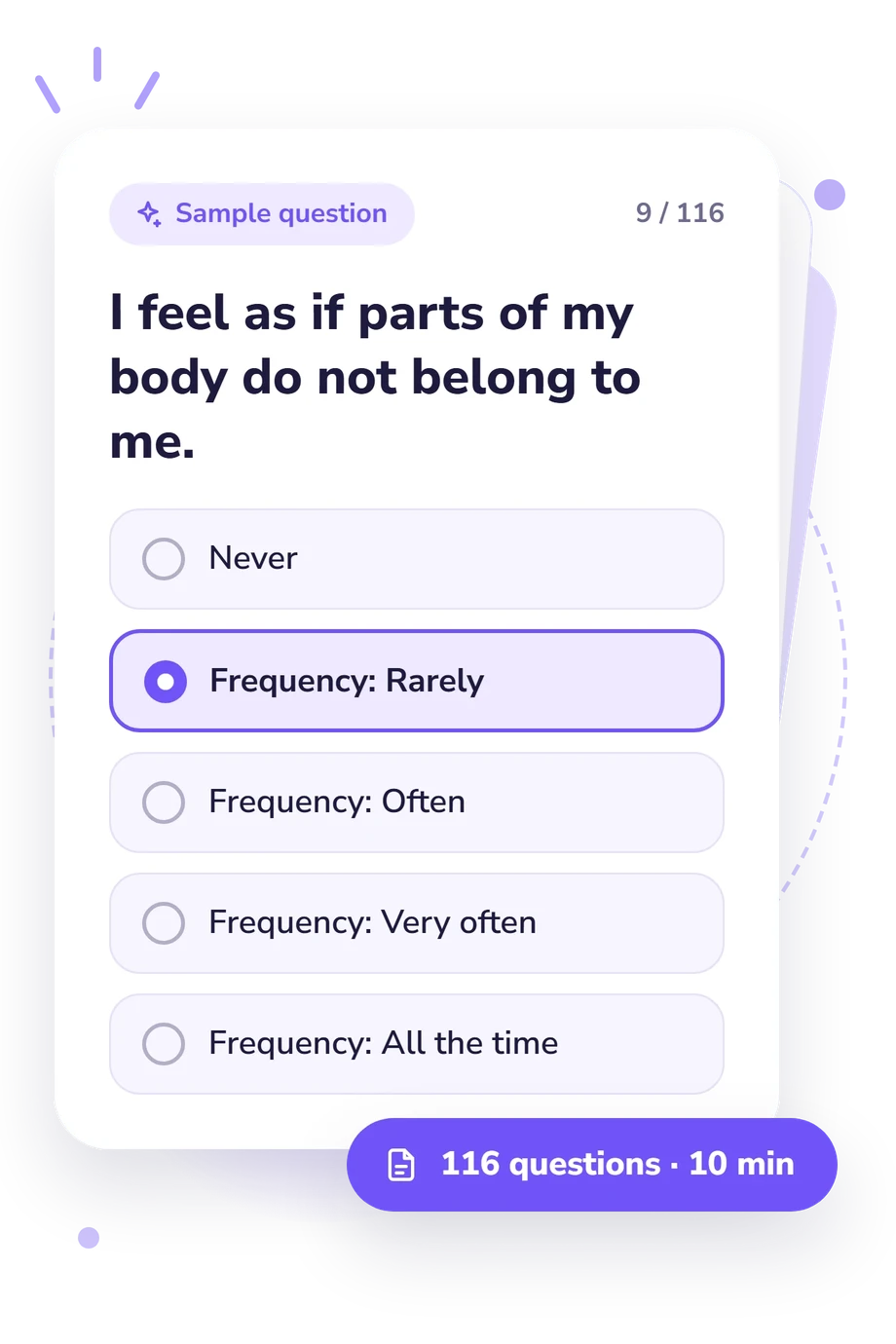
Example Questions From the Test
- Never
- Frequency: Rarely
- Frequency: Often
- Frequency: Very often
- Frequency: All the time
- Never
- Duration: A few seconds
- Duration: A few minutes
- Duration: A few hours
- Duration: About a day
- Duration: More than a day
- Duration: More than a week
- Never
- Frequency: Rarely
- Frequency: Often
- Frequency: Very often
- Frequency: All the time
Cambridge Depersonalization Scale (CDS) Test - Description and methodology of the test
For people who notice episodes of unreality, emotional distance, altered body ownership, or detachment from surroundings, the Cambridge Depersonalization Scale (CDS) Test offers a structured way to organize those experiences. It is suitable for anyone seeking a clearer picture of current or recurring symptoms. Its results can help identify patterns in depersonalization symptoms that may be useful in a broader mental-health assessment.
What This Assessment Explores
First-person items examine unreality, bodily detachment, altered perception, emotional or sensory blunting, automatic action, and unfamiliarity in familiar settings. The assessment focuses on how these experiences are expressed and sustained, rather than treating one answer as complete.
The result shows three dimensions:
- Duration (0–174) indicates whether episodes are brief or persistent, with Short duration (0–58), Moderate duration (59–116), or Long duration (117–174).
- Frequency (0–116) indicates whether episodes are infrequent or recurrent, with Low frequency (0–38), Moderate frequency (39–77), or High frequency (78–116).
- Depersonalization Scale (0–290) indicates severity and detachment intensity, with Below threshold (0–70) or Elevated (71–290); 70 is a proposed compromise between sensitivity and specificity.
Together, these depersonalization test results distinguish occasional, brief experiences from patterns that are more frequent, prolonged, or intense. Because responses reflect the period the respondent recalls, scores may vary with current circumstances and the experiences being considered.
Methodology and Evidence Base
Responses use graded self-report options. Frequency items run from Never to All the time; duration items ask how long episodes last. This separates occurrence from persistence.
The questionnaire collects frequency or duration responses and reports separate scores for the displayed scales. This distinguishes frequency, duration, and intensity in reported results.
The source instrument is the Cambridge Depersonalization Scale (Sierra & Berrios, 2000), a published self-report measure. This questionnaire is conceptually consistent with the published Cambridge Depersonalization Scale but is not presented as an adaptation or validation of that instrument.
Later studies by Sierra et al. (2005), Simeon et al. (2008), and Blevins et al. (2013) examined symptom clusters and factor structure. Those findings provide context for symptom clusters and factor structure, not norms for this questionnaire or evidence for its online scoring or result bands.
Interpretation of this depersonalization questionnaire should account for current stress, memory, self-awareness, and response style. Results describe experiences at one point in time; an elevated profile needs context and is not, by itself, a diagnosis.
- Sierra, M., & Berrios, G. E. (2000). The Cambridge Depersonalisation Scale: A new instrument for the measurement of depersonalisation. Psychiatry Research, 93(2), 153–164. 10.1016/S0165-1781(00)00100-1
- Sierra, M., Baker, D., Medford, N., & David, A. S. (2005). Unpacking the depersonalization syndrome: An exploratory factor analysis on the Cambridge Depersonalization Scale. Psychological Medicine, 35(10), 1523–1532. 10.1017/S0033291705005325
- Simeon, D., Kozin, D. S., Segal, K., Lerch, B., Dujour, R., & Giesbrecht, T. M. (2008). De-constructing depersonalization: Further evidence for symptom clusters. Psychiatry Research, 157(1–3), 303–306. 10.1016/j.psychres.2007.07.007
- Blevins, C. A., Witte, T. K., & Weathers, F. W. (2013). Factor structure of the Cambridge Depersonalization Scale in trauma-exposed college students. Journal of Trauma & Dissociation, 14(3), 288–301. 10.1080/15299732.2012.729555
Updated: