
Brief Fear of Negative Evaluation Scale (BFNE) Test
How the Scales are Structured
Who Usually Takes This Test?
See How You Compare
Below is a preview of how scores are typically distributed across each scale.
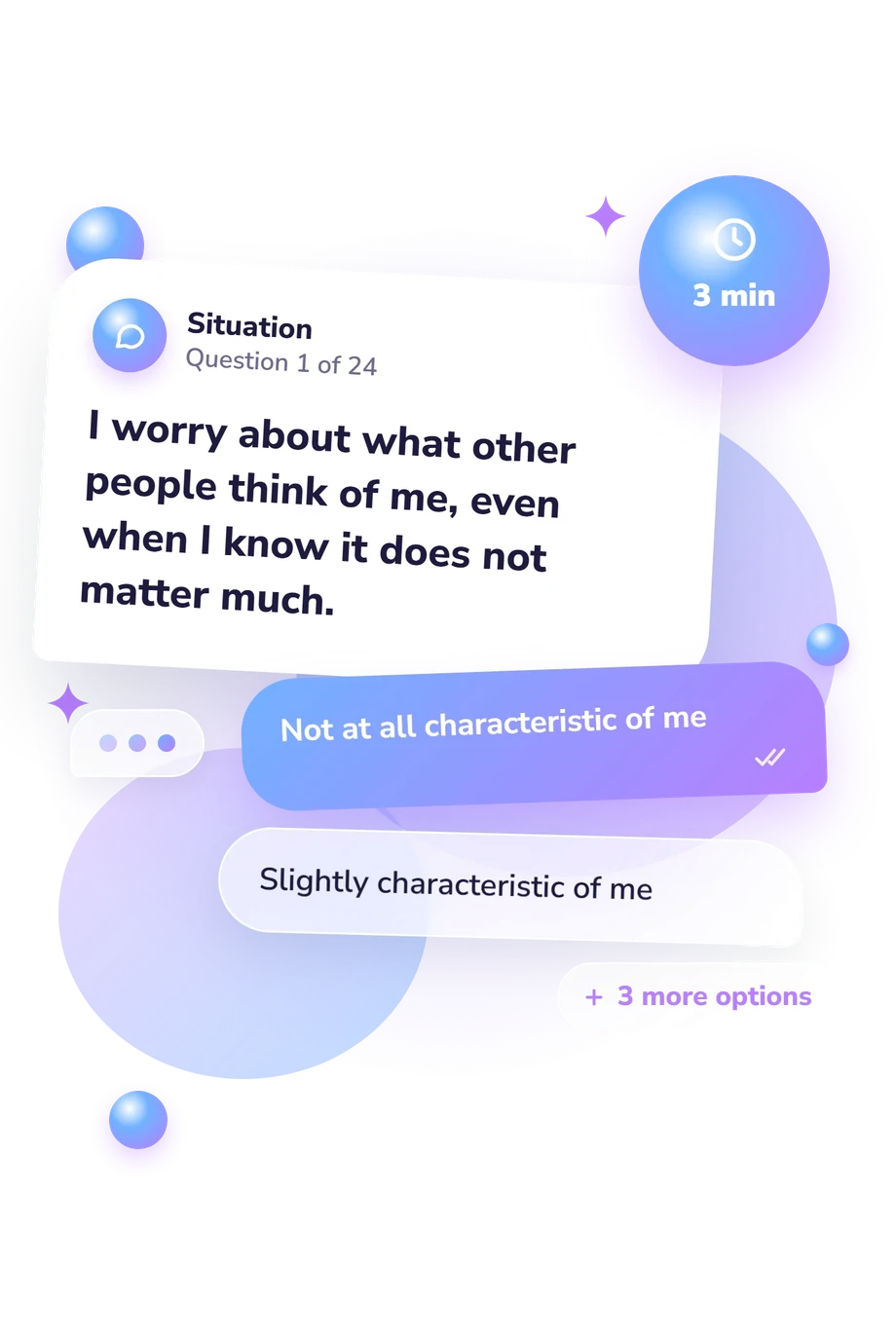
Example Questions From the Test
- Not at all characteristic of me
- Slightly characteristic of me
- Moderately characteristic of me
- Very characteristic of me
- Extremely characteristic of me
- Not at all characteristic of me
- Slightly characteristic of me
- Moderately characteristic of me
- Very characteristic of me
- Extremely characteristic of me
- Does not describe me at all
- Describes me slightly
- Describes me moderately well
- Describes me very well
- Describes me extremely well
Brief Fear of Negative Evaluation Scale (BFNE) Test - Description and methodology of the test
People who become preoccupied with criticism, disapproval, or mistakes in social situations can use the Brief Fear of Negative Evaluation Scale (BFNE) Test to examine that pattern more closely. It suits readers who want to understand whether concern about others’ judgments affects conversations, participation, or willingness to enter situations where behavior may be noticed. As a social evaluation anxiety test, it focuses on interpersonal worry rather than general nervousness.
What This Assessment Measures
These items examine concern that others will notice flaws, disapprove, or form an unfavorable impression. They address anticipatory worry, self-monitoring during interaction, and fear of mistakes, showing how social judgment may affect distress, confidence, and willingness to enter evaluative situations.
Read as a fear of negative evaluation questionnaire, the result organizes related experiences rather than identifying a single cause. The dimensions below describe what each pattern may mean for your profile:
- Concern about others’ opinions shows how much outside judgments occupy your thoughts.
- Fear of disapproval captures worry that people may find fault.
- Impression monitoring describes attention to how you appear in interaction.
- Worry about mistakes reflects concern that errors will be judged negatively.
The displayed Fear of Negative Evaluation Scale ranges from 12 to 60: Low 12–23, Moderate 24–46, and High 47–60. Higher results indicate stronger evaluation-related anxiety and may coincide with avoidance of situations in which you could be judged.
Methodology and Scientific Basis
Each item asks you to rate how characteristic a statement is on a five-point scale, from not at all characteristic to extremely characteristic. Responses are combined into a total, with higher values indicating more fear of negative evaluation. As self-report, the result reflects your perspective at completion and may be influenced by mood, recent interactions, or self-awareness.
The questionnaire is conceptually consistent with the Brief Fear of Negative Evaluation Scale (BFNE), the brief measure associated with Leary’s 1983 work. Rodebaugh and colleagues examined the instrument’s factor structure and item properties, while Weeks and colleagues evaluated the brief scale in people with social anxiety disorder. These studies support the construct, but do not establish identical norms or psychometric properties for this online version.
For interpretation, a higher score points to more frequent or intense concern about being judged, not a diagnosis or fixed personality trait. A lower score suggests less reported preoccupation in the situations represented by the items. Consider the result alongside avoidance, safety behaviors, and daily functioning; this social anxiety self-assessment cannot capture every relevant social experience.
- Leary, M. R. (1983). A brief version of the Fear of Negative Evaluation Scale. Personality and Social Psychology Bulletin, 9(3), 371–375. 10.1177/0146167283093007
- Rodebaugh, T. L., Woods, C. M., Thissen, D. M., Heimberg, R. G., Chambless, D. L., & Rapee, R. M. (2004). More information from fewer questions: The factor structure and item properties of the original and brief fear of negative evaluation scale. Psychological Assessment, 16(2), 169–181. 10.1037/1040-3590.16.2.169
- Weeks, J. W., Heimberg, R. G., Fresco, D. M., Hart, T. A., Turk, C. L., Schneier, F. R., & Liebowitz, M. R. (2005). Empirical validation and psychometric evaluation of the Brief Fear of Negative Evaluation Scale in patients with social anxiety disorder. Psychological Assessment, 17(2), 179–190. 10.1037/1040-3590.17.2.179
- Watson, D., & Friend, R. (1969). Measurement of social-evaluative anxiety. Journal of Consulting and Clinical Psychology, 33(4), 448–457. 10.1037/h0027806
Updated: