
Life Style Index (LSI) Test
How the Scales are Structured
Who Usually Takes This Test?
See How You Compare
Below is a preview of how scores are typically distributed across each scale.
Example Questions From the Test
- Yes
- No
- Yes
- No
- Yes
- No
Life Style Index (LSI) Test - Description and methodology of the test
People who notice recurring reactions to criticism, conflict, pressure, or uncomfortable feelings may find the Life Style Index (LSI) Test useful. It can offer a stress response profile for reflection, helping them explore which responses seem protective, avoidant, controlling, or emotionally intensifying in their own lives. The result can support a more specific conversation with themselves about patterns they may want to understand.
What This Assessment Explores
The questionnaire examines how a person manages uncomfortable emotion and social pressure. Its themes include anger, inhibition, mistrust, self-presentation, avoidance, suppression, and reactions to criticism. Questions about defense mechanisms and coping patterns describe predominant responses and adaptive capacity under stress.
The main patterns represented by the questions include:
- Emotional regulation shows how irritation, anger, or distress may rise and settle under pressure.
- Self-protective thinking reflects efforts to push away, reinterpret, minimize, or reorganize threatening experiences.
- Interpersonal coping describes responses to criticism, competition, mistrust, and pressure from others.
- Adaptive resources indicate how a person may preserve composure and flexibility when circumstances feel demanding.
Together, these dimensions show how the respondent's usual reactions may protect against discomfort while also shaping emotional and interpersonal strain.
Methodology and Scientific Basis
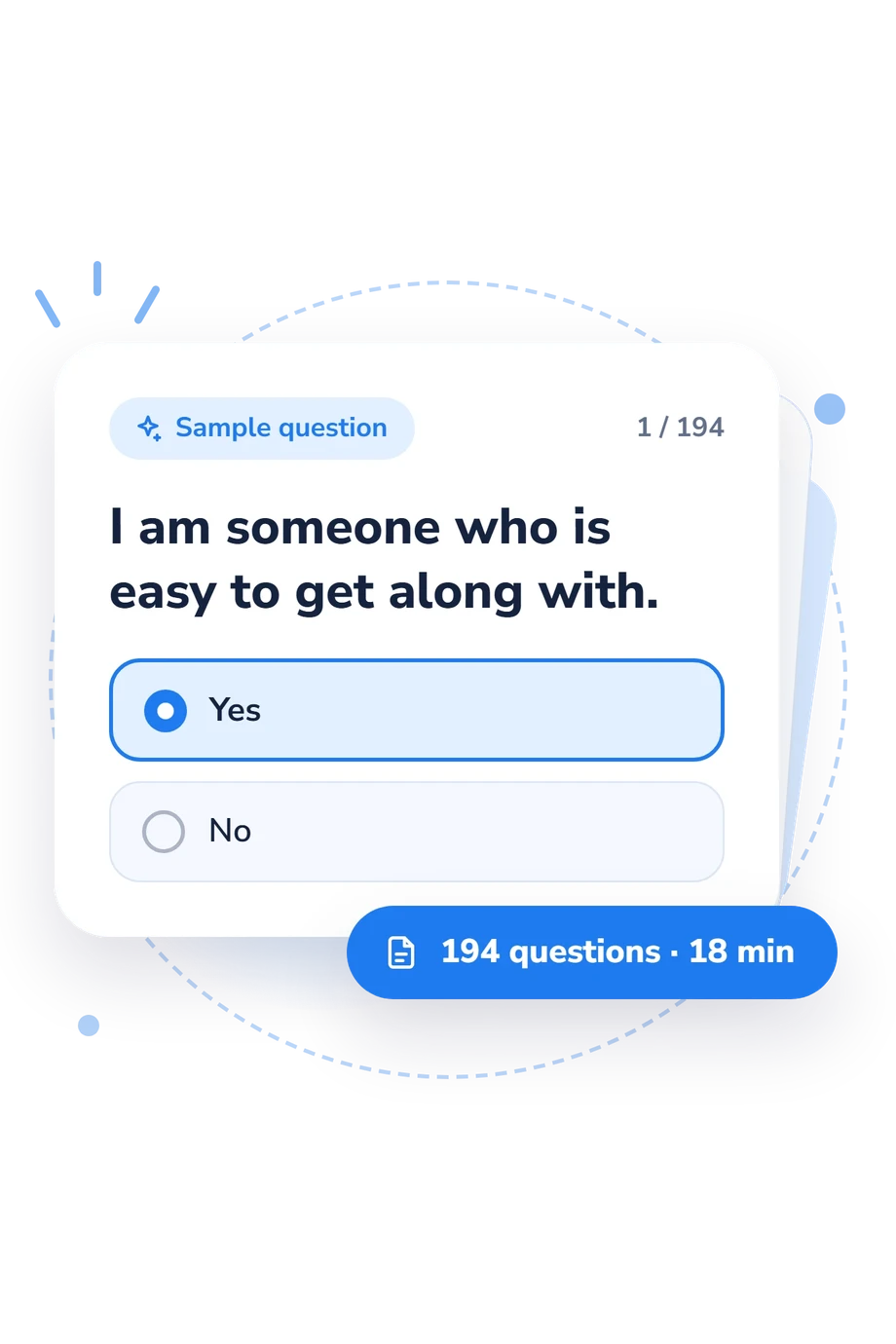
Statements use Yes/No and True/False options. They describe everyday reactions and experiences, so respondents compare each with a pattern rather than an ideal self-image. Coping strategies are considered through self-report.
One displayed Life Style Index score runs from 0-100. Its bands are Low activation 0-33, Moderate activation 34-66, and High activation 67-100; they describe activation rather than a diagnosis or fixed personality label.
A Russian LSI manual by Wasserman and colleagues describes its own instrument and does not validate this online presentation. The questionnaire is conceptually consistent with Plutchik's Life Style Index framework, which links defense mechanisms with emotions and adaptation within psychoanalytic and psychoevolutionary theory. A defense can regulate affect or protect against discomfort, and defenses may overlap rather than operate as isolated traits.
A Greek-version study by Hyphantis and colleagues reported partial alignment with the original defense structure, alongside reliability and construct-validity evidence for that version, not this presentation.
Current mood, self-awareness, memory, and self-presentation can influence answers. Interpret the result as a snapshot of self-reported defensive activation, alongside the situations that prompted it.
- Plutchik, R., Kellerman, H., & Conte, H. R. (1979). A structural theory of ego defenses and emotions. In C. E. Izard (Ed.), Emotions in Personality and Psychopathology (pp. 227-257). New York: Plenum Press. 10.1007/978-1-4613-2892-6_9
- Wasserman, L. I., Eryshev, O. F., Klubova, E. B., Petrova, N. N., Bespalko, I. G., Berebin, M. A., Savelyeva, M. I., Taukenova, L. M., Shtrakhova, A. V., Aristova, T. A., & Osadchiy, I. M. (1998). Psychological diagnostics of the Life Style Index: A manual for physicians and psychologists. Saint Petersburg: V. M. Bekhterev Scientific Research Psychoneurological Institute, 48 pp.
- Hyphantis, T., Goulia, P., Floros, G., Iconomou, G., Pappas, A.-I., Karaivazoglou, K., & Assimakopoulos, K. (2011). Assessing ego defense mechanisms by questionnaire: Psychometric properties and psychopathological correlates of the Greek version of the Plutchik's Life Style Index. Journal of Personality Assessment, 93(6), 605-617. 10.1080/00223891.2011.608759
Updated: