
Adolescent Anxiety Measurement Inventory Test
How the Scales are Structured
Who Usually Takes This Test?
See How You Compare
Below is a preview of how scores are typically distributed across each scale.
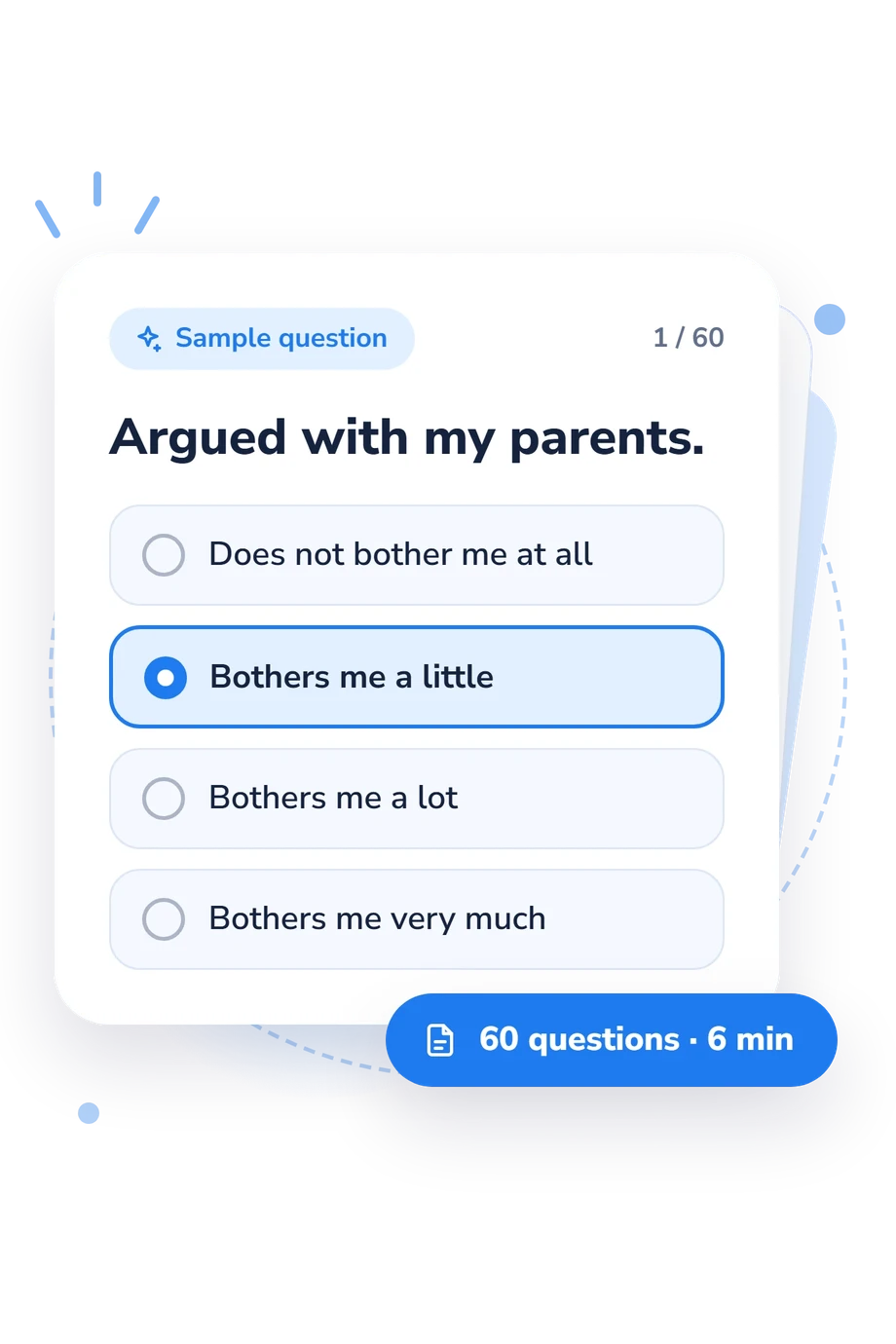
Example Questions From the Test
- Does not bother me at all
- Bothers me a little
- Bothers me a lot
- Bothers me very much
- Does not bother me at all
- Bothers me a little
- Bothers me a lot
- Bothers me very much
- Not at all upsetting
- Somewhat upsetting
- Very upsetting
- Extremely upsetting
Adolescent Anxiety Measurement Inventory Test - Description and methodology of the test
For an adolescent respondent, this adolescent anxiety test can organize concerns that otherwise feel scattered; parents and educators may use the result to support discussion. The Adolescent Anxiety Measurement Inventory Test focuses on how self-doubt, family experiences, peer evaluation, uncertainty, and everyday demands are experienced. Its profile includes a general anxiety result alongside separate domain scores, so it can show patterns without suggesting that one score captures the whole picture.
What This Assessment Explores
As a teen anxiety assessment, this questionnaire examines confidence, achievement, future plans, family, independence, belonging, comparison, and judgment.
The profile covers five dimensions:
- Self-Evaluative Anxiety (0-10) measures confidence in abilities; higher scores may signal low self-esteem. Low 0-3; Moderate 4-6; High 7-10.
- Future-Related Anxiety (0-10) measures future confidence and adaptation; higher scores may signal insecurity. Low concern 0-3; Moderate concern 4-6; High concern 7-10.
- Relations With Parents (0-10) measures family safety and satisfaction; higher scores may signal dissatisfaction. Low anxiety 0-3; Moderate anxiety 4-6; High anxiety 7-10.
- Peer Relationships (0-10) measures sensitivity to peer opinions and group norms; higher scores may signal dependence. Low 0-3; Moderate 4-6; High 7-10.
- General Anxiety (0-10) measures overall anxiety across multiple life domains; scores tending high may indicate greater sensitivity to stressful situations and internal tension. Low 0-3; Moderate 4-6; High 7-10.
Methodology and Evidence Base
Each item presents a situation and asks how much it bothers, worries, or upsets the respondent. Four ordered choices move from no distress to very strong distress, with small wording changes such as not at all or extremely.
The responses are grouped into five dimensions and converted into the displayed result bands. The questionnaire’s displayed ranges are descriptive bands; individual option weights are not specified, and no norm-referenced percentile interpretation is established.
The dimensions are conceptually consistent with Khvan and Zaitsev’s method for measuring adolescent anxiety, which covers personal, family, future, and social sources. Its adaptation status is unspecified. Zaitsev and Khvan’s 2006 book adds prevention and correction context. These sources support the construct, not authorship of this adolescent anxiety questionnaire, an online self-report tool.
Interpretation also depends on current stress, self-awareness, memory, and socially desirable responding. Results are most useful as a starting point for reflection and discussion, rather than a clinical conclusion.
- Khvan, A. A., and Zaitsev, Yu. A. Method for Measuring Anxiety in Adolescence. Psychological Diagnostics, 2008, no. 3, pp. 22-51.
- Zaitsev, Yu. A., and Khvan, A. A. Anxiety in Adolescence and Early Youth: Diagnosis, Prevention, Correction. Kemerovo: Kuzbass Regional Institute of Qualification and Retraining of Educational Workers, 2006, 112 pp.
- Panaitova, D. D., and Kotova, E. V. Features and Anxiety Levels of High School Students: An Empirical Study. Review of Pedagogical Research, 2026, vol. 8, no. 5, pp. 46-50. 10.58224/2687-0428-2026-8-5-46-50
Updated: