
Individual Media Consumption Style Questionnaire Test
How the Scales are Structured
Who Usually Takes This Test?
See How You Compare
Below is a preview of how scores are typically distributed across each scale.
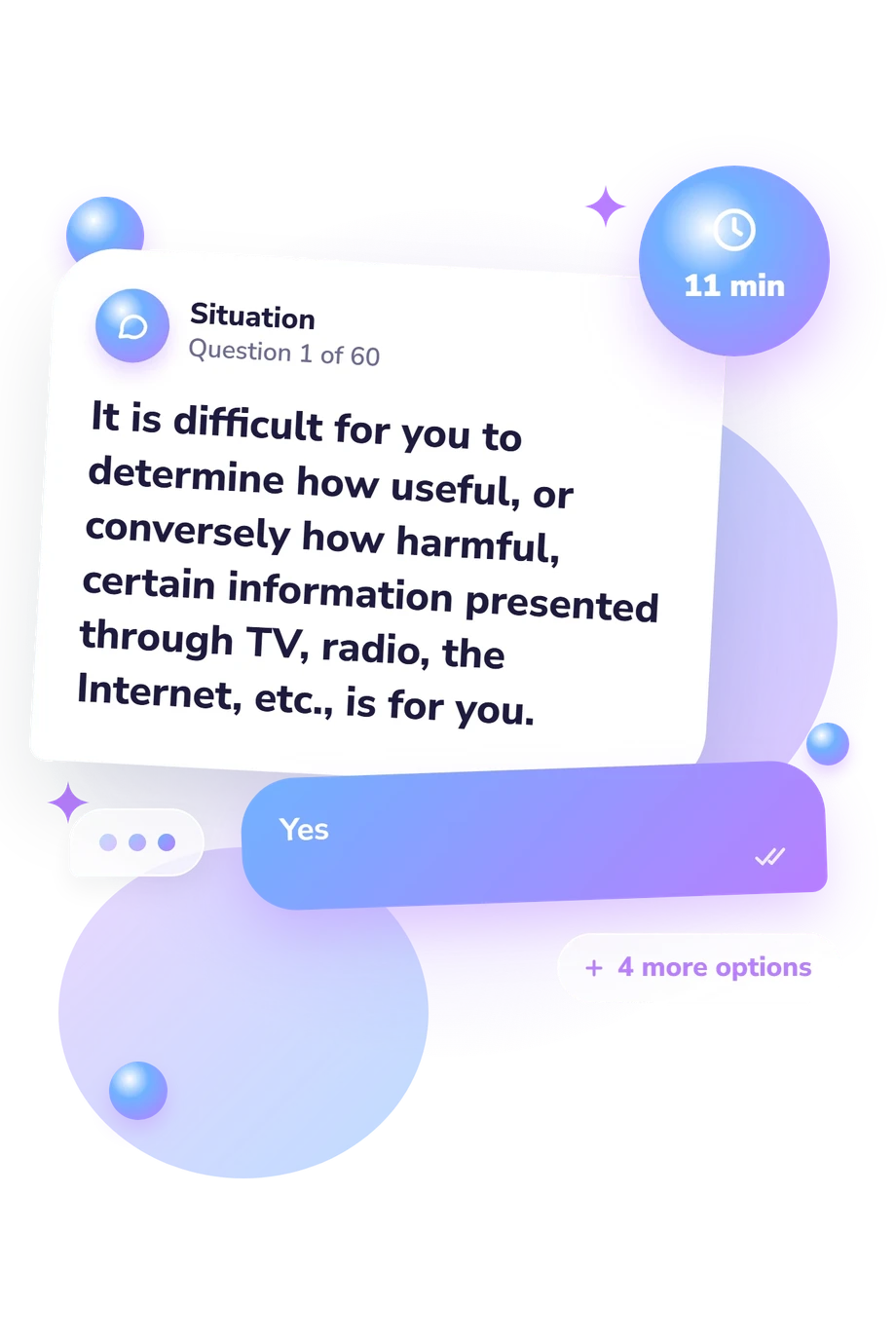
Example Questions From the Test
- Yes
- Probably yes
- Difficult to answer
- Probably no
- No
- Yes
- Probably yes
- I find it difficult to answer
- Probably no
- No
- Yes
- Probably yes
- I find it difficult to answer
- Probably no
- No
Individual Media Consumption Style Questionnaire Test - Description and methodology of the test
For readers who want to understand their everyday media habits, the Individual Media Consumption Style Questionnaire Test offers a structured way to examine which routines support focused decisions and which may pull attention away from priorities. This media consumption questionnaire organizes everyday choices into a usable profile, helping people examine their choices, strengths, and possible pressure points in daily information use.
What This Assessment Explores
The questionnaire examines finding material, noticing flaws, checking sources, limiting distractions, planning use, and emotional effects. Media literacy skills are not one score; information retrieval, critical evaluation, media self-control, and emotional-cognitive engagement appear as related but separate tendencies.
The four displayed dimensions are:
- Information Search Efficiency (-30-30) indicates efficient separation of relevant from secondary information: Low efficiency (-30-0), Adequate efficiency (1-10), High efficiency (11-30).
- Reflective Criticality (-30-30) indicates critical analysis of media messages: Low criticality (-30--10), Moderate criticality (-9-10), High criticality (11-30).
- Volitional Control (Media Consumption) (-30-30) indicates deliberate management of media routines: Low control (-30--10), Situational control (-9-10), High control (11-30).
- Emotional-Cognitive Engagement (ECI) (-30-30) shows emotional and cognitive involvement with media content: Low engagement (-30--10), Moderate engagement (-9-10), or High engagement (11-30), which may reflect excessive engagement and a tendency to overestimate the significance of media events.
Methodology and Scientific Basis
Each statement uses five response options, moving from Yes or Probably yes through an uncertain middle option to Probably no or No. The statements cover media habits, choices, reactions, and self-management.
Displayed scores sit within the stated range, and bands identify stronger or weaker tendencies; they do not show how many points any answer contributes. This media use assessment presents a profile best read across dimensions rather than as a verdict.
The work by Dolgov et al. (2009) offers broader context for individual media-consumption styles; it does not establish that this questionnaire adapts that publication. Kopovoy (2015) discusses media-consumption diagnostics, while Erofeeva, Shanin, and Kopovaya (2020) examine media-consumption culture in education. These works provide context, not evidence that the online questionnaire derives from them. Published norms or standardized scoring are not stated for this online questionnaire, so read its profile as structured self-reported tendencies rather than a norm-based measure.
Self-report results can shift with mood, routines, social desirability, and self-awareness. Scores do not establish a clinical condition; compare them with behavior and further assessment to identify habits worth examining.
- Dolgov, Yu. N., Kopovoy, A. S., Malyuchenko, G. N., & Smirnov, V. M. (2009). Development of Media Consumption Culture: Socio-Psychological Approach. Saratov University Press. ISBN 978-5-292-03967-9.
- Kopovoy, A. S. (2015). Diagnostic Relevance of Media Consumption. Penza Psychological Herald, 2015(2), 55-62. 10.17689/psy-2015.2.4.
- Erofeeva, M. A., Shanin, S. V., & Kopovaya, O. V. (2020). Culture of Media Consumption among Learners: Ways of Formation in the Educational Space. Perspectives of Science & Education, 45(3), 23-38. 10.32744/pse.2020.3.2.
Updated: