
Locus of Control Scale Test
How the Scales are Structured
Who Usually Takes This Test?
See How You Compare
Below is a preview of how scores are typically distributed across each scale.
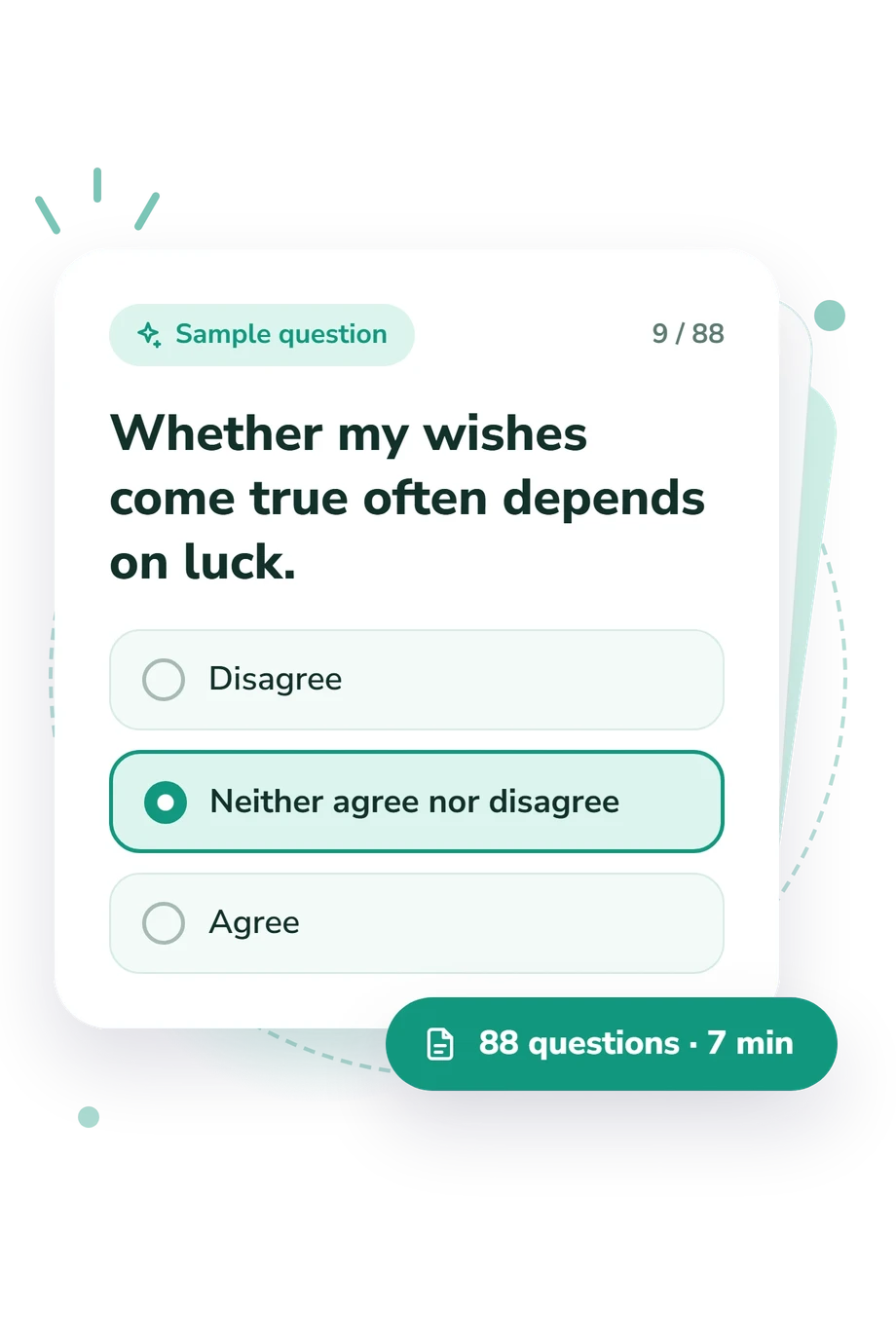
Example Questions From the Test
- Disagree
- Neither agree nor disagree
- Agree
- Disagree
- Neither agree nor disagree
- Agree
- Disagree
- Neither agree nor disagree
- Agree
Locus of Control Scale Test - Description and methodology of the test
People who want to understand how they explain success, setbacks, and influence may find the locus of control test useful. It is intended for self-reflection about whether responsibility is assigned to personal effort, other people, luck, or circumstances. As a locus of control assessment, it combines an overall orientation with domain scores, so the domain pattern adds context to the overall result.
What This Assessment Explores
Outcomes are attributed to personal efforts or outside forces. Health, achievement, failure, and relationships receive domain scores, creating a profile for the locus of control questionnaire.
Five scales use More external (-12--1), Balanced (0-0), and More internal (1-12); Failures uses External attribution (-12--1), Balanced attribution (0-0), and Internal attribution (1-12); overall uses Externality (-44--1), Balanced (0-0), and Internality (1-44).
The profile dimensions are:
- Business Relationships (-12-12) attributes business-relationship outcomes to personal or external causes.
- Health (-12-12) attributes health to personal effort or external factors.
- Personal Relationships (-12-12) attributes events to own actions or external circumstances.
- Family Relationships (-12-12) attributes events to personal responsibility or external circumstances.
- Failures (-12-12) attributes failures to internal causes or external circumstances.
- Achievement Domain (-12-12) attributes success to personal effort or external circumstances.
- Internality-Externality (-44-44) summarizes life-event attribution to own actions or external circumstances.
Methodology and Scientific Basis
Short self-report statements make up this loc test, covering responsibility, luck, effort, relationships, health, and setbacks. Items use Disagree, Neither agree nor disagree, or Agree; some use Somewhere in between as the middle response. The displayed results combine answers into domain and overall scores.
The displayed scoring logic treats positive values as greater internality, negative values as greater externality, and zero as balanced. These results describe the direction of attribution represented by this questionnaire.
The questionnaire is an English online adaptation of the Bazhin-Golynkina-Etkind instrument; Rotter's theory of generalized control expectancies supplies the broader internal-external framework.
Lange and Tiggemann's study concerns the dimensionality and reliability of Rotter's I-E scale; it does not establish reliability or dimensionality for this online questionnaire.
Because responses are self-reported and the displayed bands are interpretive labels rather than population norms or clinical cutoffs, scores can be influenced by current circumstances, self-awareness, and impression management; they are best used as a structured reflection on the situations covered by the items.
- Bazhin, E. F., Golynkina, E. A., & Etkind, A. M. (1993). Questionnaire of the Level of Subjective Control. Moscow: Smysl. 16 pp. [In Russian].
- Bazhin, E. F., Golynkina, E. A., & Etkind, A. M. (1984). The method of studying the level of subjective control. Psikhologicheskii Zhurnal, 5(3), 152-162. [In Russian].
- Rotter, J. B. (1966). Generalized expectancies for internal versus external control of reinforcement. Psychological Monographs: General and Applied, 80(1), 1-28. 10.1037/h0092976
- Lange, R. V., & Tiggemann, M. (1981). Dimensionality and reliability of the Rotter I-E locus of control scale. Journal of Personality Assessment, 45(4), 398-406. 10.1207/s15327752jpa4504_9
Updated: