
Working Alliance Inventory–Short Form (WAI-S) Test
How the Scales are Structured
Who Usually Takes This Test?
See How You Compare
Below is a preview of how scores are typically distributed across each scale.
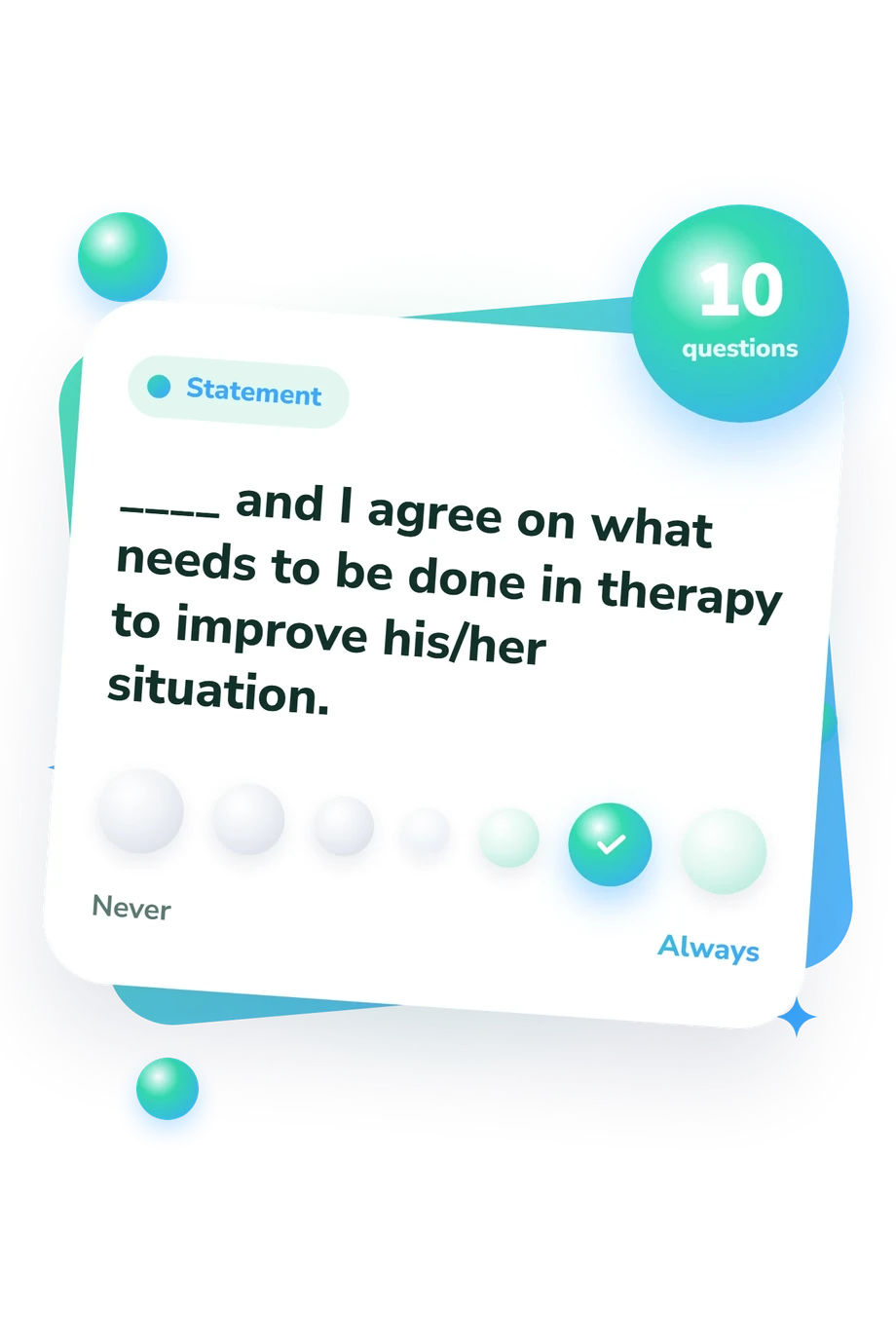
Example Questions From the Test
- Never
- Very rarely
- Rarely
- Sometimes
- Often
- Very often
- Always
- Never
- Very rarely
- Rarely
- Sometimes
- Often
- Very often
- Always
- Never
- Very rarely
- Rarely
- Sometimes
- Often
- Very often
- Always
Working Alliance Inventory–Short Form (WAI-S) Test - Description and methodology of the test
Clients and therapists seeking a clearer view of their work can use this questionnaire to reflect on cooperation, direction, and trust. The Working Alliance Inventory-Short Form (WAI-S) Test is intended for those considering an ongoing therapeutic relationship. It reflects the respondent’s experience at completion and should be interpreted within the broader relationship. As a working alliance assessment, it clarifies perceptions of shared goals, therapy tasks, mutual understanding, and bond.
What This Assessment Explores
The questionnaire functions as a therapeutic alliance measure by focusing on whether the client and therapist understand one another, agree on what to work on, and feel confident in their shared approach. The items also address trust, appreciation, liking, and the sense that therapy is moving toward useful change.
The displayed result uses one Therapeutic Alliance scale, ranging from 10-70. The visitor sees these bands:
- Low alliance (10-34) suggests that trust, shared direction, or mutual understanding may be difficult to establish.
- Moderate alliance (35-54) is an intermediate reported level of alliance.
- High alliance (55-70) reflects strong reported agreement, understanding, and emotional connection in the therapeutic work.
The bands describe the reported level of alliance at the time of responding; they do not explain why the relationship feels that way.
Methodology and Evidence Base
The WAI-S questionnaire in this assessment is a ten-item online form using relational statements about shared goals, therapy tasks, confidence, trust, and personal understanding. Its response scale runs from Never to Always through seven ordered options, showing how consistently each statement fits the therapeutic relationship.
This ten-item questionnaire is conceptually consistent with the WAI/WAI-S model of goals, tasks, and bond, but it is not identical to the published WAI-S, which contains twelve items.
This online version has no stated standardization, norms, or documented scoring algorithm. Read the result using the displayed catalogue bands rather than as a validated norm-referenced score.
Tracey and Kokotovic (1989) describe the published short form; Horvath and Greenberg (1989) provide broader WAI validation context, and Bordin (1979) supplies the goals-tasks-bond theory. These sources support the construct and theory, not validation of this specific online form.
Use the result as a focused snapshot alongside the broader course of therapy; self-report can be shaped by current mood, expectations, openness, and whether the respondent answers as a client or therapist.
- Tracey, Terence J., & Kokotovic, Anna M. (1989). Factor structure of the Working Alliance Inventory. Psychological Assessment: A Journal of Consulting and Clinical Psychology, 1(3), 207–210. 10.1037/1040-3590.1.3.207
- Horvath, Adam O., & Greenberg, Leslie S. (1989). Development and validation of the Working Alliance Inventory. Journal of Counseling Psychology, 36(2), 223–233. 10.1037/0022-0167.36.2.223
- Bordin, Edward S. (1979). The generalizability of the psychoanalytic concept of the working alliance. Psychotherapy: Theory, Research & Practice, 16(3), 252–260. 10.1037/h0085885
Updated: