
Freudly+971 508685814hello@freudly.ai
Freudly
structure of personality

Zuckerman-Kuhlman Personality Questionnaire (ZKPQ-50-CC) Test
Take the online Zuckerman-Kuhlman Personality Questionnaire (ZKPQ-50-CC) Test - AI psychologist FreudlyYou can take Zuckerman-Kuhlman Personality Questionnaire (ZKPQ-50-CC) Testhere. Online version of a simple and accurate psychological test with interpretation.en
Understand key personality traits in about 10 minutes, including stress response, sociability, and thrill seeking. Get a clear, research-based profile fast, with norms that make results easy to interpret.
Start Online Test
Questions: 5010 minutes
08:30
September 1, 2026
September 1, 2026
Material has been updated
October 2, 2025
Material has been published
32,622 views
2,775 completions
2,385 likes
Verified by Daniel Hall
Psychologist with 25 years of experience
Share
Scale Explorer

How the Scales are Structured

example score
5/10
Activity (A)
Measures a person’s typical energy level and persistence, including discomfort with inactivity.
Low
Moderate
High
01.6: Low | 1.66.7: Moderate | 6.710: High
A score of 5 falls in the Moderate range, suggesting a balanced level of energy and persistence with some drive to stay busy but not a constant need for activity.
example score
7/10
Sociability (S)
Assesses the degree to which a person seeks social interaction, group involvement, and prefers being with others versus solitude.
Low
Moderate
High
03: Low | 48: Moderate | 910: High
A score of 7 indicates a moderately high preference for social contact and group activities, with comfort engaging with others without requiring constant social stimulation.
example score
5/10
Aggression-Hostility (AH)
Assesses tendency toward anger, hostility, low impulse control, and disregard for social desirability that can show up as rudeness or impatience.
Low
Moderate
High
02.9: Low | 38: Moderate | 8.110: High
A score of 5 falls in the Moderate range, suggesting a situational tendency toward irritability or impatience rather than a consistently hostile style.
example score
4/10
Neuroticism-Anxiety (N-Anx) (NAA)
Assesses the tendency toward anxiety and fearfulness, emotional reactivity, self-doubt, and sensitivity to criticism with a tendency to suppress aggression.
Low
Moderate
High
01.6: Low | 1.77.4: Moderate | 7.510: High
A score of 4 falls in the Moderate range, suggesting a typical level of anxiety-related concern and emotional sensitivity that may show up in stressful or evaluative situations without being strongly pronounced.
example score
7/10
Impulsive Sensation Seeking (ImpSS) (ISS)
Assesses impulsive sensation seeking, including preference for novelty and excitement, spontaneous action, and low preference for planning and predictability.
Low
Moderate
High
03.4: Low | 3.58.5: Moderate | 8.610: High
A score of 7 falls in the Moderate range, suggesting a noticeable tendency toward spontaneity and seeking novel, exciting experiences while not being at the highest level of risk-taking orientation.
Start Online Test
just completed the test
DATA-BASED USER COHORTS

Who Usually Takes This Test?

Curious self-explorers
41%OF USERS
People who want a quick, clear snapshot of their anxiety, sociability, activity level, aggression tendencies, and appetite for novelty.
Counseling and coaching clients
34%OF USERS
Individuals working with a psychologist or coach who need a fast personality profile to discuss stress reactions, social behavior, and risk-taking.
Researchers and students
25%OF USERS
Psychology students and researchers who use a short, standardized questionnaire to measure the alternative five traits in studies or class projects.
BASED ON AGGREGATED, ANONYMIZED DATA FROM TENS OF THOUSANDS OF FREUDLY USERS.
Benchmarking

See How You Compare

Once you complete the test, your results are compared with real-world data from people in your country.
Below is a preview of how scores are typically distributed across each scale.
Activity (Activity, Act) (A(A)
Average
3.7
Normal range
2.44.9
min.
0
max.
10
This curve shows how scores are typically distributed.
Once you complete the test, your result will appear on the scale so you can see how you compare.
Sociability (Sociability, Sy) (S(S)
Average
7.2
Normal range
5.58.9
min.
0
max.
10
This curve shows how scores are typically distributed.
Once you complete the test, your result will appear on the scale so you can see how you compare.
Aggression-Hostility (Agg-Host) (A()
Average
5.4
Normal range
3.87.1
min.
0
max.
10
This curve shows how scores are typically distributed.
Once you complete the test, your result will appear on the scale so you can see how you compare.
Neuroticism-Anxiety (N-Anx) (N()
Average
5.1
Normal range
3.66.5
min.
0
max.
10
This curve shows how scores are typically distributed.
Once you complete the test, your result will appear on the scale so you can see how you compare.
The Need for Sensation Seeking (Impulsive Sensation Seeking, ImpSS) (TNfSS(SSI)
Average
3.7
Normal range
1.85.6
min.
0
max.
10
This curve shows how scores are typically distributed.
Once you complete the test, your result will appear on the scale so you can see how you compare.
Featured On
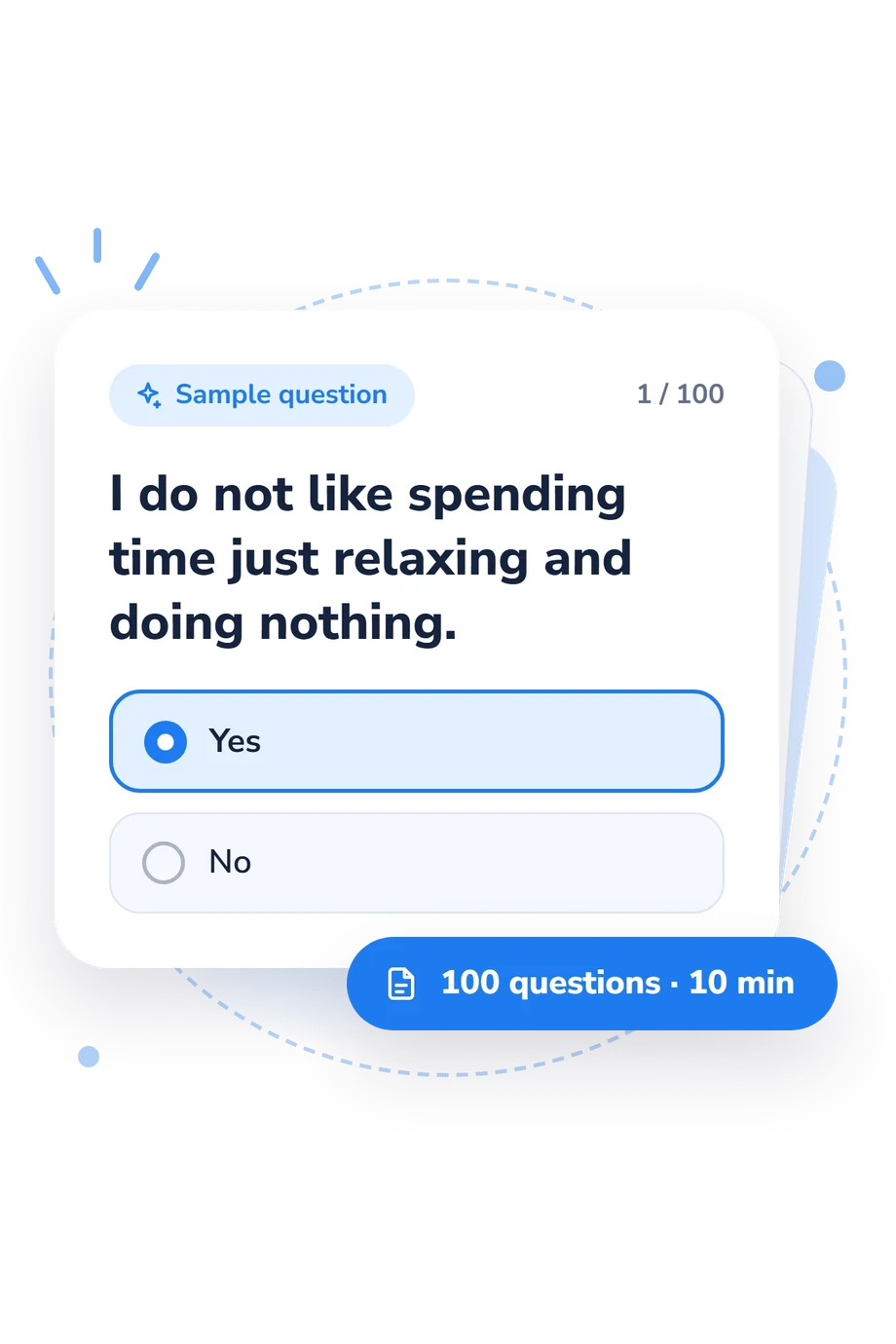
SAMPLE QUESTIONS

Example Questions From the Test

    • Yes
    • No
    • Yes
    • No
    • Yes
    • No
WHAT THE TEST MEASURES
About This Assessment
Zuckerman-Kuhlman Personality Questionnaire, ZKPQ-50-CC Test

Zuckerman-Kuhlman Personality Questionnaire (ZKPQ-50-CC) Test - Symptoms and Signs

structure of personality

This self-report inventory provides a brief assessment of personality traits associated with the alternative five-factor model. The Zuckerman-Kuhlman Personality Questionnaire (ZKPQ-50-CC) is administered as a series of statements endorsed in a yes/no format to yield trait-level scores. It contains 50 items and typically requires about 10 minutes to complete.

The scales are intended to characterize individual differences in domains such as negative emotionality, aggression-hostility, activity, sociability, and sensation seeking, which may be clinically relevant when considering stress response patterns and risk-taking tendencies. The Zuckerman-Kuhlman Personality Questionnaire (ZKPQ-50-CC) may be used in research and applied settings as an adjunct to other assessment data; interpretation should consider the broader clinical context and appropriate norms when available.

Literature: Kuhlman, D. M., Zuckerman, M., Joireman, J., Teta, P., & Kraft, M. A cross-cultural shortened form of the Zuckerman-Kuhlman Personality Questionnaire. Journal of Personality Assessment. 1999.; Zuckerman, M., Kuhlman, D. M., Joireman, J., Teta, P., & Kraft, M. A comparison of three structural models for personality: The Big Three, the Big Five, and the Alternative Five. Journal of Personality and Social Psychology. 1993.; Zuckerman, M. Zuckerman-Kuhlman personality questionnaire (ZKPQ): An alternative five-factorial model. In de Raad, B., & Perugini, M. (Eds.), Big five assessment. Hogrefe & Huber. 2002.
Popular tests
Comments
Leave a Comment