
Brief Stress Tolerance Scale Test
How the Scales are Structured
Who Usually Takes This Test?
See How You Compare
Below is a preview of how scores are typically distributed across each scale.
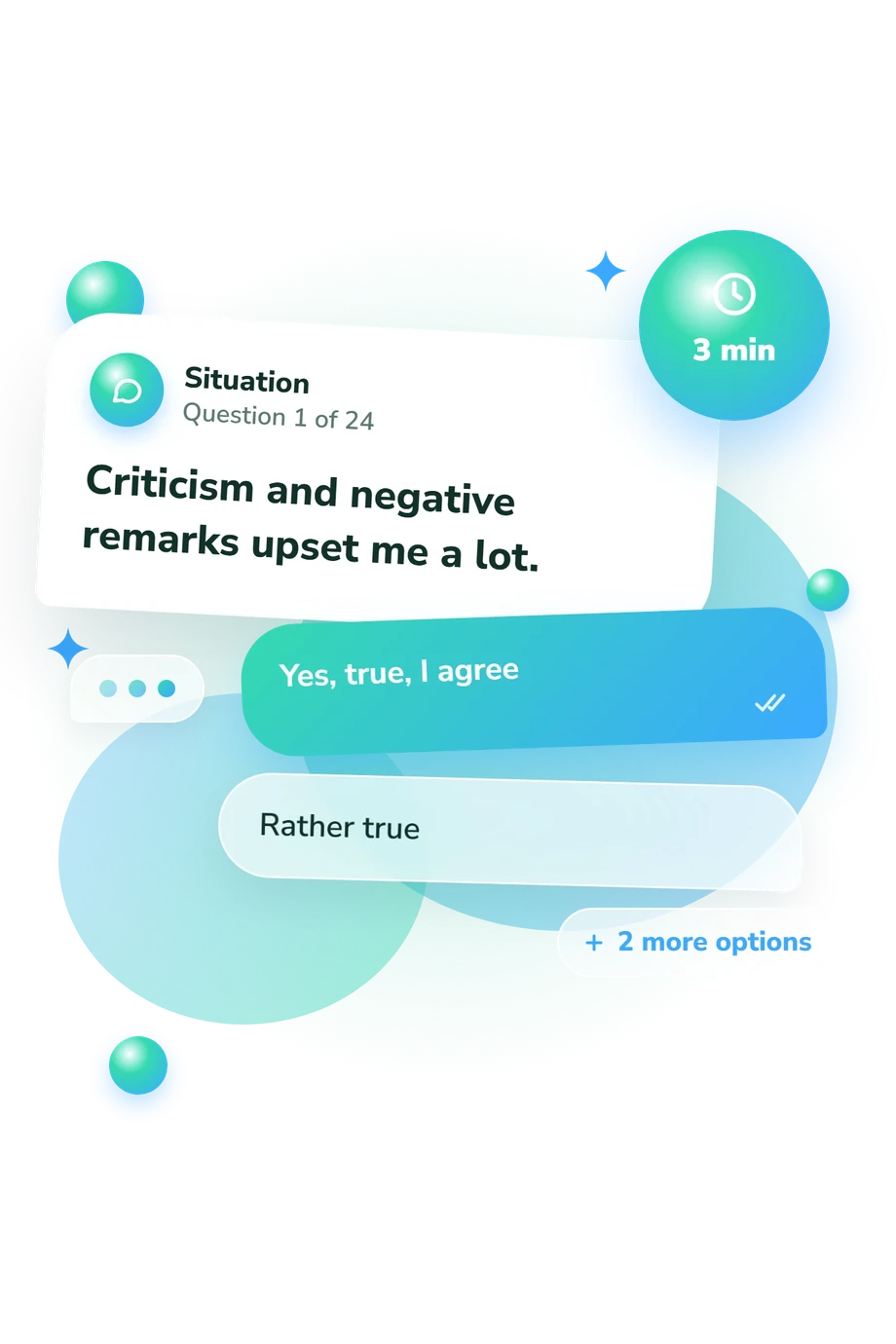
Example Questions From the Test
- Yes, true, I agree
- Probably true
- Probably not true
- No, not true, I disagree
- Yes, true, I agree
- Rather true
- Rather untrue
- No, untrue, I disagree
- Yes, true; I agree
- Probably true
- Probably untrue
- No, untrue; I disagree
Brief Stress Tolerance Scale Test - Description and methodology of the test
People considering their reactions to pressure, uncertainty, or setbacks may use the Brief Stress Tolerance Scale Test as a structured self-reflection exercise. It offers a stress tolerance assessment focused on how easily everyday demands disturb concentration, confidence, emotional balance, and persistence. The result gives a concise profile of perceived resilience, helping readers notice patterns that may be worth examining in daily life.
What This Assessment Explores
These questions explore situations in which demands or internal reactions can make functioning harder. They touch on criticism, comparison, uncertainty, deadlines, fatigue, distraction, monotony, loneliness, fear, restrictions, surprises, and recurring problems. Together, the themes reflect perceived psychological equilibrium under pressure rather than a single symptom.
For the reader, the result can be understood through these connected areas:
- Emotional sensitivity shows how criticism, fear, loneliness, or comparison may unsettle the respondent.
- Work-related strain indicates whether deadlines, mental effort, monotony, or noise interfere with concentration.
- The stress tolerance questionnaire summarizes the result on the Stress Tolerance scale, ranging from 0-9: Low resilience (0-3), Moderate resilience (4-6), or High resilience (7-9). It describes coping with difficult life situations, maintaining equilibrium, using personal resources, and adapting to challenge.
Methodology and Scientific Basis
Each item uses four ordered choices, moving from agreement or truthfulness to disagreement. This captures degree rather than a simple yes-or-no response, while the statements ask about typical reactions. The answers report how the respondent reacts while coping with stress; they do not label the person or define a separate category.
Scoring provides one overall Stress Tolerance result with the displayed bands defined above; it has no separate subscale scores. The questionnaire does not specify item weights or normative reference values and has no reported reliability estimate or clinical cutoff. The result is best read as a broad pattern rather than a norm-referenced profile.
Conceptually, the content is consistent with OPUS (Raspopin, 2009), which addresses psychological resistance to stress, and with Koteneva and Chelyshev (2020), who studied resistance to stress factors. This overlap does not show that the questionnaire was adapted from or validated against either source. Lazarus and Folkman’s (1984) appraisal-and-coping framework helps explain how perceived demands and coping resources shape responses.
Current stress, self-awareness, and response bias can shift results, especially after a difficult event, so the score is a contextual snapshot rather than a fixed personal capacity; broader assessment can add context when concerns persist.
- Raspopin E. V. Questionnaire of Psychological Resistance to Stress (OPUS). Psychological Diagnostics. 2009;(3):104-122.
- Koteneva A. V., Chelyshev P. V. Psychological Resistance of Mining Students to Stress Factors. Eurasian Mining. 2020;(1):84-88. 10.17580/em.2020.01.17.
- Lazarus R. S., Folkman S. Stress, Appraisal, and Coping. New York: Springer Publishing Company; 1984.
Updated: