
Mindset Type Questionnaire Test
How the Scales are Structured
Who Usually Takes This Test?
See How You Compare
Below is a preview of how scores are typically distributed across each scale.
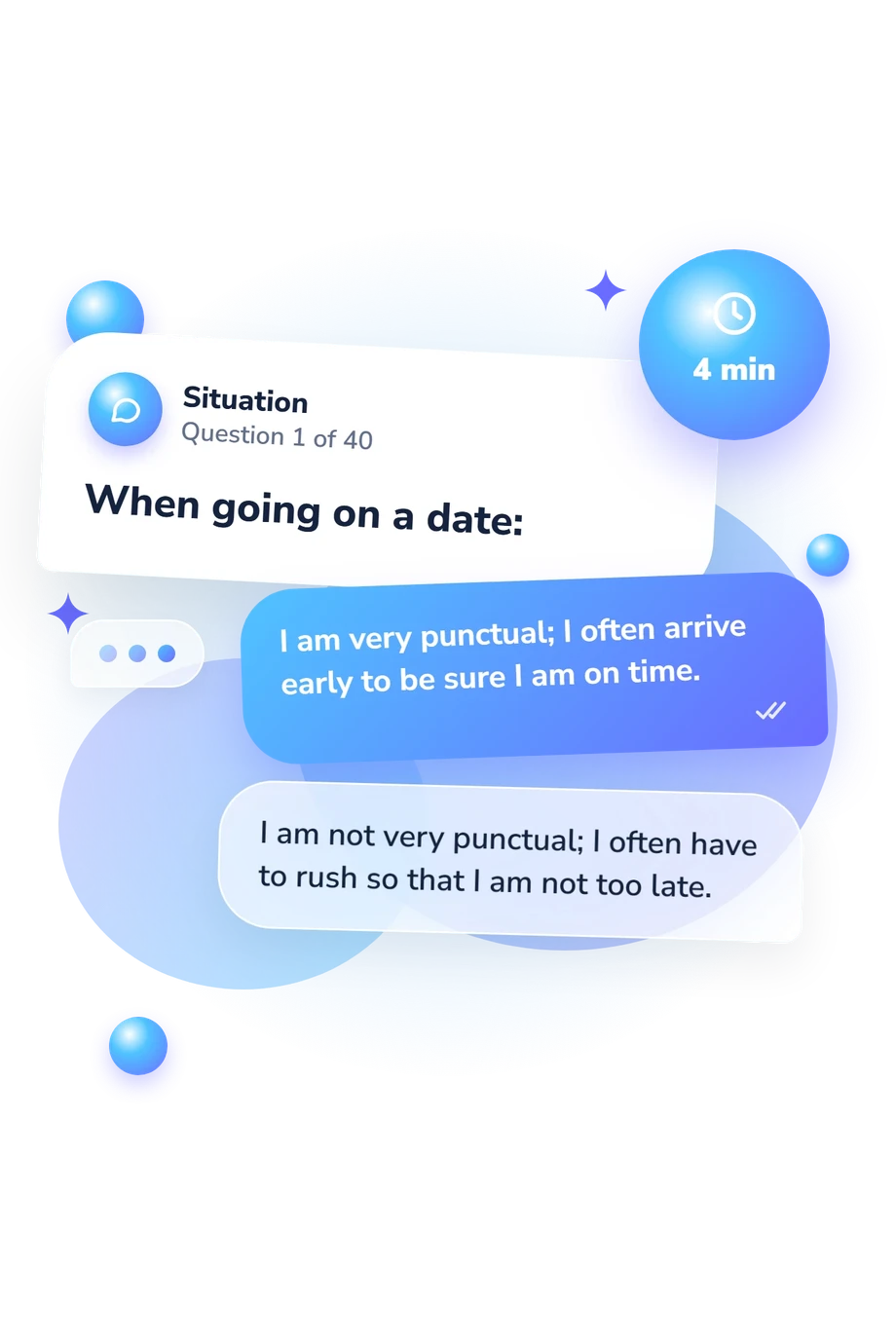
Example Questions From the Test
- I tend to follow my habits and have an established opinion.
- I often change my mind and my plans.
- a. I tend to judge people more by their feelings and intentions.
- b. What truly matters to me are actions and their outcomes.
- I often need to see my friends.
- I can go a very long time without seeing my friends.
Mindset Type Questionnaire Test - Description and methodology of the test
People who want to examine how they organize information, make decisions, and respond to other people may find this format useful. The Mindset Type Questionnaire Test offers a compact profile of preferences for everyday thinking. As a mindset questionnaire, it focuses on tendencies rather than fixed abilities, helping readers compare the result with recent experiences and self-observations.
What This Assessment Explores
What the questions measure emerges from ordinary situations: punctuality, focus, detail, perfectionism, flexibility, sensitivity, relationships, and decisions. These contrasts examine whether a person tends toward emotional or rational processing and toward more structured, analytical, intuitive, or holistic habits. A thinking style questionnaire describes preferences, not intelligence, worth, or permanent ability. It is therefore most useful for self-reflection by readers who want language for recurring ways of approaching daily situations.
The two reported dimensions are:
- Limbic Function-Cortical Activity (-5-5) indicates whether emotional, empathic, interpersonal processing or rational, logical, abstract processing is more prominent; values closer to zero suggest balance, with Limbic-leaning (-5--1), Balanced (0-0), and Cortical-leaning (1-5) bands.
- Left-Brain vs. Right-Brain (-5-5) indicates whether analytical, logical, structured processing or intuitive, imagery-based, holistic processing is more prominent; values closer to zero suggest balance, with Left-leaning (-5--1), Balanced (0-0), and Right-leaning (1-5) bands.
Methodology and Evidence Base
Each item presents two short self-descriptions, and the respondent chooses the one that feels more accurate. The contrasts cover habits, attention, decisions, emotions, relationships, and values. As a cognitive style test, the format is accessible but cannot capture every context or mixed response.
Responses produce two signed results: direction shows the more prominent style, while a value near the centre indicates balance. Because the exact point value for each answer is not stated, read the profile across dimensions, not as a tally of correct answers.
Conceptually, the questionnaire is consistent with the Herrmann Brain Dominance Instrument (HBDI) and Robert J. Sternberg’s account of thinking styles as preferred ways of using abilities. Nielsen and colleagues found no simple brain-wide left/right split, while Corballis separates metaphor from literal neuroscience. The labels should therefore be interpreted cautiously, not as claims about brain anatomy.
The questionnaire has no standardized norms or clinical cutoffs. Self-report can vary with mood, context, and self-awareness, so the result is a reflection prompt, not a complete personality account.
- Herrmann, Ned. The Whole Brain Business Book: Unlocking the Power of Whole Brain Thinking in Organizations, Teams, and Individuals. McGraw-Hill, 1996.
- Nielsen, Jared A., Brandon A. Zielinski, Michael A. Ferguson, Janet E. Lainhart, and Jeffrey S. Anderson. “An Evaluation of the Left-Brain vs. Right-Brain Hypothesis with Resting State Functional Connectivity Magnetic Resonance Imaging.” PLOS ONE, vol. 8, no. 8, 2013, e71275. 10.1371/journal.pone.0071275.
- Corballis, Michael C. “Left Brain, Right Brain: Facts and Fantasies.” PLOS Biology, vol. 12, no. 1, 2014, e1001767. 10.1371/journal.pbio.1001767.
- Sternberg, Robert J. Thinking Styles. Cambridge University Press, 1997. 10.1017/CBO9780511584152
Updated: