
Manager and Individual Assessment Test
How the Scales are Structured
Who Usually Takes This Test?
See How You Compare
Below is a preview of how scores are typically distributed across each scale.
Example Questions From the Test
- True
- False
- True
- False
- True
- False
Manager and Individual Assessment Test - Description and methodology of the test
For managers who want to examine how they conduct employee conversations, the Manager and Individual Assessment Test offers a focused review of listening, feedback, observation, and performance-support practices. It suits supervisors who want to review their individual assessment skills before taking on broader people responsibilities. The result can clarify where managerial judgment is strong and where everyday review habits may benefit from deliberate improvement.
What This Assessment Measures
Questions examine how a manager listens to a subordinate, conducts a conversation, notices emotional cues, and turns discussion into follow-up. They also test whether the respondent values trust, recognizes individual differences, and distinguishes support from control.
The themes make employee performance assessment a managerial responsibility. They include listening, trust and openness, criticism, role fit, follow-up, and employee participation.
The result has two catalogue scales:
- Number of Correct Answers, 0-80, indicates how many items were answered correctly and reflects knowledge of effective individual assessment methods and key principles for working with subordinates. Bands: Low 0-26, Moderate 27-53, High 54-80.
- Standard Evaluation, 5-95, indicates competence in conducting individual assessment; higher scores indicate greater effectiveness and support comparison with other managers. Bands: Developing 5-25, Proficient 26-74, Advanced 75-95.
Together, the outputs separate knowledge from the broader evaluation of assessment competence.
Methodology and Evidence Base
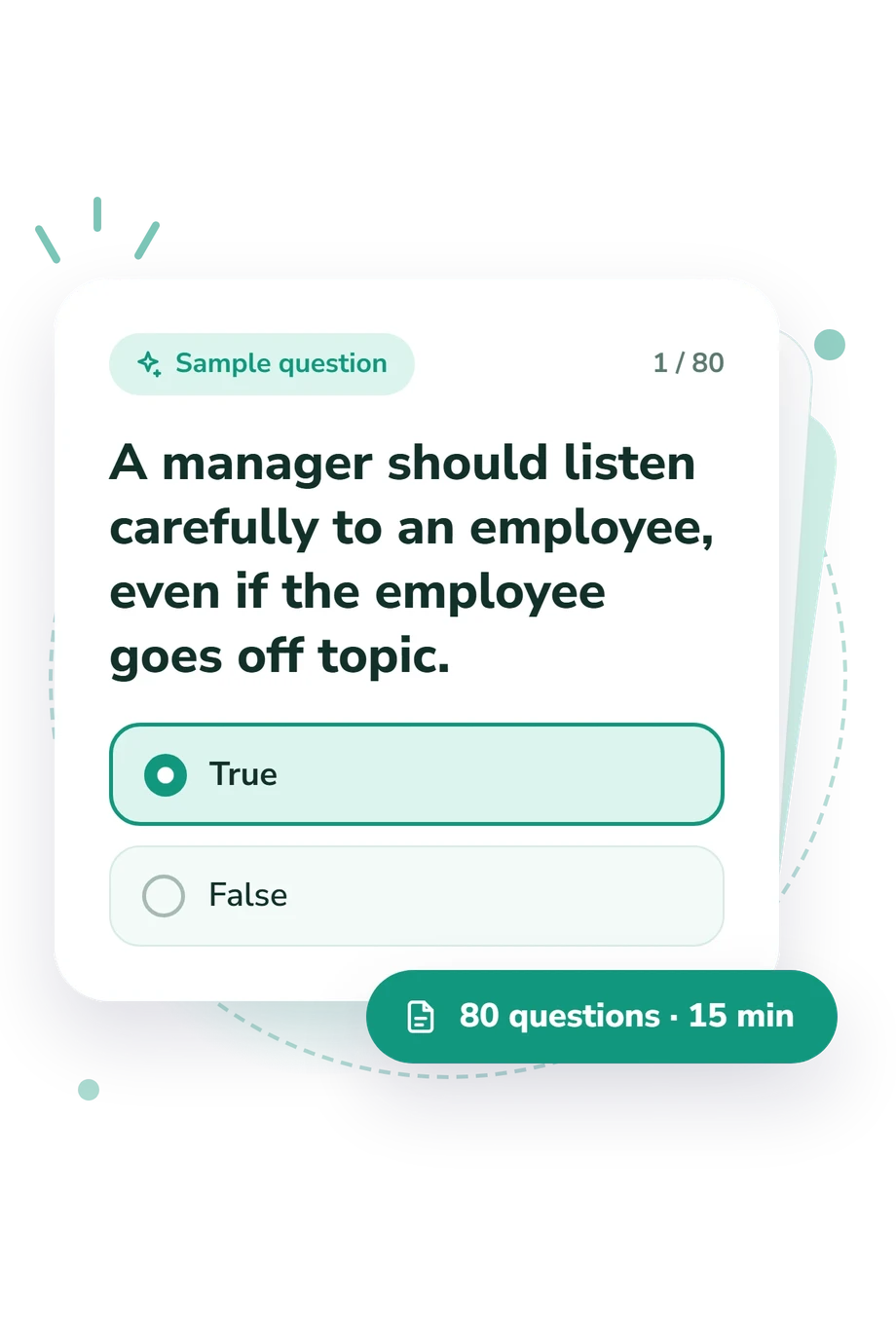
The questionnaire presents workplace statements with True or False choices. Its questions address listening, openness, observation, seating, criticism, role fit, help, follow-up, and responsibility for improving performance. This format asks respondents to judge principles rather than describe one personal incident.
Scoring reports the correct-answer count, while the calculation of the separate evaluation score and any norming procedure are not stated. The displayed bands are result labels; they show how the questionnaire presents performance, while their relationship to broader norms is not stated.
The framework is conceptually consistent with Hall (1975), which treats individual assessment as part of managerial work, and with Schein (1969), whose process-consultation approach emphasizes listening, inquiry, and helping rather than imposing solutions. Ilgen, Fisher, and Taylor (1979) add relevant evidence on how individual feedback can influence organizational behavior; that study does not establish this questionnaire’s scoring or validation.
Because respondents judge workplace statements, social desirability may shape answers, while limited self-awareness can affect how they interpret the principles. Observed behavior and feedback from others can provide useful context for reading the result.
- Hall, D. T. (1975). Experiences in Management and Organizational Behavior. Chicago: St. Clair Press.
- Schein, E. H. (1969). Process Consultation: Its Role in Organization Development. Reading, MA: Addison-Wesley Publishing Company.
- Ilgen, D. R., Fisher, C. D., & Taylor, M. S. (1979). Consequences of individual feedback on behavior in organizations. Journal of Applied Psychology, 64(4), 349-371. 10.1037/0021-9010.64.4.349
Updated: