
Freudly+971 508685814hello@freudly.ai
Freudly
egoism

Social Orientation Assessment Test
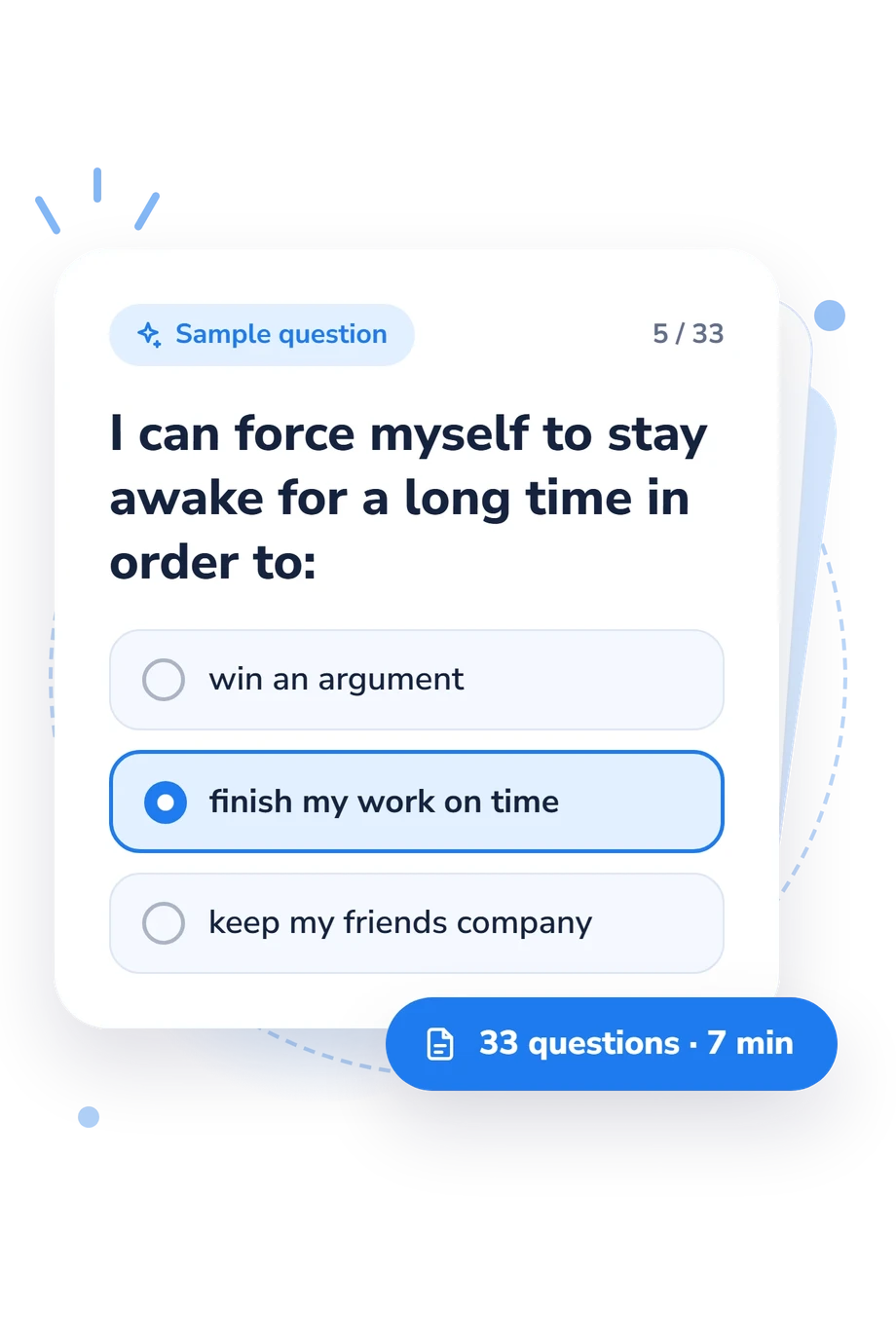
Take the online Social Orientation Assessment Test - AI psychologist FreudlyYou can take Social Orientation Assessment Testhere. Online version of a simple and accurate psychological test with interpretation.en
Understand where you focus your energy on self, tasks, or people in about 7 minutes. Get clear, practical insights to support hiring, coaching, and better teamwork.
Start Online Test
Questions: 337 minutes
08:30
October 2, 2025
October 2, 2025
Material has been updated
October 2, 2025
Material has been published
26,877 views
2,331 completion
1,883 likes
Verified by Daniel Hall
Psychologist with 25 years of experience
Share
Scale Explorer

How the Scales are Structured

example score
63/100
Business-Oriented (BO)
Measures how strongly a person applies a business-oriented approach to personal interests by organizing personal matters and pursuing efficient ways to reach personal goals.
Low
Moderate
High
039: Low | 4069: Moderate | 70100: High
A score of 63 indicates a moderate tendency to organize personal matters and look for efficient strategies to achieve personal goals.
example score
60/100
Interaction (I)
Measures how strongly a person prioritizes harmonious, cooperative, and supportive relationships in their focus and behavior.
Low interaction focus
Moderate interaction focus
High interaction focus
039: Low interaction focus | 4069: Moderate interaction focus | 70100: High interaction focus
A score of 60 suggests a moderate interaction focus, indicating a balanced tendency to value cooperation and supportive relationships without making them the sole priority.
example score
40/100
Task-Oriented (TO)
Measures the extent to which a person emphasizes efficient, organized collaboration and task-focused interaction with others.
Low
Moderate
High
033: Low | 3466: Moderate | 67100: High
A score of 40 indicates a moderate business orientation, suggesting a balanced tendency to organize cooperation and focus on effective joint work without making it the dominant style.
example score
50/100
Personal Orientation (PO)
Measures the extent to which a person prioritizes their own experiences and interests when interacting with others.
Low personal focus
Balanced personal focus
High personal focus
033: Low personal focus | 3466: Balanced personal focus | 67100: High personal focus
A score of 50 indicates a balanced tendency to consider personal experiences and interests in relationships without consistently centering interactions on oneself.
example score
54/100
Task-Oriented (TO)
Measures the degree to which a person focuses on organizing work, improving efficiency, and optimizing tasks and processes.
Low
Moderate
High
033: Low | 3466: Moderate | 67100: High
A score of 54 indicates a moderate business orientation, suggesting a balanced focus on efficiency and process improvement without it dominating other priorities.
example score
26/100
Interaction (I)
Measures the degree to which a person directs attention and energy toward coordinating with others, collaborating on tasks, and providing interpersonal support.
Low interaction focus
Moderate interaction focus
High interaction focus
033: Low interaction focus | 3466: Moderate interaction focus | 67100: High interaction focus
A score of 26 indicates a low interaction focus, suggesting collaboration and coordination with others are less central compared with task- or self-directed priorities.
example score
58/100
Personal Orientation (PO)
Measures how strongly a person prioritizes their own goals and personal plans while completing tasks.
Low personal focus
Balanced personal focus
High personal focus
033: Low personal focus | 3466: Balanced personal focus | 67100: High personal focus
A score of 58 indicates a balanced personal focus, suggesting you often consider your own goals and plans while still leaving room for task and social demands.
example score
57/100
Interaction (I)
Measures the extent to which a person prioritizes cooperation, support, and considering others' views when making decisions.
Low interaction focus
Moderate interaction focus
High interaction focus
033: Low interaction focus | 3466: Moderate interaction focus | 67100: High interaction focus
A score of 57 indicates a moderate tendency to seek collaboration and factor in others' needs and opinions while still maintaining some independence in decisions.
example score
27/100
Personal (P)
Measures the extent to which a person prioritizes personal well-being and self-interest when evaluating situations and choosing actions.
Low personal focus
Moderate personal focus
High personal focus
033: Low personal focus | 3466: Moderate personal focus | 67100: High personal focus
A score of 27 falls in the Low personal focus range, suggesting personal gain and individual needs are less likely to be the primary driver compared with task or social considerations.
example score
43/100
Task Orientation (TO)
Measures the degree to which a person prioritizes efficient task completion, optimal solutions, and organized work processes.
Low task focus
Balanced task focus
High task focus
033: Low task focus | 3466: Balanced task focus | 67100: High task focus
A score of 43 indicates a balanced business orientation, with task efficiency and process organization being important but not consistently dominant over other priorities.
example score
66/100
Interaction (I)
Measures the degree to which a person prioritizes cooperation, communication, and group coordination over personal aims.
Low interaction focus
Moderate interaction focus
High interaction focus
033: Low interaction focus | 3466: Moderate interaction focus | 67100: High interaction focus
A score of 66 indicates a moderate interaction focus, suggesting a consistent preference for collaboration and maintaining group cohesion while still balancing other priorities.
example score
38/100
Personal (P)
Measures the degree to which a person prioritizes their own feelings, interests, and personal benefit in daily choices and evaluations.
Low personal focus
Moderate personal focus
High personal focus
033: Low personal focus | 3466: Moderate personal focus | 67100: High personal focus
A score of 38 indicates a moderate personal orientation, suggesting self-interest is present but typically balanced with task demands and social considerations.
Start Online Test
just completed the test
DATA-BASED USER COHORTS

Who Usually Takes This Test?

HR and Talent Specialists
41%OF USERS
They use it to assess whether a candidate or employee is more people-focused, task-focused, or self-focused for better role fit and development planning.
Managers and Team Leads
34%OF USERS
They take it to understand how to communicate, delegate, and motivate different team members based on where their energy naturally goes.
Coaching and Therapy Clients
25%OF USERS
They use it for self-insight to spot personal blind spots and build healthier habits in work, relationships, and goals.
BASED ON AGGREGATED, ANONYMIZED DATA FROM TENS OF THOUSANDS OF FREUDLY USERS.
Benchmarking

See How You Compare

Once you complete the test, your results are compared with real-world data from people in your country.
Below is a preview of how scores are typically distributed across each scale.
Business (B)
Business (B)
Average
63.5
Normal range
45.881.2
min.
0
max.
100
This curve shows how scores are typically distributed.
Once you complete the test, your result will appear on the scale so you can see how you compare.
Interaction (I)
Interaction (I)
Average
51.7
Normal range
3370.5
min.
0
max.
100
This curve shows how scores are typically distributed.
Once you complete the test, your result will appear on the scale so you can see how you compare.
Business (B)
Business (B)
Average
73.2
Normal range
57.289.1
min.
0
max.
100
This curve shows how scores are typically distributed.
Once you complete the test, your result will appear on the scale so you can see how you compare.
Personal (P)
Personal (P)
Average
30.7
Normal range
1348.4
min.
0
max.
100
This curve shows how scores are typically distributed.
Once you complete the test, your result will appear on the scale so you can see how you compare.
Business (B)
Business (B)
Average
44.7
Normal range
26.163.4
min.
0
max.
100
This curve shows how scores are typically distributed.
Once you complete the test, your result will appear on the scale so you can see how you compare.
Interaction (I)
Interaction (I)
Average
32.8
Normal range
17.548.2
min.
0
max.
100
This curve shows how scores are typically distributed.
Once you complete the test, your result will appear on the scale so you can see how you compare.
Personal (P)
Personal (P)
Average
45.9
Normal range
29.462.4
min.
0
max.
100
This curve shows how scores are typically distributed.
Once you complete the test, your result will appear on the scale so you can see how you compare.
Interaction (I)
Interaction (I)
Average
62.5
Normal range
49.775.4
min.
0
max.
100
This curve shows how scores are typically distributed.
Once you complete the test, your result will appear on the scale so you can see how you compare.
Personal (P)
Personal (P)
Average
29.5
Normal range
17.142
min.
0
max.
100
This curve shows how scores are typically distributed.
Once you complete the test, your result will appear on the scale so you can see how you compare.
Business (B)
Business (B)
Average
71.2
Normal range
5587.4
min.
0
max.
100
This curve shows how scores are typically distributed.
Once you complete the test, your result will appear on the scale so you can see how you compare.
Interaction (I)
Interaction (I)
Average
46.1
Normal range
33.658.6
min.
0
max.
100
This curve shows how scores are typically distributed.
Once you complete the test, your result will appear on the scale so you can see how you compare.
Personal (P)
Personal (P)
Average
54.8
Normal range
41.268.4
min.
0
max.
100
This curve shows how scores are typically distributed.
Once you complete the test, your result will appear on the scale so you can see how you compare.
Featured On
SAMPLE QUESTIONS

Example Questions From the Test

For each item, there are three possible response options. First, select the one option that best reflects your view or most closely corresponds to reality, and assign it 2 points. Of the remaining two options, assign 1 point to the option that is still more preferable. The remaining option—the one farthest from your perspective and least consistent with reality—should be assigned 0 points.
    • You are praised as a good worker
    • You manage to complete a difficult task
    • You receive support from friends
    • Concern for the interests of the work
    • Wanting to defend one's point of view
    • Wanting to stand up for a colleague
    • prefers an individual approach
    • can engage students in the subject
    • teaches camaraderie and mutual help
WHAT THE TEST MEASURES
About This Assessment
Method for Determining Social Orientation Test

Social Orientation Assessment Test - Symptoms and Signs

egoism
personality orientation

This self-report measure is designed to clarify an individual’s predominant focus across personal interests, task demands, and social interaction. The Social Orientation Assessment provides a brief snapshot of relative priorities across these domains and may be used to inform case formulation, coaching goals, or applied organizational decision-making.

The instrument consists of 33 items and typically takes about 7 minutes to complete. It yields domain-based scores that support comparison of emphasis across self-directed, task-oriented, and relationship-oriented tendencies, and results should be interpreted in the context of other assessment data and the referral question.

The Social Orientation Assessment is attributed to Harry T. Reis and is intended for use by trained professionals familiar with psychometric interpretation and appropriate limits of inference.

Author: David A. Kenny, Harry T. Reis
Literature: Schneider, B., & Barbera, K. M. (Eds.). The Oxford handbook of organizational climate and culture. Oxford University Press. 2014.; Pascarella, E. T., & Terenzini, P. T. How college affects students: A third decade of research. Jossey-Bass. 2005.; Deci, E. L., & Ryan, R. M. Self-determination theory: Basic psychological needs in motivation, development, and wellness. Guilford Press. 2017.; Bass, B. M. The orientation inventory. Consulting Psychologists Press. 1962.
Popular tests
Comments
Leave a Comment