
Manager and Human Relations Test
How the Scales are Structured
Who Usually Takes This Test?
See How You Compare
Below is a preview of how scores are typically distributed across each scale.
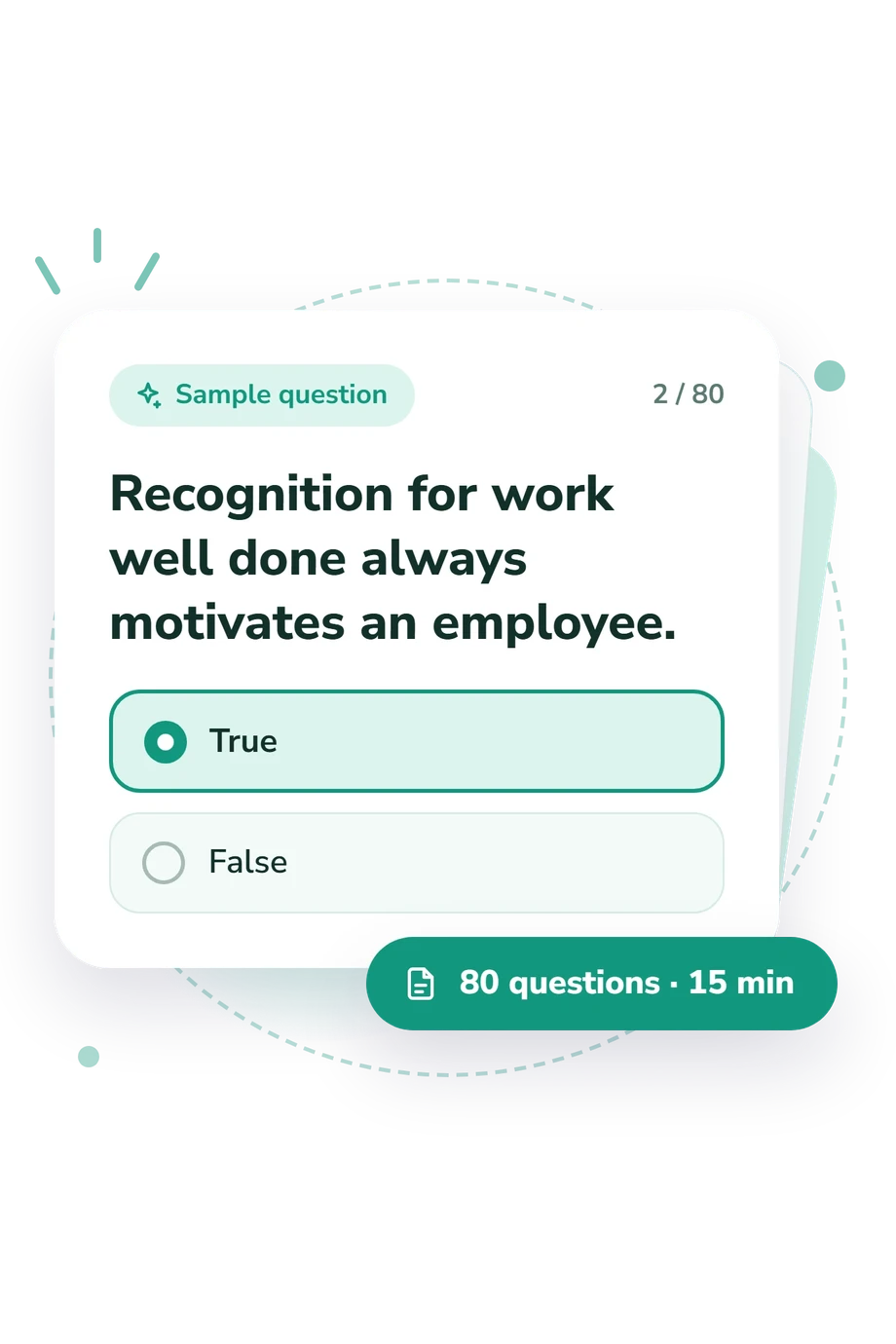
Example Questions From the Test
- True
- False
- True
- False
- True
- False
Manager and Human Relations Test - Description and methodology of the test
Managers, supervisors, and anyone examining how workplace decisions affect people can use the Manager and Human Relations Test as a structured reflection on leadership judgment. The assessment examines human relations management through questions about employee needs, communication, motivation, conflict, fairness, and organizational control. Your result summarizes knowledge and competence in these areas, helping you recognize strengths and choose practical skills to develop.
What This Assessment Explores
The questionnaire examines how managers reason about employee needs, participation, communication, motivation, conflict, discipline, fairness, authority, and organizational change. It suits readers who want to reflect on effective human relations and see how their judgments align with the test’s keyed principles. For many readers, this workplace leadership assessment prompts reflection on collaborative decision-making and employee-centered practice. Its two displayed indicators are:
- Number of Correct Responses (0-80) counts statements answered correctly and reflects knowledge and understanding; bands are Low (0-26), Moderate (27-53), and High (54-80).
- Standard Score (5-95) indicates relative human-relations competence among a large sample of managers; bands are Needs development (5-25), Typical range (26-74), and Strong (75-95).
Read together, the results separate the raw keyed count from the comparative category and can point to areas for further reflection without explaining every management judgment individually.
Methodology and Evidence Base
The format presents short propositions about managerial principles and uses objectively keyed choices to assess human-relations knowledge and competence. Representative questions use True/False alternatives; the respondent selects the answer matching the scoring key. The keyed count records correct answers and feeds a comparative result interpreted against a large sample of managers. Results are aggregate summaries, not separate scores for individual themes.
Its conceptual framework is Likert’s management-systems model, particularly the contrast between employee-centered and control-centered work. Likert’s later systems 1-4 formulation and Yukl’s leadership research provide context for participation, supportive supervision, communication, influence, and task coordination. The questionnaire is conceptually consistent with these works; it is not the published Likert instrument or an adaptation of it.
For interpretation, a higher comparative result indicates greater effectiveness in managing human relations within this framework, while a lower result suggests skills for development. The managerial effectiveness assessment can be affected by guessing, socially desirable responding, or unfamiliarity with workplace situations. Use the result to reflect on the principles behind it and their relevance to workplace decisions.
- Likert, Rensis. (1961). New Patterns of Management. New York: McGraw-Hill.
- Likert, Rensis. (1967). The Human Organization: Its Management and Value. New York: McGraw-Hill.
- Likert, Rensis. (1979). From Production- and Employee-Centeredness to Systems 1-4. Journal of Management, 5(2), 147-156. 10.1177/014920637900500205
- Yukl, Gary A. (1998). Leadership in Organizations (4th ed.). Upper Saddle River, NJ: Prentice Hall.
Updated: