
Belief in a Dangerous World Scale Test
How the Scales are Structured
Who Usually Takes This Test?
See How You Compare
Below is a preview of how scores are typically distributed across each scale.
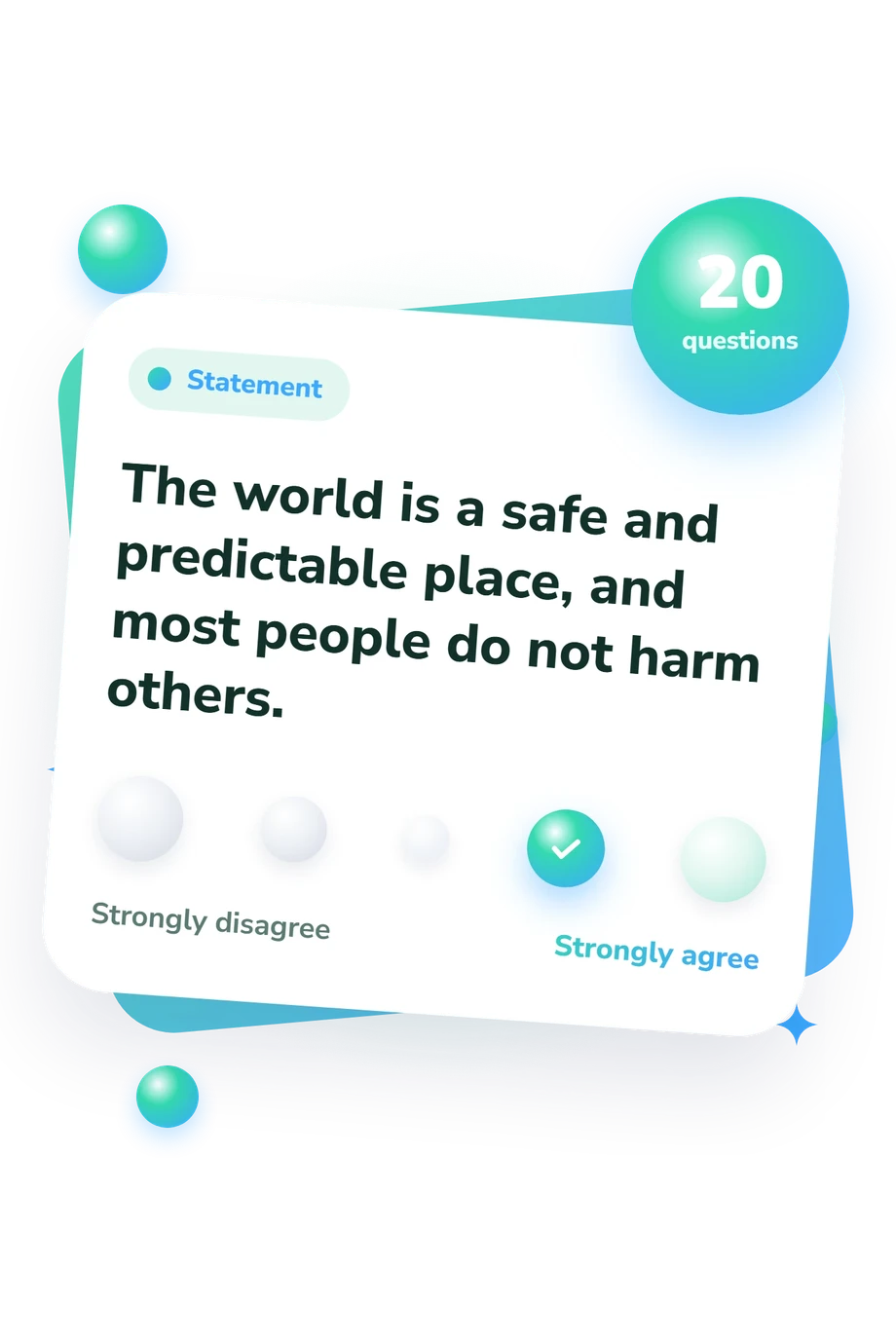
Example Questions From the Test
- Strongly disagree
- Somewhat disagree
- Not sure
- Somewhat agree
- Strongly agree
- Strongly disagree
- Somewhat disagree
- Not sure
- Somewhat agree
- Strongly agree
- Strongly disagree
- Somewhat disagree
- Not sure
- Somewhat agree
- Strongly agree
Belief in a Dangerous World Scale Test - Description and methodology of the test
For people examining how they interpret safety, trust, and social order, the Belief in a Dangerous World Scale Test offers a focused way to consider those assumptions. It is suited to readers who notice recurring concerns about crime, conflict, instability, or the reliability of other people. The result from this worldview assessment describes a general outlook on threat and order, helping place everyday reactions within a broader pattern.
What This Assessment Explores
This questionnaire examines how broadly a person expects danger to shape social life, rather than measuring one fear or a passing mood. Its statements contrast a safe, predictable society with one marked by aggression, moral decline, crime, catastrophe, or sudden chaos. The pattern captures perceived social danger as a social belief and may relate to personality characteristics connected with security, vigilance, and order.
Belief in a Dangerous World is the displayed scale, scored from 10 to 50. Its bands are Lower belief (10–23), Moderate belief (24–36), and Higher belief (37–50). Higher results indicate a stronger expectation that society is unstable and threatening, potentially accompanying anxiety or a preference for safety.
The item themes can be understood through three connected areas:
- Predictability reflects whether society feels orderly or volatile.
- Aggression reflects expectations that people may harm others.
- Instability reflects concern about crime, conflict, or collapse.
Methodology and Evidence Base
Each statement uses a five-point agreement format, from Strongly disagree to Strongly agree, with an uncertain middle option. Items address safety, social stability, aggression, victimization, crime, and sudden disorder. The statements present both reassuring and threatening views of society, so each response should be read in the context of its wording.
The item content corresponds to Altemeyer’s dangerous-world belief scale and is conceptually consistent with Duckitt’s 2002 Belief in a Dangerous World Scale and dual-process model linking worldview beliefs with ideology and prejudice. Although Altemeyer’s broader work discusses authoritarian attitudes, this questionnaire focuses on danger perceptions and does not measure authoritarianism.
Results are presented as a total within the stated range, and no item-level weighting or reverse-scoring procedure is specified. Higher totals indicate stronger danger-oriented beliefs, while lower totals indicate greater confidence in social safety. The stated ranges are descriptive result bands within this questionnaire and organize interpretation. Personal experience, current events, and candor can affect self-report, so the result describes an outlook at completion rather than a fixed trait.
- Duckitt, J., Wagner, C., du Plessis, I., & Birum, I. (2002). The psychological bases of ideology and prejudice: Testing a dual process model. Journal of Personality and Social Psychology, 83(1), 75–93. 10.1037/0022-3514.83.1.75
- Duckitt, J. (2001). A dual-process cognitive-motivational theory of ideology and prejudice. In M. P. Zanna (Ed.), Advances in Experimental Social Psychology (Vol. 33, pp. 41–113). Academic Press. 10.1016/S0065-2601(01)80004-6
- Altemeyer, B. (1988). Enemies of Freedom: Understanding Right-Wing Authoritarianism. San Francisco, CA: Jossey-Bass.
Updated: