
Child Illness Attitude Assessment Test
How the Scales are Structured
Who Usually Takes This Test?
See How You Compare
Below is a preview of how scores are typically distributed across each scale.
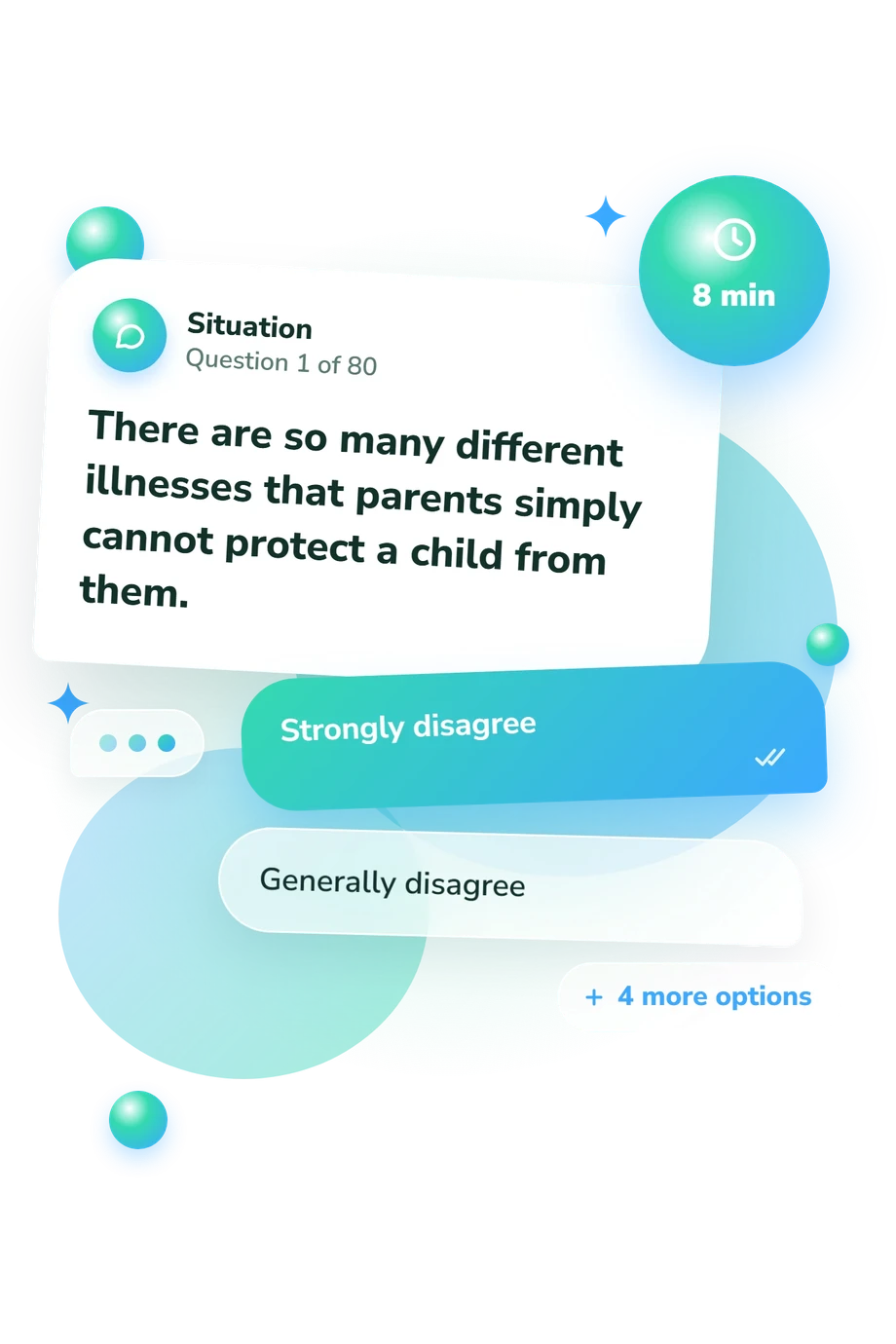
Example Questions From the Test
- Strongly disagree
- Generally disagree
- Disagree more than agree
- Agree more than disagree
- Generally agree
- Strongly agree
- Strongly disagree
- Generally disagree
- Somewhat disagree
- Somewhat agree
- Generally agree
- Strongly agree
- Strongly disagree
- Generally disagree
- Disagree more than agree
- Agree more than disagree
- Generally agree
- Strongly agree
Child Illness Attitude Assessment Test - Description and methodology of the test
Parents who want to examine how they respond when a child is unwell may use the Child Illness Attitude Assessment Test to reflect on protective decisions, emotional reactions, and beliefs about responsibility. The result organizes responses into dimensions, helping readers notice whether concern, restriction, perceived severity, or tension shapes caregiving. A parent can use this child illness self-assessment to clarify uncertainty about protection, severity, responsibility, and fear.
What This Assessment Explores
This assessment is intended for parents examining parental attitudes to childhood illness, especially decisions made when a child is sick. Its themes cover activity, perceived severity, anxiety, responsibility, and overall tension. The five displayed scales describe the profile as follows:
- Activity Restriction Control (-30-30) shows whether activity is restricted too much or too little: Low restriction (-30--1), Balanced control (0-15), High restriction (16-30).
- Nosognosia (-30-30) shows whether severity is underestimated or exaggerated: Underestimates severity (-30--1), Balanced perception (0-0), Overestimates severity (1-30).
- Anxiety (-30-30) captures anxious reactions: Anxiety denied / suppressed (-30--1), Relatively neutral (0-0), Pronounced anxiety (1-30).
- Internality (-30-30) places illness responsibility with the parent or outside causes: Internal control (-30--1), Mixed/neutral control (0-0), External control (1-30).
- General Tension (-30-30) is the questionnaire’s total score for overall tension: Lower tension (-30--1) or Elevated tension (0-30).
Methodology and Evidence Base
Responses use six-point agreement choices, from strong disagreement to strong agreement, with minor wording differences across items. The items cover protection, activity, medical seriousness, parental responsibility, fear, and perceived control. Answers are combined into the displayed dimension scores; the published ranges do not by themselves reveal how many points any single answer contributes.
Conceptually, this child illness attitude questionnaire is consistent with DOBR, the closest source instrument, but it should not be called a validated adaptation without documented evidence. Related studies by Bogacheva and colleagues, Suregoina and Kholmogorova, and Galasyuk and Mitina concern parental experiences of autism, chronic disabling illness, and families of children with special needs; they provide context rather than validation or standardization for this questionnaire.
Read the profile as a pattern rather than an isolated score: current stress, memory, self-awareness, and the wish to appear competent can influence self-report. The online questionnaire has no stated population norms or diagnostic thresholds, so its scores are descriptive rather than standardized clinical measures; it may be discussed alongside a fuller assessment when needed.
- Kagan, V. E., & Zhuravleva, I. P. (1991). Methods for diagnosing attitudes toward a child's illness (DOBR). In D. N. Isaev & V. E. Kagan (Eds.), Psychodiagnostic methods in pediatrics and child psychoneurology: Methodological manual (pp. 30-34). Saint Petersburg: PMI.
- Bogacheva, O. I., Ivanov, M. V., Balakireva, E. E., Koval-Zaitsev, A. A., Kulikov, A. V., Niktina, S. G., & Shalina, N. S. (2023). The structure of parental attitude to the disease of a child with autism spectrum disorder. Bulletin of Psychotherapy, 87, 49-59.
- Suregoina, A. Yu., & Kholmogorova, A. B. (2015). Parents' adaptation to different types of chronic disabling illness in a child: Consequences of spinal cord injury and cerebral palsy in adolescence and young adulthood. Counseling Psychology and Psychotherapy, 23(1), 177-195.
- Galasyuk, I. N., & Mitina, O. V. (2018). Parental attitude in families with a special child. Psychological Science and Education, 23(4), 102-111. 10.17759/pse.2018230410.
Updated: