
University of Rhode Island Change Assessment (URICA) Test
How the Scales are Structured
Who Usually Takes This Test?
See How You Compare
Below is a preview of how scores are typically distributed across each scale.
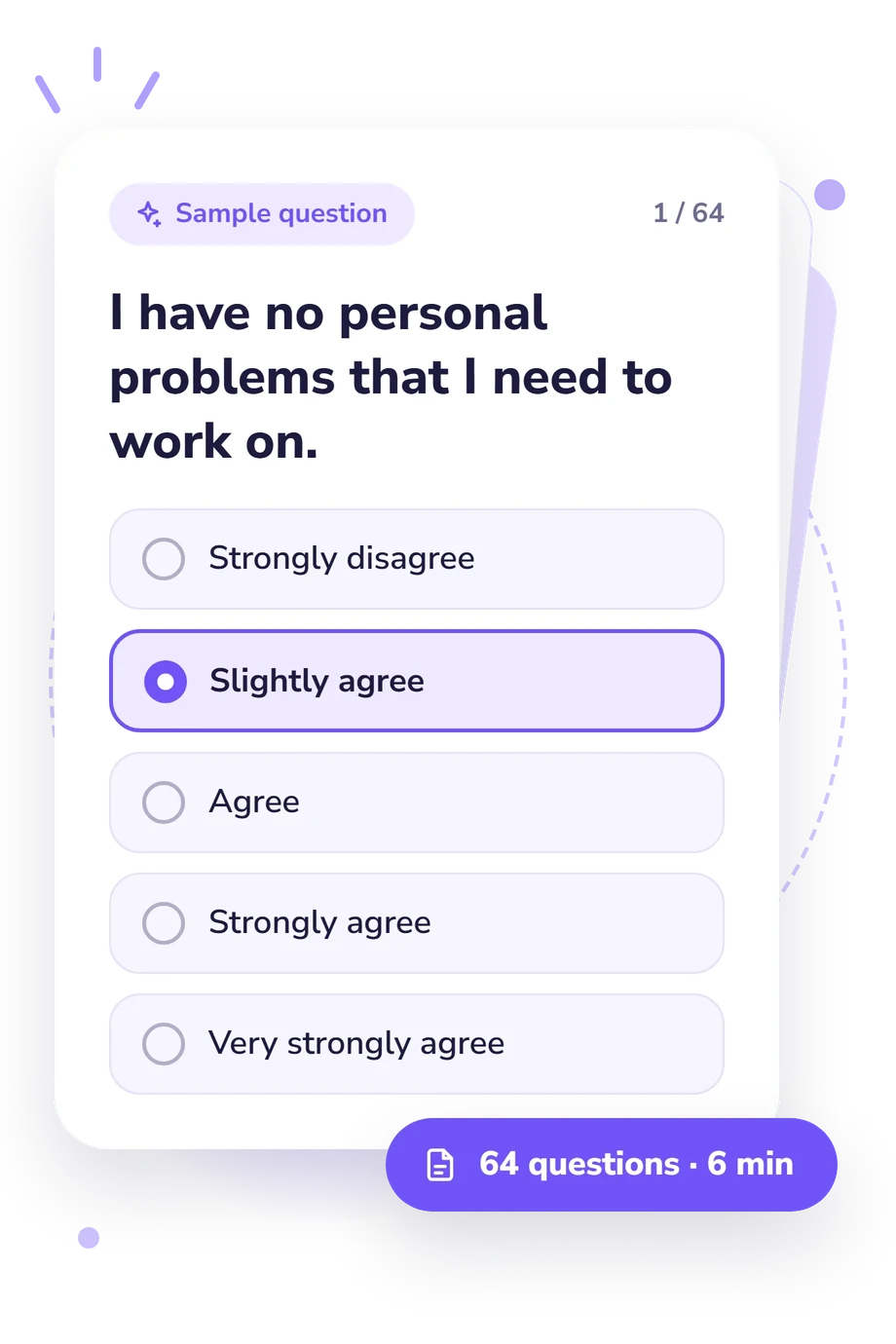
Example Questions From the Test
- Strongly disagree
- Slightly agree
- Agree
- Strongly agree
- Very strongly agree
- Does not apply at all
- Applies slightly
- Applies to a considerable degree
- Applies strongly
- Applies very strongly
- Does not apply at all
- Applies very slightly
- Applies moderately
- Applies strongly
- Applies very strongly
University of Rhode Island Change Assessment (URICA) Test - Description and methodology of the test
People who want to understand their current readiness for personal change may use the University of Rhode Island Change Assessment (URICA) Test as a structured self-reflection exercise. It is useful when you are distinguishing limited or absent recognition of a difficulty, recognizing it and weighing change, active efforts to change, or protection of progress already made. As a change readiness assessment, it offers four independently scored tendencies that together form a current profile.
What This Assessment Measures
An URICA assessment focuses on a person’s current position in changing a troubling behavior, habit, situation, or response pattern. The four scales are interpreted together as a profile of current change readiness, with each showing a distinct tendency: limited recognition, recognizing and weighing change, active change, or sustaining gains.
The four displayed dimensions are:
- Maintenance (0–100) reflects sustaining gains and preventing relapse; Low maintenance 0–49, High maintenance 50–100.
- Action (0–100) reflects active behavioral and lifestyle change; Low action 0–49, High action 50–100.
- Contemplation (0–100) reflects recognizing a problem and weighing change while readiness develops; Low reflection 0–49, High reflection 50–100.
- Precontemplation (0–100) reflects limited problem recognition and low perceived need to change, sometimes under external pressure; Low 0–49, High 50–100.
Methodology and Evidence Base
The URICA questionnaire presents statements about problems, motivation, help-seeking, effort, setbacks, and maintaining progress. Each uses five ordered response options, with wording about agreement, applicability, truth, or degree. The respondent marks how closely it fits rather than choosing a diagnostic category.
Responses form four dimension scores, producing a profile rather than a pass/fail result. Bands simplify the display, but item wording alone does not reveal reverse scoring, weights, or a separate diagnostic formula; those details should not be inferred.
The closest evidence is the 1983 URICA study, a stages-of-change measure associated with Prochaska and colleagues. A 1989 follow-up examined the framework over time. This online questionnaire is conceptually consistent with that work, not automatically identical to the research administration or independently standardized in this format.
Read the profile as a snapshot of current readiness. Self-report can be influenced by context, self-awareness, memory, and the wish to appear consistent or motivated, so results may change as circumstances change. The useful question is what needs recognition, consideration, action, or protection now.
- McConnaughy, E. A., Prochaska, J. O., & Velicer, W. F. (1983). Stages of change in psychotherapy: Measurement and sample profiles. Psychotherapy: Theory, Research, and Practice, 20(3), 368–375. 10.1037/h0090198
- McConnaughy, E. A., DiClemente, C. C., Prochaska, J. O., & Velicer, W. F. (1989). Stages of change in psychotherapy: A follow-up report. Psychotherapy: Theory, Research, Practice, Training, 26(4), 494–503. 10.1037/h0085468
Updated: