
Ten-Item Personality Inventory (TIPI) Test
How the Scales are Structured
Who Usually Takes This Test?
See How You Compare
Below is a preview of how scores are typically distributed across each scale.
Example Questions From the Test
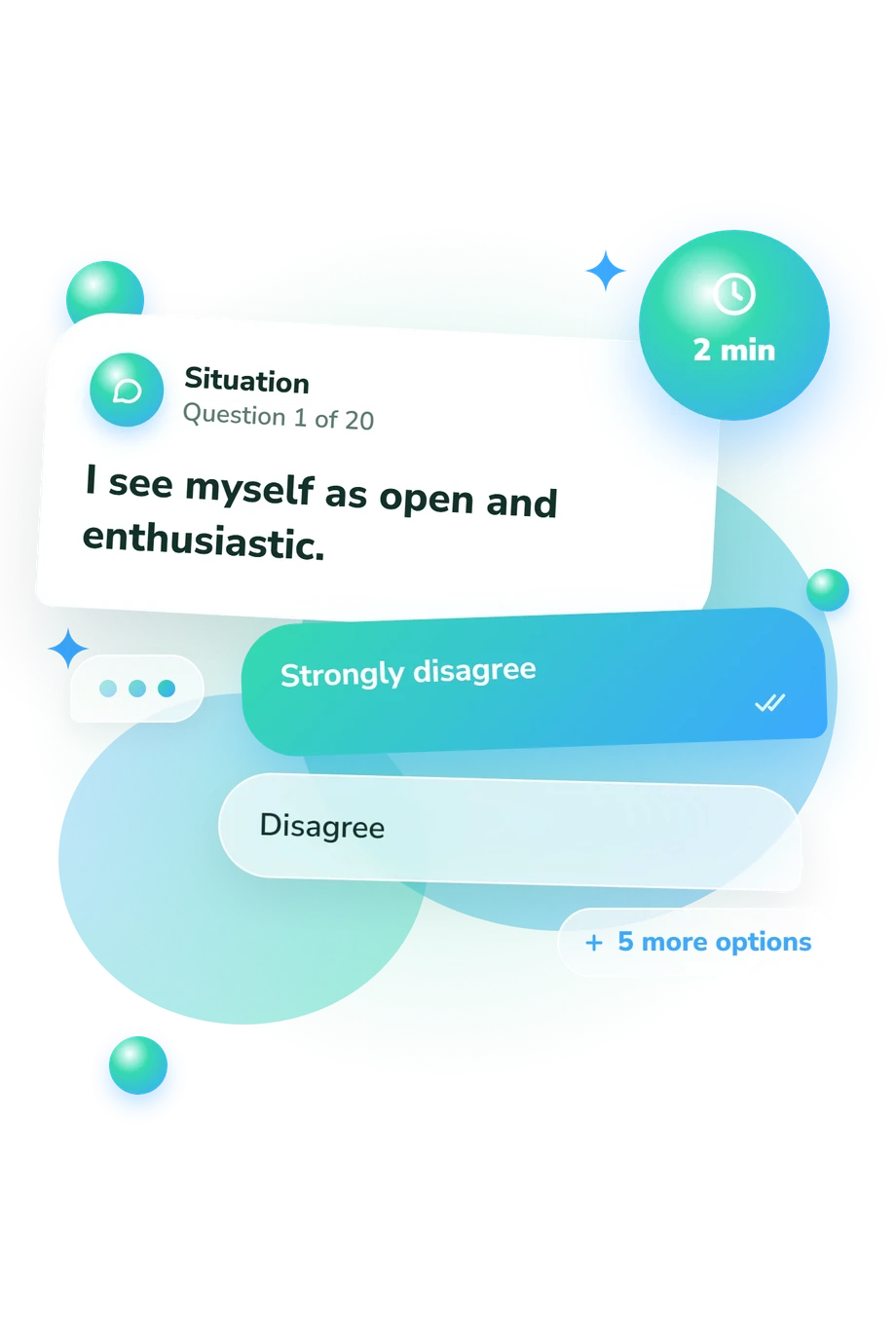
- Strongly disagree
- Disagree
- Slightly disagree
- Neither agree nor disagree
- Slightly agree
- Agree
- Strongly agree
- Disagree strongly
- Disagree
- Disagree a little
- Neither agree nor disagree
- Agree a little
- Agree
- Agree strongly
- Disagree strongly
- Disagree moderately
- Disagree a little
- Neither agree nor disagree
- Agree a little
- Agree
- Agree strongly
Ten-Item Personality Inventory (TIPI) Test - Description and methodology of the test
People deciding whether to examine recurring everyday tendencies can use the Ten-Item Personality Inventory (TIPI) Test to consider how familiar descriptions fit their behavior. It suits respondents who want a structured prompt for judging characteristic choices, reactions, and social habits across ordinary situations. As a Big Five personality test, it helps clarify whether a brief check of broad tendencies is useful before deeper self-observation.
What This Assessment Measures
Five broad domains organize the result around thinking, emotional regulation, self-management, relationships, and social energy. The questionnaire asks about characteristic personality traits rather than isolated moods. The scales and bands are:
- Openness to Experience (1–7) reflects curiosity and flexibility; Low 1–2.9, Moderate 3–5, and High 5.1–7 show increasing comfort with novelty.
- Emotional Stability (1–7) reflects calmness under stress; Lower stability 1–2.9, Moderate stability 3–5, and Higher stability 5.1–7 show increasing resilience.
- Conscientiousness (1–7) reflects organization and self-discipline; Low 1–2.9, Moderate 3–5, and High 5.1–7 show increasing goal direction.
- Agreeableness (1–7) reflects trust and cooperation; Reserved/Critical 1–2.9, Balanced 3–5, and Very Friendly 5.1–7 show warmer interpersonal tendencies.
- Extraversion (1–7) reflects sociability and activity; Low 1–2.9, Moderate 3–5, and High 5.1–7 show increasing social energy.
Methodology and Evidence Base
Each item uses a seven-point agreement scale from 1, Strongly disagree, to 7, Strongly agree, with a neutral midpoint. The ten prompts use paired descriptors, and wording that points in opposite directions should be interpreted consistently when reading the domain results. This yields a comparative profile, not a facet-by-facet inventory.
The questionnaire is conceptually consistent with TIPI-RU (Sergeeva et al., 2016), while this online presentation is a conceptual match rather than a direct adaptation of that published version. The original Ten-Item Personality Inventory was described by Gosling, Rentfrow, and Swann (2003), and Muck, Hell, and Gosling (2007) provide construct-validation context for a short TIPI version. It is a five-factor personality questionnaire grounded in the Big Five framework; its displayed bands are descriptive ranges for this questionnaire and should not be treated as norms established for this online version.
Read scores as relative tendencies within their displayed bands, not fixed labels. Current mood, self-perception, and context can influence answers, so honest, context-aware responses matter. Its brevity means it cannot represent every personality facet or explain behavior in every setting.
- Sergeeva, A. S., Kirillov, B. A., & Dzhumagulova, A. F. (2016). Translation and adaptation of short five factor personality questionnaire (TIPI-RU): Convergent validity, internal consistency and test-retest reliability evaluation. Experimental Psychology (Russia), 9(3), 138–154. 10.17759/exppsy.2016090311
- Gosling, S. D., Rentfrow, P. J., & Swann, W. B., Jr. (2003). A very brief measure of the Big-Five personality domains. Journal of Research in Personality, 37(6), 504–528. 10.1016/S0092-6566(03)00046-1
- Muck, P. M., Hell, B., & Gosling, S. D. (2007). Construct validation of a short five-factor model instrument: A self-peer study on the German adaptation of the Ten-Item Personality Inventory (TIPI-G). European Journal of Psychological Assessment, 23(3), 166–175. 10.1027/1015-5759.23.3.166
Updated: