
Comparative Value Indices Test
How the Scales are Structured
Who Usually Takes This Test?
See How You Compare
Below is a preview of how scores are typically distributed across each scale.
Example Questions From the Test
- find them easily
- find them after some searching
- rarely find them
- find them after someone points out one or several of them to you
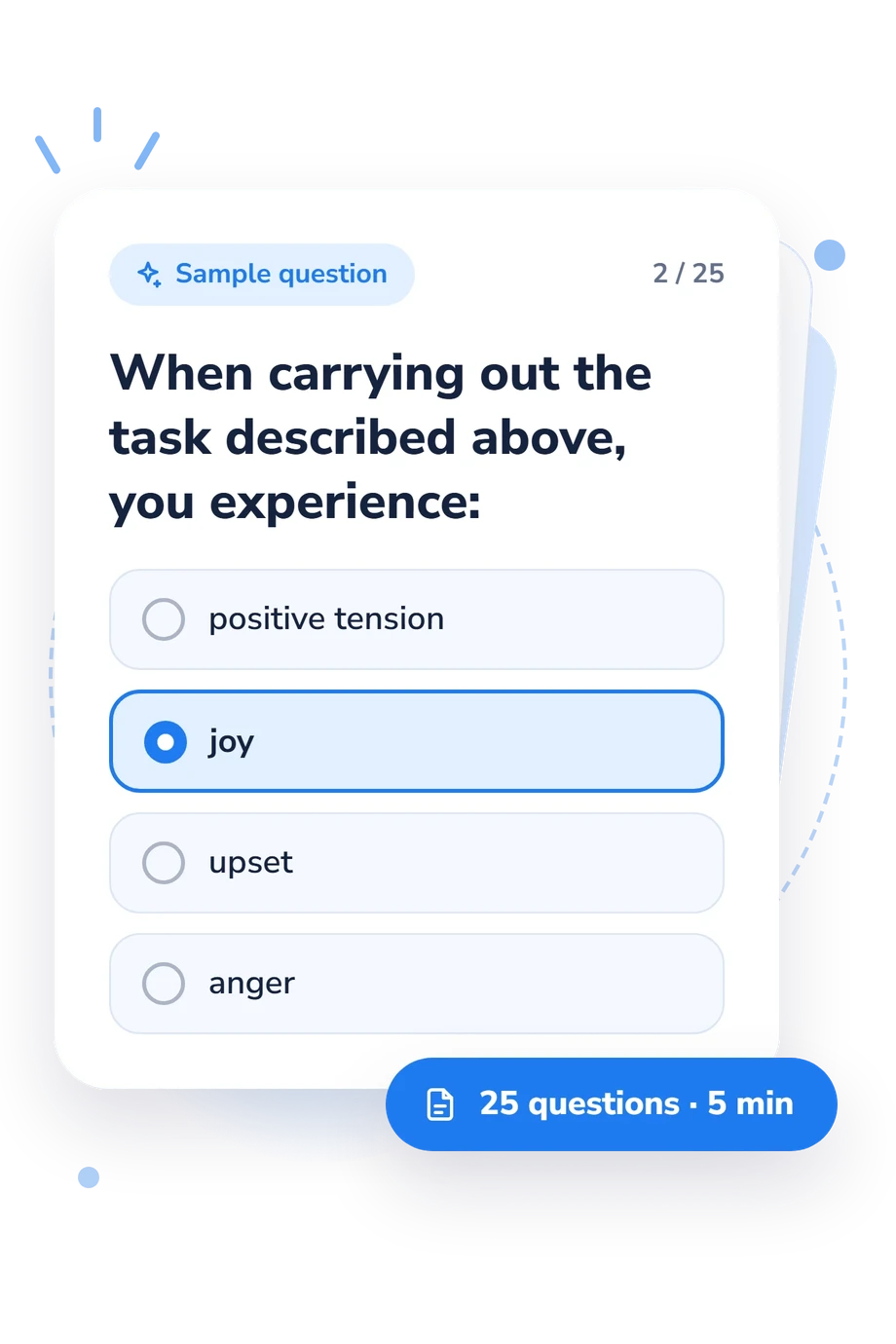
- positive tension
- joy
- upset
- anger
- only the differences between them
- only their similarities
- differences first, then similarities
- similarities first, then differences
Comparative Value Indices Test - Description and methodology of the test
People who want to understand their habitual way of handling information can use the Comparative Value Indices Test as a structured self-reflection exercise. It is a cognitive style test for readers who are curious about attention, interpretation, learning preferences, and the way they move between details and an overall impression. The result offers a profile of information processing rather than a judgment of ability, intelligence, or worth.
What This Assessment Explores
This questionnaire explores how a person notices, organizes, remembers, and integrates information in ordinary situations. Its scenarios cover picture puzzles, comparing objects, learning concepts, reading, route planning, creative work, instructions, and conflicting information. Together, they contrast detail-by-detail analysis with broader pattern recognition, while allowing for a middle position that changes with the situation.
The result is reported on the Cognitive Style scale, ranging from 25-125, with three displayed bands:
- Ectenic (Detail-focused), 25-65, indicates a stronger tendency to examine parts, distinctions, sequences, and explicit structure.
- Situational (Balanced), 66-85, indicates a more flexible movement between detailed analysis and an integrated view.
- Synoptic (Big-picture), 86-125, indicates a stronger tendency to grasp relationships, general patterns, and the whole context.
For someone choosing a learning style questionnaire, these dimensions can clarify whether stepwise explanations, examples, visual organization, or broad conceptual framing feels more natural.
Methodology and Scientific Basis
Each item presents a familiar situation with four response options. The alternatives contrast ways of approaching information: following a plan or adapting, using rules or examples, relying on mental images or verbal descriptions, and attending to parts or the whole. This gives the questionnaire a situational self-report format rather than a single abstract rating.
Responses are combined on one continuum. The questionnaire reports the range and bands, but not the point value assigned to each option, so the score should be read descriptively rather than treated as a formula or universal threshold.
Its interpretive framework is conceptually consistent with the E&L Questionnaire (Ehrman & Leaver, 2002). Ehrman and Leaver’s 2003 work and Yasuda’s 2019 exploratory study offer relevant context for cognitive styles in learning, but this online version is not a standardized adaptation or reproduction of those studies. It is best used as a self-report profile of detail-oriented or big-picture thinking. Responses may vary with mood, familiarity, goals, and self-perception; without published norms for this version, generalization is limited.
- Ehrman, M., & Leaver, B. L. (2002). Ehrman & Leaver Learning Style Questionnaire Version 2.0.
- Ehrman, M., & Leaver, B. L. (2003). Cognitive styles in the service of language learning. System, 31(3), 393-415. 10.1016/S0346-251X(03)00050-2
- Yasuda, T. (2019). An exploratory study for factorial validity of cognitive styles among Japanese adult EFL learners: From educational and cultural perspectives. Asian-Pacific Journal of Second and Foreign Language Education, 4, 3. 10.1186/s40862-018-0063-1
Updated: