
Creative Personality Characteristics Test
How the Scales are Structured
Who Usually Takes This Test?
See How You Compare
Below is a preview of how scores are typically distributed across each scale.
Example Questions From the Test
- Mostly true
- Partly true / maybe
- No
- I don't know / can't decide
- Mostly true
- Partly true
- No
- I don’t know / can’t say
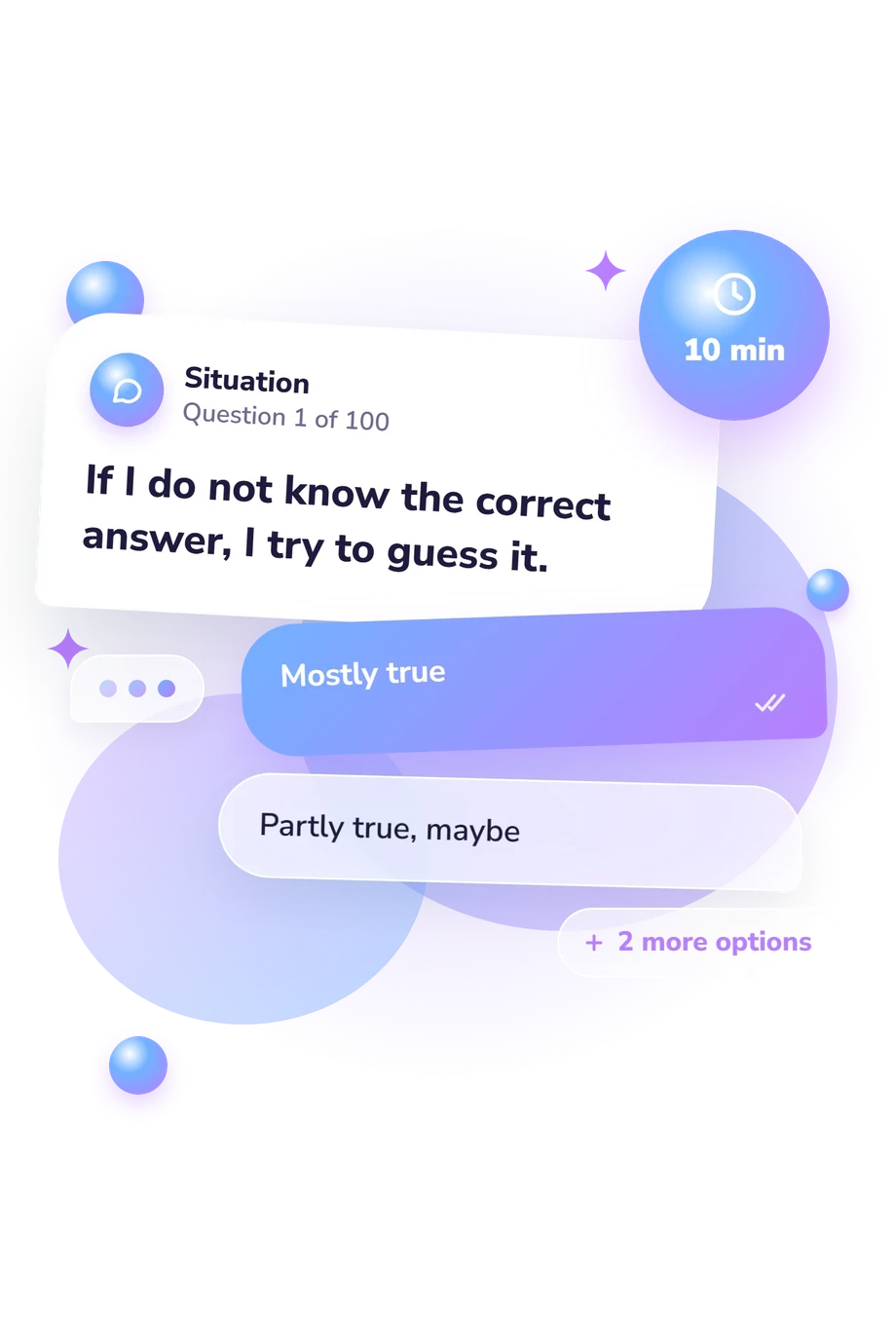
- Mostly true
- Partly true, maybe
- No
- I don’t know / can’t decide
Creative Personality Characteristics Test - Description and methodology of the test
People who want to understand how they approach novelty, ambiguity, and creative effort can use the Creative Personality Characteristics Test as a structured self-reflection exercise. Intended for readers interested in everyday creative tendencies, the assessment focuses on creative personality traits rather than artistic skill. The result profiles imaginative, exploratory, flexible, and bold approaches to unfamiliar situations.
What This Test Measures
The questions examine responses to novelty, ambiguity, discovery, and uncertainty. It describes creative thinking in everyday situations rather than artistic skill, including how someone imagines possibilities, questions familiar answers, pursues new knowledge, and acts when outcomes are unclear. The result shows which approaches are more or less prominent for the respondent.
The result groups these themes into five dimensions:
- Imagination (0-24) measures mental imagery and going beyond reality; Lower 0-10, Typical 11-20, High 21-24.
- Complexity (0-26) measures alternatives and ambiguity; Lower complexity 0-12, Moderate complexity 13-21, Higher complexity 22-26.
- Curiosity (0-24) measures seeking knowledge and hidden meaning; Lower curiosity 0-13, Moderate curiosity 14-21, High curiosity 22-24.
- Risk-Taking (0-26) measures unconventional action under uncertainty; Low 0-12, Moderate 13-21, High 22-26.
- Overall Creativity Score (0-100) reflects personality-related creativity; Low 0-50, Moderate 51-83, High 84-100.
Methodology and Evidence Base
The questionnaire uses a four-choice self-report format. For each statement, the respondent selects mostly true, partly true or maybe, no, or I do not know or cannot decide. Items cover guessing, questioning, imagining, trying unfamiliar activities, tolerating several possible answers, and pursuing ideas that may not yet be practical.
The displayed result uses component scores and an overall score. Its ranges and bands describe the questionnaire’s interpretation, but they do not establish a universal clinical cutoff or reveal how many points any particular response contributes.
The questionnaire’s structure is conceptually consistent with the published Creativity Assessment Packet (CAP) by Williams, a source instrument rather than a framework. A manual for that instrument describes its approach, while the study by Halpin, Halpin, and Torrance is relevant to creative personality assessment because it examines how creative personality is measured. The questionnaire reports the displayed dimensions and overall score; its scoring description does not specify how individual responses contribute points or establish norms for this online version.
Self-report results depend on self-awareness, current circumstances, and candid reporting. Scores may shift with mood or situation, so interpret the pattern alongside lived behavior and use it for further reflection.
- Frank E. Williams. Creativity Assessment Packet (CAP): Manual. Buffalo, NY: D.O.K. Publishers, 1980.
- Frank E. Williams. Creativity Assessment Packet (CAP): Examiner's Manual. Austin, TX: Pro-Ed, 1993.
- Gerald Halpin, Glennelle Halpin, and E. Paul Torrance. "Relationships Between Creative Thinking Abilities and a Measure of the Creative Personality." Educational and Psychological Measurement 34, no. 1 (1974): 75-82. 10.1177/001316447403400111
Updated: