
Tolerance Index Test
How the Scales are Structured
Who Usually Takes This Test?
See How You Compare
Below is a preview of how scores are typically distributed across each scale.
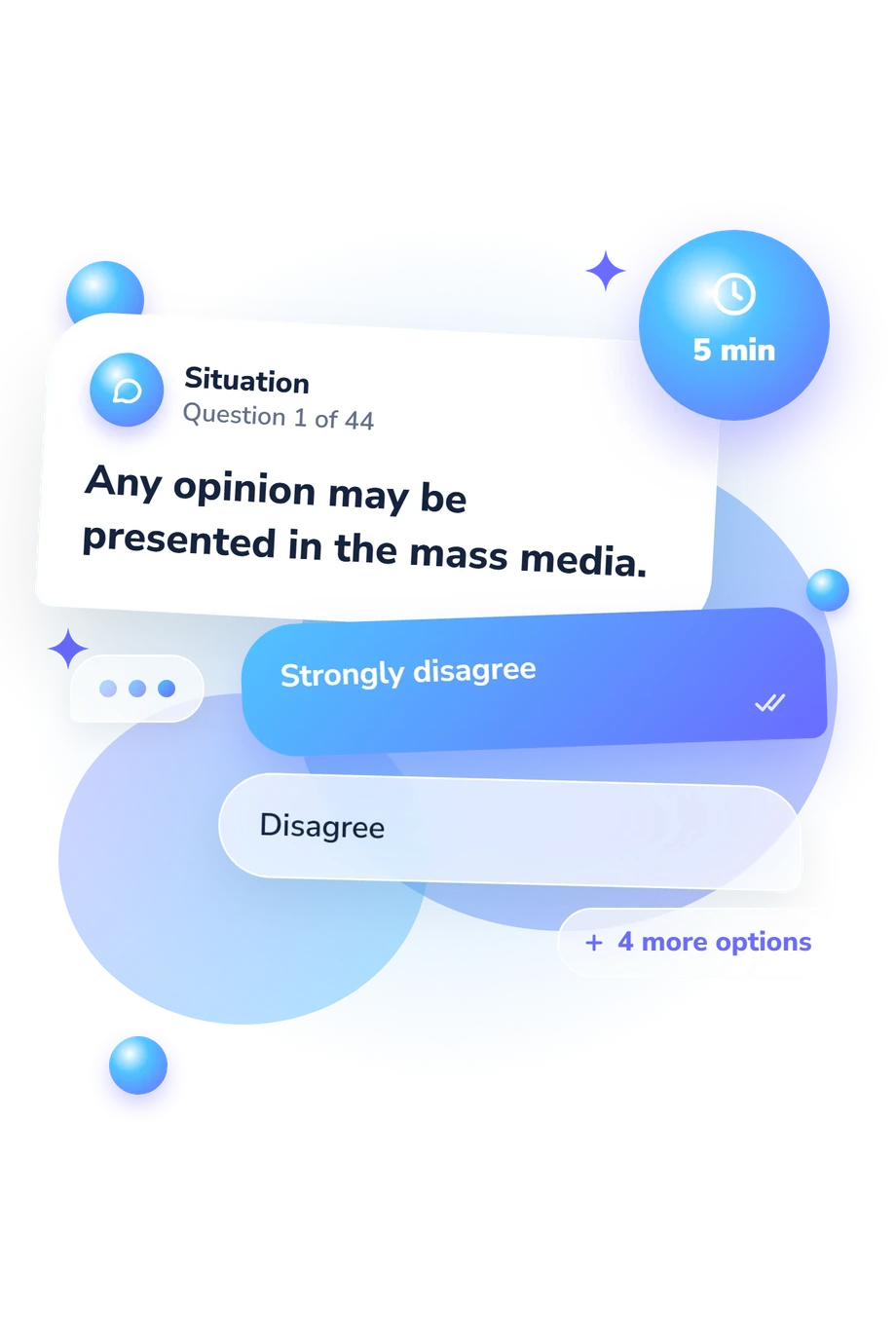
Example Questions From the Test
- Strongly disagree
- Disagree
- Somewhat disagree
- Somewhat agree
- Agree
- Completely agree
- Absolutely disagree
- Disagree
- Somewhat disagree
- Somewhat agree
- Agree
- Completely agree
- Strongly disagree
- Disagree
- Somewhat disagree
- Somewhat agree
- Agree
- Completely agree
Tolerance Index Test - Description and methodology of the test
For readers who want to examine how they respond to disagreement, diversity, and social difference, the Tolerance Index Test offers a way to consider patterns across several related attitudes. This tolerance questionnaire is intended for anyone curious about how their views may shape interpersonal reactions and responses to unfamiliar groups. The resulting profile can show which forms of openness, acceptance, or rigidity are most prominent in their self-report.
What This Assessment Explores
The tolerance assessment covers openness, social acceptance, and intercultural attitudes. Four areas follow:
- Tolerance as a Personality Trait (7–42) measures dispositional attitudes and beliefs; higher show tolerant traits, lower suggest intolerance: Lower tolerance trait (7–18), Moderate tolerance trait (19–30), Higher tolerance trait (31–42).
- Social Tolerance (8–48) measures attitudes to diverse groups, minorities, people with disabilities, and social processes; higher show acceptance without prejudice, lower may indicate social isolation or discrimination: Low (8–21), Moderate (22–34), High (35–48).
- Ethnic Tolerance (7–42) measures ethnic attitudes and intercultural interaction; higher show acceptance and cultural respect, lower suggest prejudice or closed-mindedness: Low (7–18), Moderate (19–30), High (31–42).
- Tolerance Index (22–132) assesses overall personal, social, and ethnic tolerance: Low (22–60), Average (61–99), High (100–132).
An Average result may reflect tolerant and intolerant features varying by situation; higher results suggest pronounced tolerance, lower a tendency toward intolerance.
Methodology and Scientific Basis
Each statement uses six ordered response options, from strong disagreement to complete agreement. Items address rights, social inclusion, intergroup contact, authority, conflict, and reactions to difference. The questionnaire displays scores for each domain and for the overall index, while the bands show the direction and range of the resulting profile. Without a documented item-to-scale mapping, reverse-scoring rule, or point contributions, interpretation is limited to the stated result bands.
The questionnaire is conceptually consistent with the Tolerance Index Quick Questionnaire, which separates general, social, and ethnic aspects of tolerance. The related psychodiagnostic framework describes comparable dimensions; Allport’s work situates prejudice and attitudes toward out-groups within social theory, while Novikova and Novikov add intercultural context. The online version is not a standardized reproduction or validated adaptation of that instrument.
The result is most useful alongside the situations that prompted agreement or disagreement. Its tolerance profile can reveal openness, acceptance, and areas for reflection. Self-report answers may shift with current mood, social desirability, and self-awareness, so a single score is not a fixed description of the person.
- Soldatova, G. U., Kravtsova, O. A., Khukhlaev, O. E., & Shaigerova, L. A. (2008). Tolerance Index Quick Questionnaire. In G. U. Soldatova & L. A. Shaigerova (Eds.), Psychodiagnostics of Personality Tolerance (pp. 46–51). Moscow: Smysl.
- Soldatova, G. U., Kravtsova, O. A., Khukhlaev, O. E., & Shaigerova, L. A. (2002). Psychodiagnostics of Tolerance. In Psychologists about Migrants and Migration in Russia: Information and Analytical Bulletin, No. 4 (pp. 59–65). Moscow: Smysl.
- Novikova, I. A., & Novikov, A. L. (2013). Tolerance Types and Features of Intercultural Adaptation in International Students. Journal of Educational and Social Research, 3(7), 625–630. 10.5901/jesr.2013.v3n7p625
- Allport, G. W. (1954). The Nature of Prejudice. Reading, MA: Addison-Wesley.
Updated: