
Brief Gender-Role Beliefs Scale (GBRS) Test
How the Scales are Structured
Who Usually Takes This Test?
See How You Compare
Below is a preview of how scores are typically distributed across each scale.
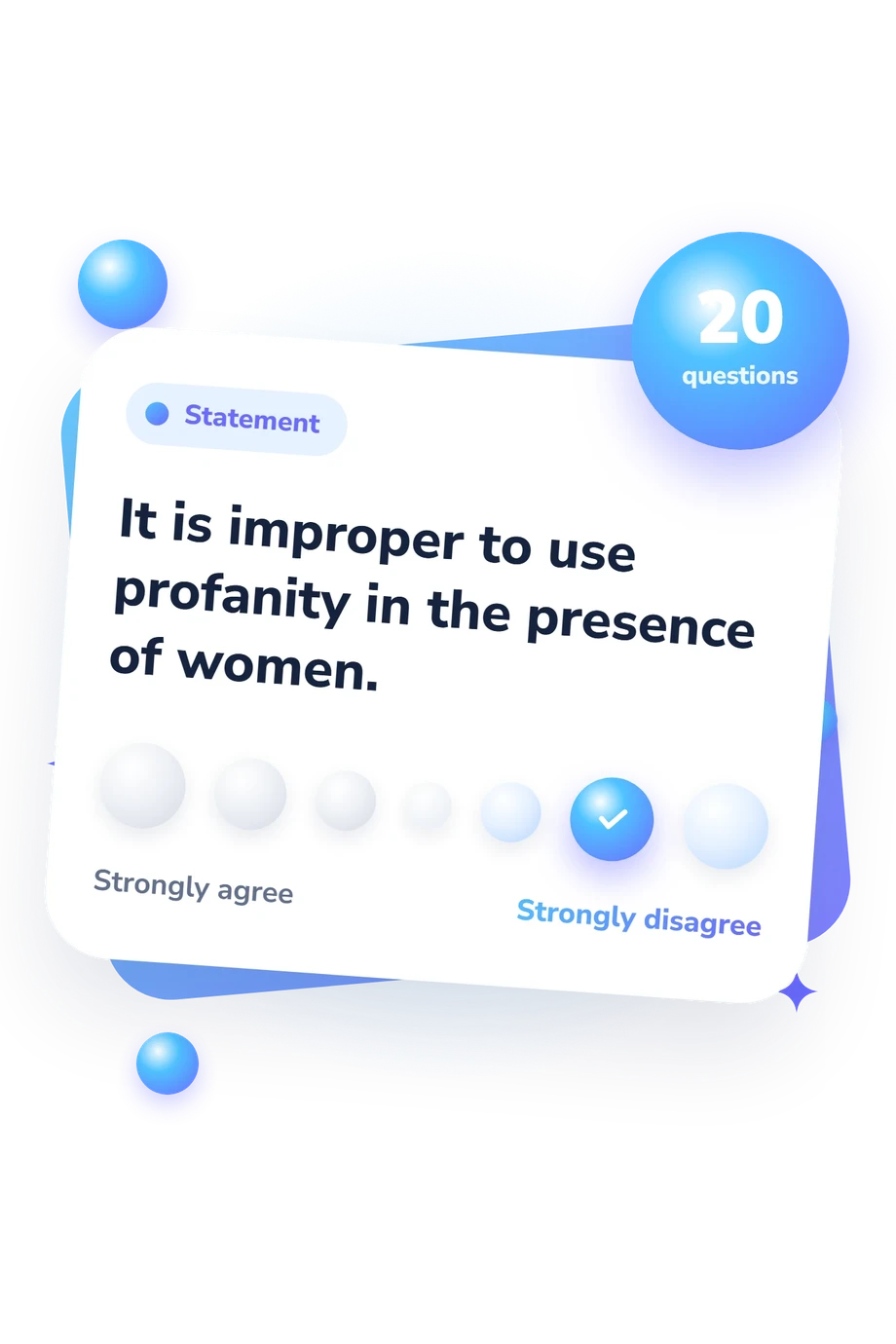
Example Questions From the Test
- Strongly agree
- Agree
- Somewhat agree
- Not sure
- Somewhat disagree
- Disagree
- Strongly disagree
- Strongly agree
- Agree
- Somewhat agree
- Not sure
- Somewhat disagree
- Disagree
- Strongly disagree
- Strongly agree
- Agree
- Somewhat agree
- Unsure
- Somewhat disagree
- Disagree
- Strongly disagree
Brief Gender-Role Beliefs Scale (GBRS) Test - Description and methodology of the test
People who want to examine how social expectations shape their views of men’s and women’s behavior can use this gender role test as a focused self-reflection exercise. As a gender attitudes test, it suits readers curious about dating conventions, family responsibilities, workplace roles, courtesy, and judgments about acceptable conduct. The result gives a broad indication of whether their responses lean traditional, mixed, or contemporary.
What This Assessment Explores
Prescriptive expectations, rather than identity or personality, are the focus. This gender stereotypes questionnaire asks about dating initiative, sexual freedom, paid work, childcare, family authority, financial etiquette, occupations, courtesy, and speech. It shows whether traditional gender stereotypes are accepted, questioned, or rejected in everyday situations.
These themes show what the result can reflect:
- Dating and sexual expectations indicate views of gendered rules in courtship and sexual autonomy.
- Family and work beliefs show whether care, housework, and careers are assigned by gender.
- Authority and financial etiquette capture expectations about who should lead, decide, pay, or provide.
- Courtesy and expression reveal whether conduct, language, or occupations are judged differently by gender.
Together, they contribute to the Gender-Role Beliefs score of 10-70. More traditional is 10-30, Mixed / moderate is 31-50, and More modern is 51-70. Higher results indicate more contemporary gender-role attitudes; lower results indicate more traditional views.
Methodology and Scientific Basis
Each statement uses seven ordered choices from Strongly agree to Strongly disagree, with a middle option for uncertainty. Answers are combined into a directional total according to whether each item expresses a traditional or contemporary belief. The result summarizes an attitude pattern rather than counting isolated opinions.
The questionnaire is conceptually consistent with the Short Gender Role Beliefs Scale (Brown & Gladstone, 2012), a 10-item form developed from the original Gender Role Beliefs Scale. The earlier GRBS by Kerr and Holden (1996) defines gender-role ideology as prescriptive beliefs about appropriate behavior for men and women. This online version follows the same general framework, not the published scale’s validation procedure.
Readers can use it as a gender roles questionnaire to compare stated beliefs with the score’s traditional-to-contemporary direction. Research on the short form reported reliability, construct validity, and test-retest evidence in its own samples; those findings do not standardize every online administration. No population-specific norms are supplied for small score differences.
Self-report results may shift with current relationships, social pressure, cultural context, and interpretation of the statements. Use them to reflect on assumptions, especially when answers vary across situations.
- Brown, Michael J., & Gladstone, Nancy. (2012). Development of a Short Version of the Gender Role Beliefs Scale. International Journal of Psychology and Behavioral Sciences, 2(5), 154-158. 10.5923/j.ijpbs.20120205.05
- Kerr, P. S., & Holden, R. R. (1996). Development of the Gender Role Beliefs Scale (GRBS). Journal of Social Behavior & Personality, 11(5), 3-16.
Updated: