
World Health Organization-Five Well-Being Index (WHO-5) Test
How the Scales are Structured
Who Usually Takes This Test?
See How You Compare
Below is a preview of how scores are typically distributed across each scale.
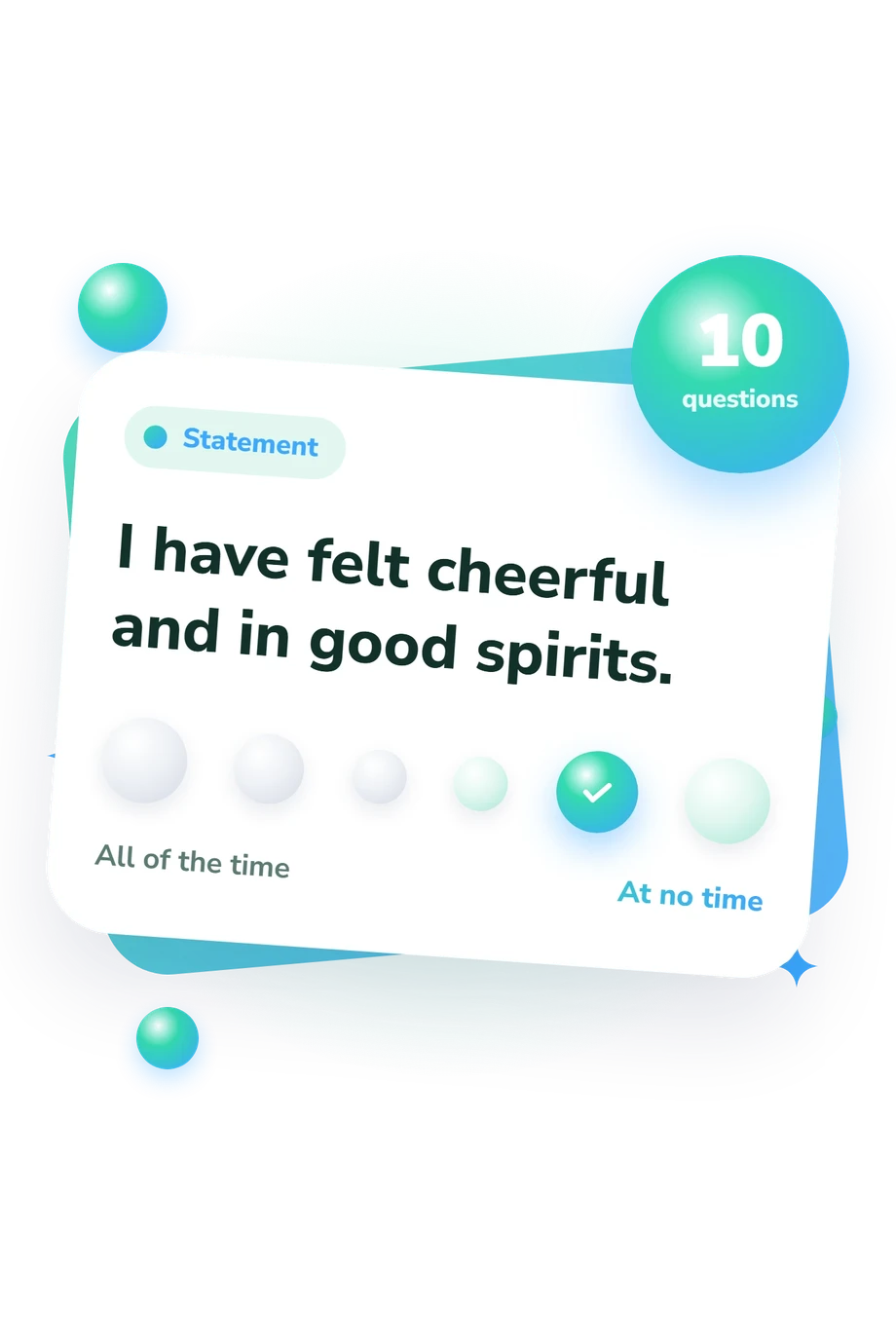
Example Questions From the Test
- All of the time
- Most of the time
- More than half of the time
- Less than half of the time
- Some of the time
- At no time
- All of the time
- Most of the time
- More than half of the time
- Less than half of the time
- Some of the time
- At no time
- All of the time
- Most of the time
- More than half of the time
- Less than half of the time
- Some of the time
- At no time
World Health Organization-Five Well-Being Index (WHO-5) Test - Description and methodology of the test
People who want a focused check-in on recent emotional functioning may use the World Health Organization-Five Well-Being Index (WHO-5) Test to consider how their well-being has felt in everyday life. The WHO-5 well-being test suits self-reflection about current mental health when someone wants a simple result to discuss, compare with later check-ins, or use as a prompt for further thought.
What This Assessment Measures
This questionnaire focuses on positive well-being rather than a single symptom. Its statements cover cheerful mood, calmness, energy, refreshing sleep, and daily interest during the preceding two weeks. The result is a snapshot of recent experience, not a complete portrait of mental health.
For someone using this WHO-5 mental health questionnaire, the result can highlight current strengths or areas worth noticing.
The content falls into three themes:
- Cheerful mood shows how often positive spirits have been present.
- Calmness and vitality indicate whether relaxation and energy have been available.
- Rest and engagement reflect waking refreshed and finding interest in daily life.
The Well-Being Index runs from 0–100: higher scores indicate better well-being. Low well-being is 0–49; Adequate well-being is 50–100. A score below 50% may indicate risk of poor mental well-being and a need for further assessment.
Methodology and Evidence Base
The response format asks about the same recent period using six ordered frequency choices, from All of the time to At no time. This lets the respondent describe how consistently each experience has occurred instead of choosing a yes-or-no answer.
Scoring combines the five item responses into one overall index. The online form does not state a standardized point contribution for each displayed option, so individual weights should not be inferred from the labels alone.
The closest evidence base is the WHO-5 Well-Being Index, a brief instrument for subjective well-being, together with the WHO Regional Office for Europe’s DepCare work. The systematic review by Topp, Ostergaard, Sondergaard, and Bech (2015) examined the measure’s research literature. This questionnaire is conceptually consistent with that work, not an adaptation of the published instrument, and should not be assumed to have identical norms, validation, or administration procedures.
For practical WHO-5 score interpretation, read the result alongside current context. Self-report can be affected by memory, self-awareness, temporary stress, physical health, or a wish to present oneself positively, so a persistent or concerning pattern calls for broader assessment.
- World Health Organization. (2024). The World Health Organization-Five Well-Being Index (WHO-5). Geneva: World Health Organization. WHO/UCN/MSD/MHE/2024.1.
- World Health Organization Regional Office for Europe. (1998). Wellbeing Measures in Primary Health Care/The DepCare Project: Report on a WHO Meeting, Stockholm, Sweden, 12–13 February 1998. Copenhagen: World Health Organization Regional Office for Europe.
- Topp, C. W., Ostergaard, S. D., Sondergaard, S., & Bech, P. (2015). The WHO-5 Well-Being Index: A Systematic Review of the Literature. Psychotherapy and Psychosomatics, 84(3), 167–176. 10.1159/000376585
Updated: