
Freudly+971 508685814hello@freudly.ai
Freudly
congruence

Cultural Congruence Assessment for Primary School Children Test
Take the online Cultural Congruence Assessment for Primary School Children Test - AI psychologist FreudlyYou can take Cultural Congruence Assessment for Primary School Children Testhere. Online version of a simple and accurate psychological test with interpretation.en
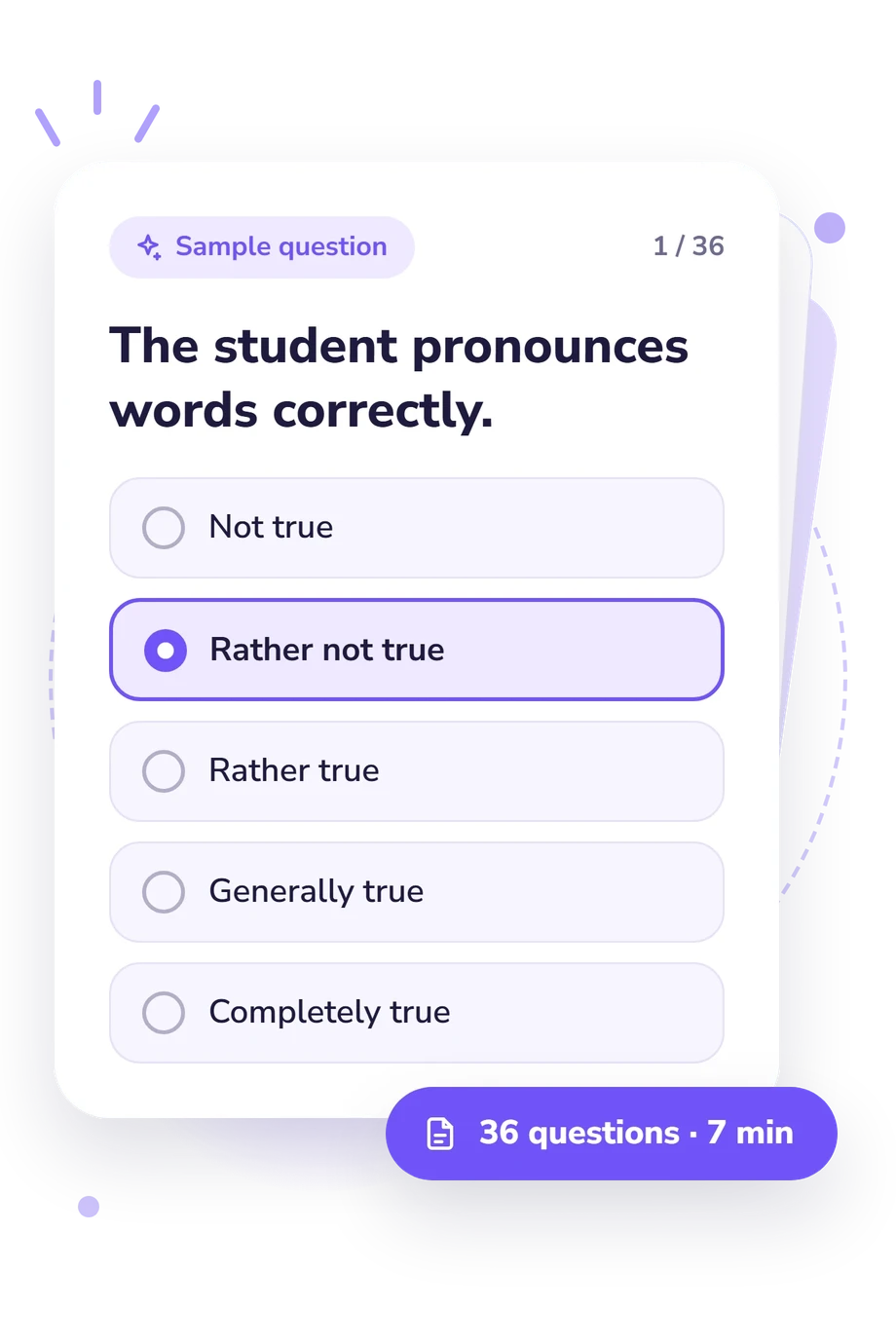
In about 7 minutes, it shows how well a child’s behavior aligns with age-expected cultural norms at school and home. With 36 items from parents and teachers, it quickly flags growth needs to guide support plans.
Start Online Test
Questions: 367 minutes
08:30
October 2, 2025
October 2, 2025
Material has been updated
October 2, 2025
Material has been published
13,244 views
1,061 completion
908 likes
Verified by Daniel Hall
Psychologist with 25 years of experience
Share
Scale Explorer

How the Scales are Structured

example score
8/16
Rule Adherence (RA)
Measures how consistently the child follows routines and complies with established rules in everyday situations.
Low regulation
Moderate regulation
High regulation
05: Low regulation | 611: Moderate regulation | 1216: High regulation
A score of 8 indicates moderate regulation, suggesting the child follows routines and rules in many situations but may show inconsistency across settings or tasks.
example score
8/16
Self-Care (SC)
Assesses how independently the child manages everyday self-care tasks and follows basic routines.
Developing
Moderate
Strong
07: Developing | 812: Moderate | 1316: Strong
A score of 8 indicates a moderate level of self-care independence, with some daily tasks managed independently and others still requiring support or reminders.
example score
16/28
Obedience (O)
This scale measures how consistently a child follows rules and adult instructions in everyday situations.
Low
Moderate
High
09: Low | 1019: Moderate | 2028: High
A score of 16 falls in the Moderate range, suggesting the child generally complies with rules and adult expectations but may be inconsistent across situations.
example score
13/28
Self-Control (SC)
Assesses how well the child regulates emotions and behavior to meet situational demands and age-typical norms.
Needs support
Developing
Strong
013: Needs support | 1421: Developing | 2228: Strong
A score of 13 falls in the “Needs support” range, suggesting self-regulation may be less consistent across settings and situations than is typical for age.
example score
2/28
Academic Competence (AC)
Measures the child’s mastery of core academic skills, learning motivation, and ability to work independently on school tasks.
Low
Moderate
High
09: Low | 1019: Moderate | 2028: High
A score of 2 falls in the Low range, suggesting academic skills and independent learning behaviors are currently observed infrequently compared with typical expectations.
example score
18/28
Social Interaction (SI)
Assesses how effectively a child communicates and builds relationships with peers and adults in the school environment.
Needs support
Developing
Well-developed
012: Needs support | 1320: Developing | 2128: Well-developed
A score of 18 falls in the Developing range, suggesting generally adequate social engagement with some situations where communication or relationship-building may be less consistent.
example score
97/144
Cultural Congruence Level (CCL)
Measures how closely a child's behavior and routines align with expected cultural norms in the school environment.
Lower congruence
Moderate congruence
High congruence
0101: Lower congruence | 102130: Moderate congruence | 131144: High congruence
A score of 97 falls in the Lower congruence range, suggesting the child may show more frequent mismatches with school-age cultural expectations across everyday situations.
Start Online Test
just completed the test
DATA-BASED USER COHORTS

Who Usually Takes This Test?

Primary classroom teachers
41%OF USERS
Teachers use it to compare a child’s behavior and learning habits with age norms and decide whether classroom supports or referrals are needed.
Concerned parents
34%OF USERS
Parents take it to share home observations and understand why their child may struggle with rules, routines, or peer relationships.
School psychologists
25%OF USERS
School psychologists use it to build an individualized plan by spotting which areas—social skills, self-control, obedience, academics, or self-care—need targeted help.
BASED ON AGGREGATED, ANONYMIZED DATA FROM TENS OF THOUSANDS OF FREUDLY USERS.
Benchmarking

See How You Compare

Once you complete the test, your results are compared with real-world data from people in your country.
Below is a preview of how scores are typically distributed across each scale.
Regulation (R)
Regulation (R)
Average
5.6
Normal range
2.88.5
min.
0
max.
16
This curve shows how scores are typically distributed.
Once you complete the test, your result will appear on the scale so you can see how you compare.
Self-care (S)
Self-care (S)
Average
7.6
Normal range
510.2
min.
0
max.
16
This curve shows how scores are typically distributed.
Once you complete the test, your result will appear on the scale so you can see how you compare.
Obedience (O)
Obedience (O)
Average
14.3
Normal range
10.618
min.
0
max.
28
This curve shows how scores are typically distributed.
Once you complete the test, your result will appear on the scale so you can see how you compare.
Self-control (S)
Self-control (S)
Average
7.1
Normal range
2.411.7
min.
0
max.
28
This curve shows how scores are typically distributed.
Once you complete the test, your result will appear on the scale so you can see how you compare.
Academic Competence (AC)
Average
12
Normal range
8.315.7
min.
0
max.
28
This curve shows how scores are typically distributed.
Once you complete the test, your result will appear on the scale so you can see how you compare.
Social Interaction (SI)
Average
12.6
Normal range
8.716.5
min.
0
max.
28
This curve shows how scores are typically distributed.
Once you complete the test, your result will appear on the scale so you can see how you compare.
Level of Cultural Congruence (LoCC)
Average
68.6
Normal range
42.295
min.
0
max.
144
This curve shows how scores are typically distributed.
Once you complete the test, your result will appear on the scale so you can see how you compare.
Featured On
SAMPLE QUESTIONS

Example Questions From the Test

    • Not true
    • Rather not true
    • Rather true
    • Generally true
    • Completely true
    • Does not describe
    • Mostly does not describe
    • Mostly describes
    • Generally describes
    • Completely describes
    • Does not describe
    • Mostly does not describe
    • Somewhat describes
    • Generally describes
    • Completely describes
WHAT THE TEST MEASURES
About This Assessment

Cultural Congruence Assessment for Primary School Children Test - Symptoms and Signs

congruence

Assessment of a child’s fit with age-expected cultural and social norms can inform educational planning and support needs. The Cultural Congruence Assessment for Primary School Children is designed to evaluate how closely a primary school-aged child’s behavior aligns with culturally normative expectations across everyday settings.

The measure consists of 36 items and typically takes about 7 minutes to complete. Items reflect broad domains commonly relevant to school functioning, including social interaction, academic competence, self-control, compliance with rules, and self-care/routine-related behaviors. Ratings may be informed by multiple adult informants (e.g., teacher and parent/caregiver) to capture behavior across contexts.

Developed by John W. Berry, the Cultural Congruence Assessment for Primary School Children can be used as a structured method to summarize observed behavior relative to local expectations for the child’s age group, supporting identification of areas that may warrant further evaluation or targeted intervention.

Author: John W. Berry
Literature: Berry, J. W., Poortinga, Y. H., Breugelmans, S. M., Chasiotis, A., & Sam, D. L. Cross-cultural psychology: research and applications. Cambridge University Press. 2011.
Popular tests
Comments
Leave a Comment