
Emotion Use Test
How the Scales are Structured
Who Usually Takes This Test?
See How You Compare
Below is a preview of how scores are typically distributed across each scale.
Example Questions From the Test
- This is never true of me
- This is rarely true of me
- This is sometimes true of me
- This is often true of me
- This is always true of me
- This is never true of me
- This is rarely true of me
- This is sometimes true of me
- This is often true of me
- This is always true of me
- This is never true of me
- This is rarely true of me
- This is sometimes true of me
- This is often true of me
- This is always true of me
Emotion Use Test - Description and methodology of the test
People considering their motivation, emotionally charged interactions, or goal-related habits can use the Emotion Use Test as a focused self-report profile rather than a broad personality label. It helps readers examine how their emotional habits may shape persistence, communication, and responses under pressure. This emotional intelligence questionnaire offers a starting point for practical reflection on everyday effectiveness.
What This Assessment Explores
The questions address two forms of emotional use. One concerns harnessing your own emotions for persistence, creativity, performance, and personal effectiveness; the other concerns influencing people’s feelings to achieve goals. Items include motivation, mood regulation, and emotionally charged interaction. This suits readers reflecting on motivation, self-control, negotiation, and conflict.
The result separates two related dimensions:
- Use of Other People’s Emotions (-20-20) describes influencing feelings to pursue goals through persuasion, flattery, guilt, intimidation, or exploiting emotional states. Bands: Low use (-20--4), Situational use (-3-3), High use (4-20).
- Use of One’s Own Emotions (-20-20) describes regulating and channeling feelings to sustain effort, support creativity, improve performance, and pursue goals. Bands: Limited use (-20--5), Developing use (-4-2), Effective use (3-20).
Together, they form an emotion management assessment of goal-directed influence and personal emotional regulation; a higher category is not automatically more ethical because context matters.
Methodology and Scientific Basis
Its conceptual reference is the Mayer-Salovey-Caruso Emotional Intelligence Test (MSCEIT), a published ability measure grounded in Salovey and Mayer’s emotional-intelligence framework. This questionnaire is conceptually consistent with that work, but it is a short self-report tool, not the MSCEIT or an MSCEIT score.
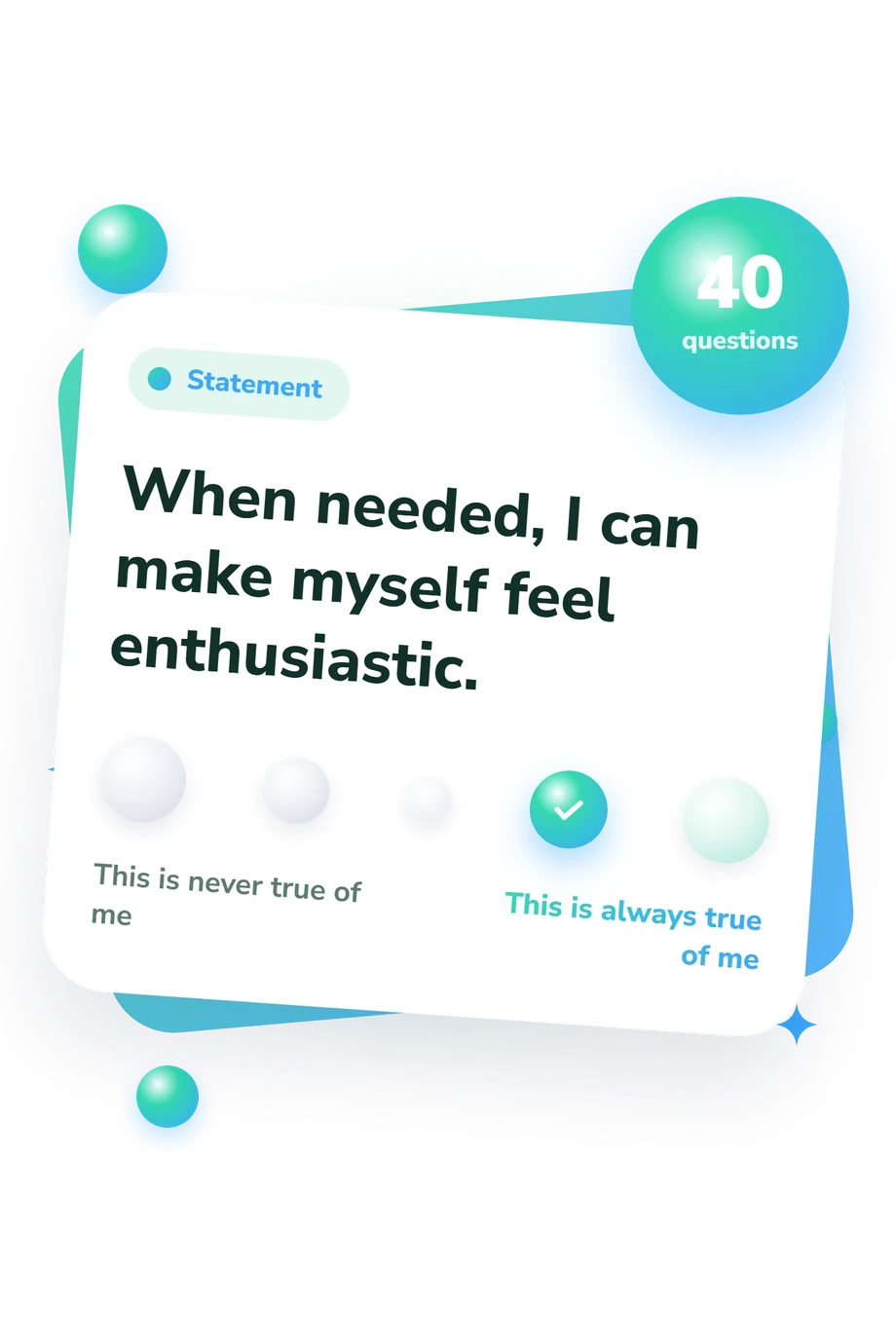
Each statement uses a five-point format from never to always. Items cover constructive abilities and difficulties, such as creating enthusiasm, using frustration productively, feeling controlled by emotions, or being unable to influence others. The online scoring combines responses into the two displayed scores; answer values cannot be inferred from the ranges alone.
Read the bands as this questionnaire’s own descriptive categories, not standardized or norm-referenced scores. They may highlight mood regulation, persistence, or reliance on emotional pressure, but they do not establish a diagnosis, fixed trait, or universal ranking of emotional skill. The profile is separate from a standardized MSCEIT score.
Honest self-report can also shift with current stress, relationship context, self-awareness, and impression management. The result from this emotion use questionnaire is most useful when compared with concrete examples of your own emotional regulation, motivation, and interpersonal behavior.
- Mayer, J. D., Salovey, P., & Caruso, D. R. (2002). Mayer-Salovey-Caruso Emotional Intelligence Test (MSCEIT) Users Manual. Toronto, ON: Multi-Health Systems.
- Mayer, J. D., Salovey, P., Caruso, D. R., & Sitarenios, G. (2003). Measuring emotional intelligence with the MSCEIT V2.0. Emotion, 3(1), 97-105. 10.1037/1528-3542.3.1.97
- Salovey, P., & Mayer, J. D. (1990). Emotional Intelligence. Imagination, Cognition and Personality, 9(3), 185-211. 10.2190/DUGG-P24E-52WK-6CDG
Updated: