
Early Decision Categories Test
How the Scales are Structured
Who Usually Takes This Test?
See How You Compare
Below is a preview of how scores are typically distributed across each scale.
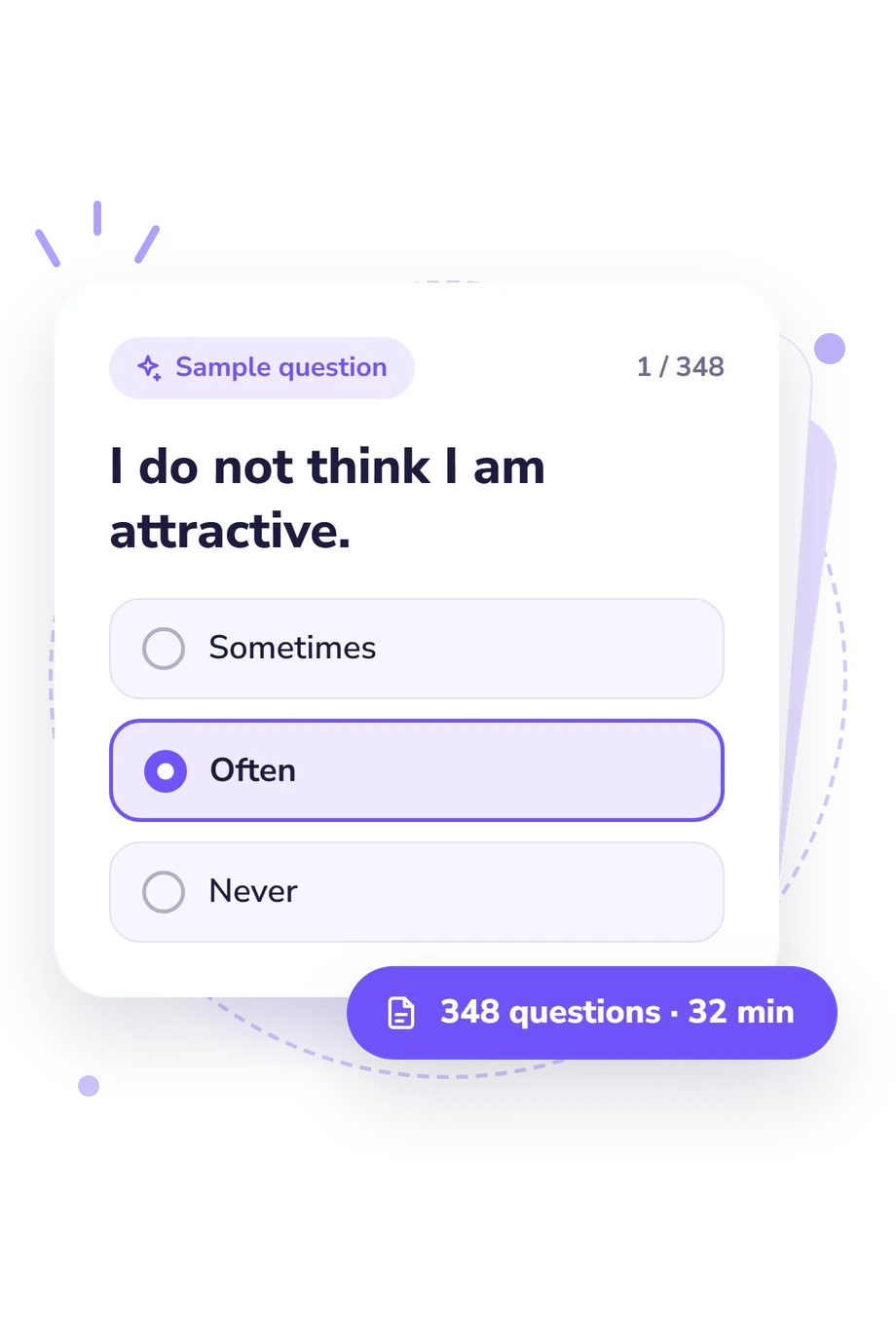
Example Questions From the Test
- Sometimes
- Often
- Never
- Sometimes
- Often
- Never
- Sometimes
- Often
- Never
Early Decision Categories Test - Description and methodology of the test
Readers who want to examine how early expectations may still shape choices, relationships, effort, and self-expectations can use the Early Decision Categories Test as a structured reflection exercise. It offers a way to notice childhood decision patterns that may recur in adult reactions, without reducing a person to one label. Comparing the displayed result with current choices and reactions can help identify patterns worth examining more closely.
What the Test Measures
The questionnaire examines childhood-formed attitudes that can shape choices, relationships, effort, and expectations. The scale assesses the respondent’s predominant early decision category, reflected by childhood-formed life attitudes that may influence adult behavior and life scripts.
Statements address worth, closeness, belonging, agency, emotion, work, and the future. This early decision categories questionnaire organizes recurring themes rather than isolated answers.
The sample statements cluster into four useful themes:
- Self-worth and lovability show beliefs about deserving care, attention, and affection.
- Agency and competence reflect expectations about decisions, success, completion, and influence.
- Closeness and belonging indicate whether intimacy, groups, and reliance feel safe or disappointing.
- Emotion and effort reveal attitudes toward vulnerability, rest, seriousness, and proving value.
The single displayed scale, Early Decision Categories, ranges from 0-100: Low 0-33, Moderate 34-66, and High 67-100.
Methodology and Scientific Basis
Each statement is answered with Sometimes, Often, or Never. The items are self-report prompts, so the selected responses produce the displayed category score. The exact point contribution of each option is not shown.
Maksimova’s 2006 book discusses early decisions and the later life attitudes they may shape; this questionnaire is conceptually consistent with that construct, but it is not presented as a direct adaptation or standardized reproduction of a published instrument. Redecision-therapy ideas from Mary McClure Goulding and Robert L. Goulding explain how early conclusions may be reconsidered, while Pasichnyk, Handzilevska, and Nikitchuk (2017) provide related discussion of childhood scenario sets. These sources support interpretation, not authorship of this test.
A life script assessment is best read as a broad pattern to compare with lived examples, not as a causal explanation. No population norms, reliability coefficients, or diagnostic status are stated for this questionnaire. Self-report can also be affected by current mood, self-knowledge, and the wish to present oneself favorably, so a single result should be interpreted cautiously alongside broader personal context.
- Maksimova, Svetlana Valentinovna. Creativity: Creation or Destruction? Moscow: Academic Project, 2006. 222 pp. ISBN 5-8291-0677-9.
- Pasichnyk, Ihor D., Halyna B. Handzilevska, and Uliana Nikitchuk. "Psychological Immunity of Ukrainian Migrants Depending on Childhood Scenario Sets." Psychological Prospects, no. 30, 2017, pp. 145-156. 10.29038/2227-1376-2017-30-145-156.
- Goulding, Mary McClure, and Robert L. Goulding. Changing Lives Through Redecision Therapy. New York: Brunner/Mazel, 1979. 297 pp. ISBN 0-87630-191-X.
Updated: