
Working Alliance Inventory – Short Form (WAI-S) Test
How the Scales are Structured
Who Usually Takes This Test?
See How You Compare
Below is a preview of how scores are typically distributed across each scale.
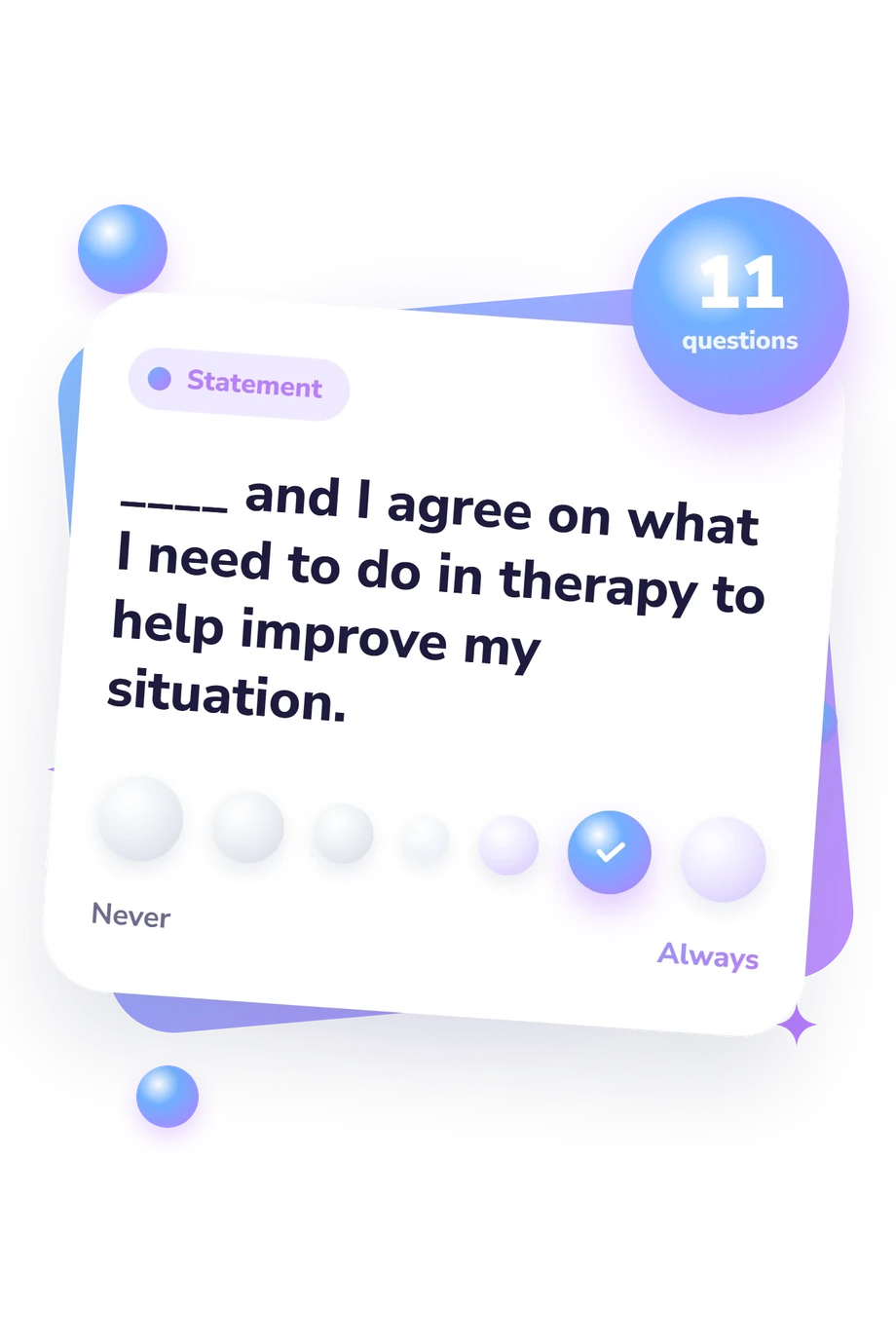
Example Questions From the Test
- Never
- Very rarely
- Rarely
- Sometimes
- Often
- Very often
- Always
- Never
- Very rarely
- Rarely
- Sometimes
- Often
- Very often
- Always
- Never
- Very rarely
- Rarely
- Sometimes
- Often
- Very often
- Always
Working Alliance Inventory – Short Form (WAI-S) Test - Description and methodology of the test
For people who want to understand how therapy is progressing, the Working Alliance Inventory - Short Form (WAI-S) Test focuses attention on the working relationship rather than symptoms alone. This working alliance inventory test can help a client reflect on whether therapist and client share a direction, understand the work similarly, and feel enough trust to engage productively. The result offers a focused starting point for discussion.
What This Assessment Explores
The questionnaire examines the alliance as a practical part of psychotherapy: whether therapist and client agree on goals, understand the tasks, and experience a supportive bond. It also touches on confidence in the therapist, mutual trust, insight, and agreement about what deserves attention. The WAI-S assessment captures the client's current experience of the therapy relationship, so its result describes perceived alignment in this phase of treatment.
These are the three dimensions reflected in the items:
- Goal agreement shows whether both people are aligned about the changes therapy is meant to support.
- Task agreement indicates whether session activities seem understandable, relevant, and appropriate.
- Bond reflects trust, appreciation, understanding, and confidence within the relationship.
The Therapeutic Alliance scale runs from 11-77. Its bands are Low alliance (11-33), Moderate alliance (34-55), and Strong alliance (56-77), representing the overall quality of connection and alignment.
Methodology and Scientific Basis
Each statement asks how often a therapy experience is true, using seven ordered choices from Never to Always, including Very rarely, Rarely, Sometimes, Often, and Very often; one item uses equivalent Very seldom wording. The online result reflects overall alliance strength: higher scores indicate a stronger alliance, with agreement, trust, and collaboration contributing to that interpretation. The displayed bands describe the level represented by the result.
The online questionnaire is conceptually consistent with the published Working Alliance Inventory-Short Form associated with Tracey and Kokotovic; it is presented as an online form, not as a separately validated adaptation or shortened version of that instrument. Bordin’s working-alliance model provides the theoretical basis, while Horvath and Greenberg reported the broader instrument’s development and validation. This therapeutic alliance questionnaire applies that framework as a structured self-report measure, while its meaning remains tied to the respondent’s perspective.
Current mood, recent sessions, expectations, and self-awareness may influence responses, so the result is best treated as focused reflection rather than a clinical diagnosis or standalone measure of treatment outcome.
- Tracey, Terence J., & Kokotovic, Anna M. (1989). Factor Structure of the Working Alliance Inventory. Psychological Assessment, 1(3), 207–210. 10.1037/1040-3590.1.3.207
- Horvath, Adam O., & Greenberg, Leslie S. (1989). Development and Validation of the Working Alliance Inventory. Journal of Counseling Psychology, 36(2), 223–233. 10.1037/0022-0167.36.2.223
- Bordin, Edward S. (1979). The Generalizability of the Psychoanalytic Concept of the Working Alliance. Psychotherapy: Theory, Research & Practice, 16(3), 252–260. 10.1037/h0085885
Updated: